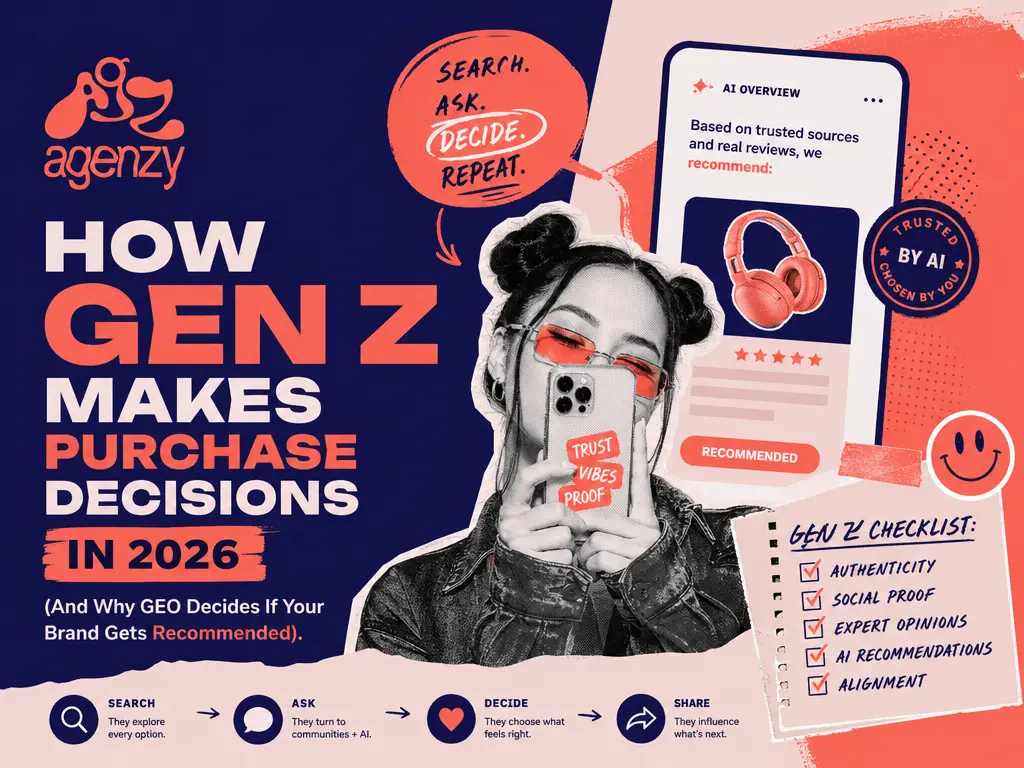
How Gen Z Makes Purchase Decisions in 2026 (And Why GEO Decides If Your Brand Gets Recommended)
At Agenzy, we work exclusively with brands that want to reach the next generation of buyers. And the single most important shift we've seen in the past 12 months isn't a new social platform or a new ad format. It's where Gen Z goes when they're about to spend money.
They don't Google it. They ask AI.
And if your brand isn't in AI's answer, you simply don't exist in that moment.
This post breaks down exactly how Gen Z makes purchase decisions in 2026, why the old playbook fails them, and why Generative Engine Optimization (GEO) has become the foundational strategy for any brand that wants to win their wallet.
Gen Z Buying Behavior in 2026: The Numbers That Should Concern Every Marketer
Gen Z (born 1997-2012) now represents over $360 billion in direct spending power in the US alone, and their influence on household purchases pushes that number significantly higher. But the way they spend is unlike any generation before them.
Here's what the data shows in 2026:
56% of Gen Z have purchased directly through social media in the past month, versus 36.5% for the general population (WorldMetrics, 2026)
69% of Gen Z live paycheck to paycheck - up from 57% in 2023 - meaning every purchase decision is deliberate, not impulsive (Fortune, 2026)
48% say they are likely to switch brands based on cost or value - the lowest brand loyalty score of any generation (Dentsu, 2026)
32% say explainer-style content directly influences their decision to buy - they research before they commit
44% have made a purchase on TikTok, Instagram, Pinterest, YouTube, or Facebook in the past 30 days
That last stat is the one most brands focus on. But it misses the more important shift happening upstream of the purchase.
The Purchase Journey Nobody Is Talking About
Most brands are optimizing for the moment Gen Z swipes their card. But Gen Z's purchase journey starts somewhere most marketers aren't even measuring.
It starts with a question to an AI.
"What's the best [product] for [use case]?"
"Is [brand] actually good or is it just Instagram marketing?"
"Which marketing agency should I hire if I want to reach Gen Z?"
These aren't search queries. They're conversations. And they happen in ChatGPT, Perplexity, Google AI Overviews, and increasingly in Claude and Gemini. ChatGPT now handles over 200 million queries daily. Perplexity exceeded 500 million monthly queries in late 2025. Nearly 31% of the entire US population now uses generative AI search as part of their decision-making process (eMarketer, 2026).
Gen Z isn't just adopting AI faster than other generations - they're treating it as a utility. They use it for tutoring, creative work, shopping research, and brand vetting. By the time they land on your website or click your TikTok, AI has already told them whether you're worth their time.
If AI didn't mention you, you were never in the running.
Why Gen Z's Path to Purchase Is No Longer Linear
Traditional marketing assumes a funnel: awareness, consideration, purchase. Gen Z obliterates that model.
Their actual path looks more like this:
See a product referenced in a TikTok comment or Reddit thread
Screenshot it
Ask ChatGPT or Perplexity: "Is [brand] legit? What are people saying?"
Check social proof - but specifically unsponsored social proof (comments, reviews, forum posts)
Price compare across apps in under 60 seconds
Purchase - sometimes in-store, sometimes in-app, sometimes both
Notice step 3. That AI query is a critical filter that most brands have zero visibility into and zero strategy for. We wrote about why Gen Z ignores your ads and this is the deeper structural reason - even when your ad lands, the AI verification step is where you can lose them.
The non-linear path also means that how Gen Z searches differs fundamentally from older generations. They don't type keywords. They have conversations. And they expect answers, not links.
What GEO Is, and Why It's the Gen Z Strategy
Generative Engine Optimization (GEO) is the practice of structuring your brand, content, and online presence so that AI engines cite you, recommend you, and include you in their synthesized answers.
It's different from SEO. SEO gets you ranked on a results page that Gen Z barely opens. GEO gets you mentioned in the AI response they're actually reading.
Here's the brutal reality we deal with every day at Agenzy: 80% of URLs cited in ChatGPT, Perplexity, and Google AI Overviews don't appear in Google's top 100 results for the same query. Traditional SEO rankings do not predict AI citations. They are two completely different systems.
For Gen Z brands specifically, GEO matters because:
Gen Z trusts AI recommendations as peer-level validation, not advertising. When ChatGPT recommends a brand, they read it like a friend's opinion, not a sponsored post.
AI answers appear before any scroll - zero-click searches now account for nearly 60% of all Google searches, and AI Overviews have an 83% zero-click rate. Gen Z never gets to your result if AI answers first.
Content with statistics and citations achieves 30-40% higher visibility in AI responses - and Gen Z content heavily favors data-backed claims over opinion.
You can read our full breakdown of what GEO is and how it works and why traditional SEO is dying as a standalone strategy.
The 4 Reasons Gen Z Buying Behavior Makes GEO Non-Negotiable
1. Gen Z Researches More Deeply Than Any Generation Before Them
Contrary to the "short attention span" myth, Fortune's 2026 data shows Gen Z actually agonizes over purchases longer than Baby Boomers. They research carefully because they have less margin for financial error - 69% are living paycheck to paycheck.
That deep research phase is where AI plays. They're cross-referencing AI answers with Reddit threads, TikTok comments, and review sites. If your brand appears authoritatively in AI's response, you gain credibility across that entire research phase, not just one touchpoint.
2. Gen Z Treats Authenticity as a Filter, Not a Preference
Gen Z has grown up watching brands buy influencer posts, fake reviews, and ad-heavy social feeds. They've developed a finely-tuned filter for inauthenticity. GEO forces authenticity - AI engines don't cite brands because they paid for it. They cite brands because those brands are genuinely referenced, discussed, and validated across the web.
At Agenzy, we've tracked this through our work in GEO service delivery: the brands that get cited by AI most consistently are those with real third-party coverage, legitimate PR mentions, and community-generated content - not the brands with the biggest ad budgets.
3. Gen Z Discovers Brands Through Community, Not Ads
Reddit is now one of the most-cited sources across ChatGPT and Perplexity. Niche communities on Discord, TikTok comment sections, and independent review platforms feed directly into AI training and retrieval. Gen Z participates in exactly these spaces.
This means your GEO strategy for Gen Z needs to include earned presence in the platforms they trust - which feeds back into AI visibility in a compounding loop. It's not about being on Reddit for the sake of it. It's about being genuinely part of conversations that AI engines use as source material.
4. Gen Z's Brand Switching Behavior Rewards Presence, Not Loyalty Programs
With 48% of Gen Z ready to switch brands over value, your brand needs to keep showing up at every purchase moment - not just at acquisition. GEO creates persistent visibility. Every time a Gen Z buyer asks AI about your category, if you're cited, you stay in consideration even as they evaluate alternatives.
AI Share of Voice - the percentage of AI conversations in your category where your brand is mentioned - is the metric that captures this. In our own tracking at Agenzy, brands with high AI Share of Voice consistently outperform on repeat consideration, even without heavy retargeting spend.
What GEO-First Gen Z Marketing Actually Looks Like
So what does a brand do with this?
Based on our work at Agenzy, here's the practical GEO stack for reaching Gen Z buyers:
1. Answer-first content structure
Every piece of content should open with a direct, quotable answer to a question your Gen Z buyer is asking AI. Don't bury the lead. AI systems evaluate the first 200 words most heavily - put your core claim there.
2. Statistics and citations woven throughout
Data-backed content gets cited in AI responses at 30-40% higher rates. Build your content around real numbers, link to credible sources, and make every key claim attributable.
3. Genuine third-party coverage
AI engines don't cite brand-owned content alone. Build earned media: PR, expert roundups, industry features, community mentions. This is what how AI engines decide what brands to recommend comes down to at its core.
4. Structured content for AI extraction
FAQs, clear H2 headers, numbered lists, and defined terminology all signal to AI that your content is structured for answering queries - which directly improves citation rates.
5. Platform-native presence where Gen Z already talks
TikTok, Reddit, YouTube comments - organic community presence in these platforms feeds into AI's source material. Our content creation service is built around generating this kind of authentic, platform-native content at scale.
What This Means for Lithuanian Businesses Specifically
In the Lithuanian market, the GEO gap is even more pronounced. International AI engines like ChatGPT and Perplexity are drawing on a global pool of English-language content. Lithuanian brands that publish only in Lithuanian or only locally-focused content are invisible to the AI layer entirely.
We covered this in depth in our piece on GEO and Lithuanian businesses, but the short version for Gen Z brands: the Lithuanian Gen Z buyer is using the same AI tools as their counterparts in London or Berlin. If your brand has no English-language footprint and no international citations, you don't show up.
For Lithuanian brands targeting Gen Z locally, the GEO strategy needs to operate on two tracks - Lithuanian-language community presence and English-language authority content - so that AI engines have source material to draw on in both contexts.
The Bottom Line
Gen Z is the most researched generation of buyers in history. They check, cross-reference, AI-verify, and community-validate before almost every meaningful purchase. And the AI verification step - the moment they ask ChatGPT or Perplexity whether your brand is worth trusting - is now the most important moment in the entire purchase journey.
GEO isn't a nice-to-have for reaching Gen Z. It's the infrastructure that decides whether your brand is in the room when they make their decision.
At Agenzy, this is exactly what we build for our clients - GEO visibility that works for the way Gen Z actually buys, not the way they bought five years ago.
If you want to understand where your brand currently stands in AI conversations, book a call with us. We'll pull the data and show you exactly what AI is - and isn't - saying about you.
Frequently Asked Questions
What is Gen Z buying behavior in 2026?
Gen Z buying behavior in 2026 is characterized by deep AI-assisted research, strong preference for peer and community validation over advertising, high brand switching rates based on value, and discovery that starts on social media but is filtered through AI engines like ChatGPT and Perplexity before purchase.
Why does GEO matter for Gen Z marketing?
GEO (Generative Engine Optimization) matters for Gen Z marketing because Gen Z uses AI search tools as a primary research and brand-vetting mechanism. If your brand is not cited in AI responses, you are excluded from the critical verification step in Gen Z's purchase journey.
How does Gen Z use AI in purchasing decisions?
Gen Z uses AI tools including ChatGPT, Perplexity, and Google AI Overviews to research brands, verify social proof, compare products, and validate purchase decisions before committing. AI queries often happen between social discovery and actual purchase.
What is Generative Engine Optimization (GEO)?
Generative Engine Optimization (GEO) is the practice of structuring brand content, online presence, and third-party mentions so that AI language models include and recommend a brand in their synthesized responses to user queries. It is distinct from traditional SEO, which optimizes for ranked links rather than AI citations.