By Emilis Zabilius, co-founder at Agenzy.
An AI visibility audit of a B2B compliance software company, run on 75 buyer prompts in July 2026, produced three findings worth acting on. The company was named in 23.59% of 2,153 AI answers, sixth of 18 tracked brands. Its largest market was its weakest: the United States at 17.49%, and ChatGPT inside the United States at 11.03%. Across 376 answers to questions where a buyer described a problem without naming a category, the company was named once.
Three things in this audit travel to any B2B company: an average that hides one bad engine cell, a gap on problem-shaped questions, and listicles the company cannot edit deciding who gets shortlisted.
The company is real and masked here. Every number is exactly as measured, and competitors appear as Competitor A through Competitor Q. The audit ran on Peec AI across ChatGPT, Perplexity and Google AI Overviews, in the United States, the United Kingdom, Germany and a fourth European market.
What an AI visibility audit is
An AI visibility audit measures how often AI assistants name a brand when buyers ask category questions, where those mentions are missing, which competitors take the space, and which web pages the engines opened and quoted while answering. It is a measurement of answers, taken against a defined set of buyer questions.
A complete audit reads five things. This one read the first four.
The prompt set, meaning the buyer questions the audit measures against, and how the brand scores on each one.
The engine split, because ChatGPT, Perplexity and Google AI Overviews answer the same question differently.
Competitor share on the same questions, so a score has something to sit against.
The sources, meaning the domains and the individual pages the engines opened and cited.
The technical read: whether the site can be crawled, and what the engines find when they get there.
There was no technical crawl in this engagement. Nothing below is a finding about the company's schema, its robots.txt or its bot access.
What this AI visibility audit of a B2B SaaS company measured
An AI visibility audit includes the prompt set, the brands tracked against it, the engines and markets the questions run in, and the count of answers behind every percentage. Here that meant 75 non-branded prompts, 18 brands, three engines, four markets and 2,153 counted answers.
The company sells automated identity verification, business verification with registry and ownership data, and anti-money-laundering, sanctions and politically exposed person screening, through an API and mobile SDKs. Its buyers are fintechs, neobanks, lending platforms, crypto exchanges, marketplaces and iGaming operators in the United States and Europe. European headquarters, selling globally in English.
The table below is the full scope of the measurement, including the parts it left out.
What the audit covered | This audit, one day in July 2026 |
|---|---|
Prompts tracked | 75, English, none naming any brand |
Topics | 9 |
Markets | United States 39 prompts, United Kingdom 18, Germany 11, a fourth European market 7 |
Engines | ChatGPT, Perplexity, Google AI Overviews |
Brands tracked | 18: the company and 17 competitors |
AI answers | 2,250 chats in the run, 2,153 counted for visibility |
Window | one full batch, a single day in July 2026 |
Instrument | Peec AI |
Not covered | no site crawl, no crawler-access check, no schema review |
Every percentage in this article is a share of those 2,153 counted answers.
This audit ran three engines because a pre-engagement read covers the engines the prospect's buyers were using at the time. A full engagement adds Gemini by default, and Claude and Copilot where the client's buyers use them.
A prompt here is a buyer question. The set was built from the buying journey: how a compliance lead picks a vendor, what a developer asks before integrating, what someone with an onboarding fraud problem types before they know vendors exist. No prompt carries the company's name or a competitor's name, because a branded prompt scores high for the wrong reason.
The prompt wording in this article is generalized to its shape.
Where the company ranked: 23.59% visibility, sixth of 18
The B2B compliance software company in this audit was named in 508 of 2,153 AI answers, which is 23.59% visibility, sixth of 18 tracked brands. Visibility is the share of AI answers that name the brand. Share of voice is that brand's share of all brand mentions in the same answers.
The table below holds the top eight of the 18 tracked brands, ordered by visibility, with the audited company's row in bold.
Rank of 18 tracked brands | Brand, masked, and what it sells | Visibility: share of 2,153 AI answers naming it | Share of voice: share of all brand mentions in those answers | Sentiment, 0 to 100 | Average position in the answer's list, 1 = first |
|---|---|---|---|---|---|
1 | Competitor A, European identity verification vendor | 45.01% | 14.99% | 58 | 3.4 |
2 | Competitor B, global KYC and AML platform | 44.68% | 15.93% | 57 | 3.4 |
3 | Competitor C, a vendor inside a larger security group | 32.75% | 7.94% | 60 | 4.4 |
4 | Competitor D, enterprise identity and AML vendor | 32.65% | 9.70% | 57 | 3.8 |
5 | Competitor E, identity infrastructure platform | 31.58% | 11.59% | 58 | 3.0 |
6 | The company | 23.59% | 5.94% | 59 | 3.9 |
7 | Competitor F, global identity data and KYB vendor | 23.27% | 6.59% | 60 | 4.7 |
8 | Competitor G, a vendor inside a larger security group | 22.02% | 6.99% | 59 | 4.1 |
The remaining ten tracked brands all scored under 11%, from 10.92% down to 2.32%. Two leaders are named in roughly twice as many answers as this company, and below the eighth row the field drops off.
Sentiment is a 0 to 100 score for how positively an answer describes a brand. All 18 tracked brands land between 50 and 60 on it, so in this category on this day the column separates nobody and the plan ignored it.
Average position is where a brand lands in a list inside the answer. The company sits at 3.9 against 3.4 for the two leaders, so an answer that names this company tends to name it near the top of its list. The shortfall sits in how often it gets named at all.
The two percentage columns measure different things. Visibility counts the answers a brand appears in. Share of voice counts how much of the brand talk inside those answers belongs to it. This company is named in 23.59% of answers and holds 5.94% of all brand mentions. Competitor E is named in 31.58% and holds 11.59%, which is a third more visibility carrying nearly twice the share of voice.
The 23.59% average was true of no engine and no market
For the B2B compliance software company in this audit, the company-level figure of 23.59% is an average of engines and markets that behave nothing alike. Split by engine, the same 75 prompts returned a 13 percentage point spread.
Engine | Answers measured (of 2,153) | Visibility: share of that engine's answers naming the company | Sentiment, 0 to 100 | Average position |
|---|---|---|---|---|
Google AI Overviews | 657 | 28.46% | 64 | 3.4 |
Perplexity | 746 | 27.48% | 62 | 3.9 |
ChatGPT | 750 | 15.47% | 53 | 4.6 |
ChatGPT, the engine with the most answers in the run, is also the one that names the company least often.
Split by market, the spread was 17 percentage points, and it ran against the company's commercial priorities.
Market | Answers measured (of 2,153) | Visibility: share of that market's answers naming the company | Average position |
|---|---|---|---|
A fourth European market | 208 | 34.62% | 2.6 |
Germany | 306 | 33.99% | 3.9 |
United Kingdom | 501 | 26.55% | 4.3 |
United States | 1,138 | 17.49% | 4.1 |
The United States carries more than half the sample and returns the lowest visibility in it.
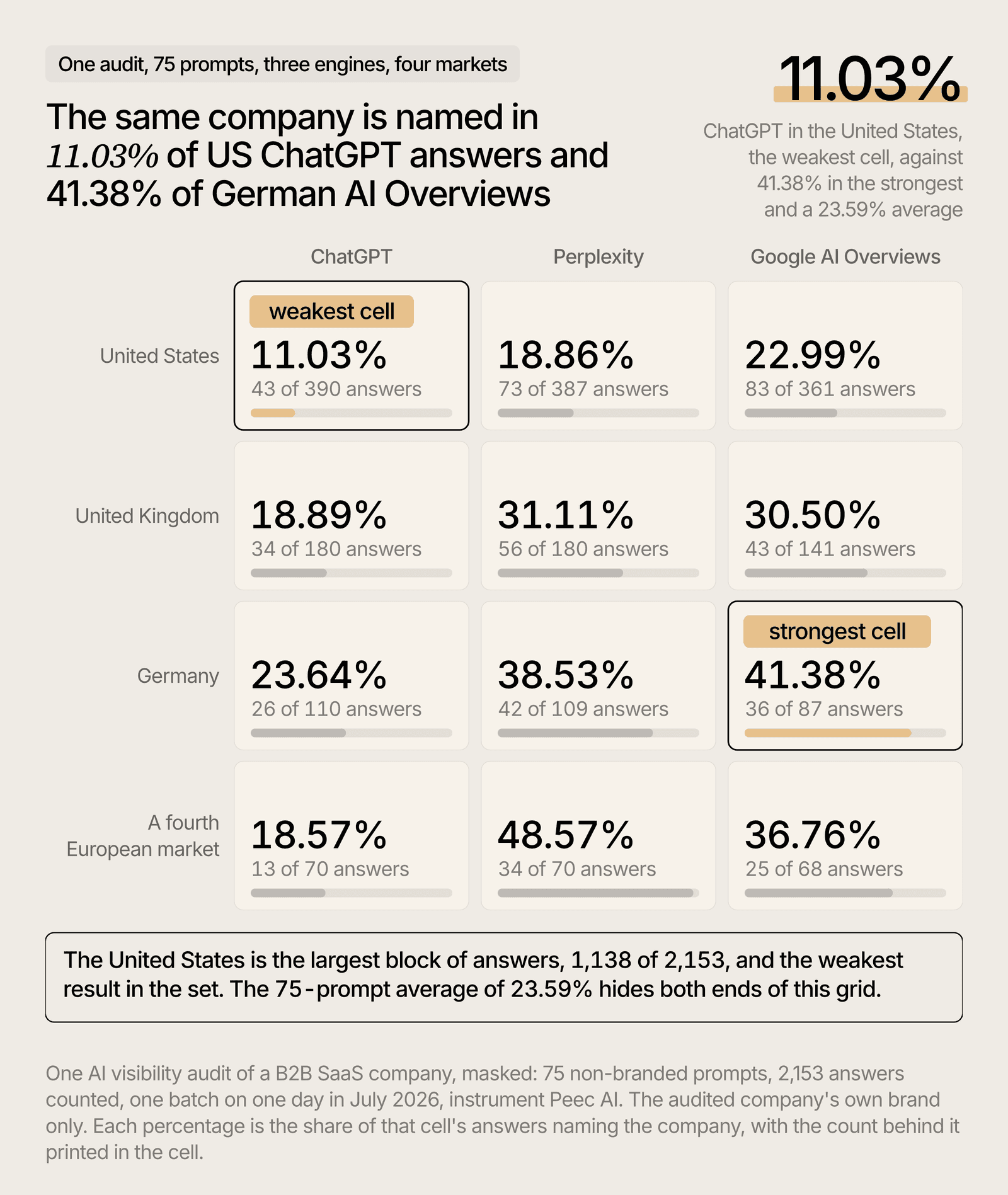
Crossing the two cuts is where the case for the plan came from. The grid below holds the company's visibility in each engine and market pair, with the count of answers behind every cell.
Market | ChatGPT: answers naming the company | Perplexity | Google AI Overviews |
|---|---|---|---|
United States | 11.03% (43 of 390) | 18.86% (73 of 387) | 22.99% (83 of 361) |
United Kingdom | 18.89% (34 of 180) | 31.11% (56 of 180) | 30.50% (43 of 141) |
Germany | 23.64% (26 of 110) | 38.53% (42 of 109) | 41.38% (36 of 87) |
A fourth European market | 18.57% (13 of 70) | 48.57% (34 of 70) | 36.76% (25 of 68) |
ChatGPT in the United States is the weakest cell in the grid at 11.03%. Google AI Overviews in Germany is the strongest at 41.38%. A single company-level score of 23.59% describes neither cell, and a report built on that one number hides both.
Our own monthly report is built the same way, by engine and by market wherever a client sells in more than one. It carries no weighted index, and the visibility average always sits beside the per-engine split (what a GEO agency's monthly report should show).
Topic split: where the company competes and where it is absent
Broken out by topic, the B2B compliance software company in this audit competes hard on vendor-comparison demand and is absent from problem-shaped demand. The nine topics ran from 45.15% to 0.27%, and the three competitor columns show what the leaders scored on the identical questions, so each row reads as a gap.
Topic | Answers in the topic | The company | Competitor A, the highest-scoring tracked vendor | Competitor B, second highest | Competitor C, third |
|---|---|---|---|---|---|
Pricing and vendor selection | 237 answers | 45.15% | 49.37% | 43.04% | 32.49% |
Choosing an identity verification provider | 356 answers | 44.10% | 84.83% | 74.16% | 57.30% |
Business verification (KYB) | 89 answers | 37.08% | 11.24% | 64.04% | 10.11% |
Regional compliance (EU, UK, US) | 89 answers | 35.96% | 59.55% | 58.43% | 35.96% |
Developer integration, API and SDK | 130 answers | 26.92% | 49.23% | 45.38% | 50.77% |
Verification technology and fraud signals | 289 answers | 21.45% | 37.37% | 29.76% | 27.68% |
Industry-specific solutions | 470 answers | 13.83% | 56.38% | 58.72% | 45.11% |
AML, sanctions and ongoing monitoring | 117 answers | 13.68% | 22.22% | 26.50% | 8.55% |
Onboarding fraud and compliance problems | 376 answers | 0.27% | 6.38% | 9.31% | 3.99% |
The company is within five points of the leaders on pricing and vendor selection, and far behind them on every topic where the engine has to decide which vendors belong in the answer at all.
The last row is the single most useful number in the audit. Across 376 answers to questions shaped like "our signups are full of fake accounts, what can we do", the company was named once.
Nine tracked competitors are named inside that same topic, scoring between 2.39% and 12.23%. The demand exists and the engines answer it with other vendors.
Prompt level: 50 of 75 prompts returned a mention, 25 returned none
Fifty of the 75 prompts tracked for the B2B compliance software company in this audit returned at least one mention on the measurement day. Twenty-five returned none.
The strong end was strong. The six highest-scoring prompts are below, generalized to their shape. Each prompt ran 30 times in the batch and a few returned fewer counted answers.
Visibility: share of that prompt's 30 answers naming the company | What the question asked | Average position |
|---|---|---|
96.7% (29 of 30 answers) | a question about how verification vendors structure their pricing | 1.2 |
93.3% | a question about alternatives to the big enterprise vendors, for smaller teams | not reported |
90.0% | a question about meeting one EU rule in one regulated vertical | not reported |
89.7% | a question about the best value at high verification volumes in Germany | not reported |
86.7% | a question about providers suited to fintechs in one region | not reported |
80.0% | a question about automated document verification across 200 or more countries | not reported |
The audit reported an average position for the top prompt only, so the other five rows carry frequency and nothing else.
All six ask about pricing structure, coverage or fit for one kind of buyer, and the company has a specific answer to each. On the pricing prompt it was named in 96.7% of answers at an average position of 1.2, so it is named, and named first, in almost every answer to that question.
The 25 zeros sat in three clusters. Twelve of the 13 onboarding-fraud prompts scored zero. So did both of the AML-monitoring and sanctions-automation prompts. So did the prompts covering large US verticals: neobanks, crypto exchanges, high-volume fintechs, healthcare, marketplaces and iGaming.
What the engines actually read
Across these 75 questions the engines opened 15 domains most often, and 12 of the 15 are vendor sites. The company's own domain was opened 652 times, more than any tracked competitor's. What the engines quoted from those domains is a second table, and it reads differently.
Retrievals count how many chats opened at least one page on a domain while answering. The table below holds the most opened domains in the run.
Source | Who runs it | Retrievals: chats of 2,153 that opened a page on the domain | Does the page name the company |
|---|---|---|---|
A non-tracked identity verification vendor's site | competitor-adjacent vendor | 841 | yes |
The company's own site | own domain | 652 | yes |
A second non-tracked identity verification vendor's site | competitor-adjacent vendor | 561 | yes |
A non-tracked compliance vendor's site | corporate | 544 | yes |
Competitor B's site, a global KYC and AML platform | tracked competitor | 540 | no |
Competitor A's site, a European identity verification vendor | tracked competitor | 495 | no |
Competitor L's site, a European KYC platform | tracked competitor | 459 | yes |
A third non-tracked verification vendor's site | corporate | 427 | yes |
A payments platform's site, identity sold inside a payments suite | corporate | 372 | no, and no tracked brand at all |
user-generated discussion | 321 | yes | |
A software review marketplace | user-generated reviews | 228 | yes |
Most of these domains are places where a buyer meets a vendor list, and the company is missing from two of the three most opened competitor sites. The four domains that complete the top 15 are two more non-tracked vendor sites, opened 392 and 307 times, and two tracked competitors' sites, opened 279 and 271 times.
Across the 75 questions in this audit, the company's own domain is the second most opened source. Two of its pages account for 255 of those 652 retrievals, which is 39%: two comparison posts the company wrote about its own category, one on verification software and one on screening providers.
Those two pages are retrieved heavily and cited at the low end. The comparison post was cited 90 times on 111 retrievals, a rate of 0.81 citations per retrieval, and the listicle 60 times on 144 retrievals, a rate of 0.42. The independent pages above them in the citation table run from 1.19 to 2.78. Two of the 25 most-cited pages in this run belong to this company, and the engines open both far more often than they quote them.
The 25 most-cited pages in this run, counted by type: 9 vendor-run listicles, 7 independent comparisons or buyer guides, 4 corporate or product pages, 2 Reddit threads, 1 national regulator page, 1 review profile and 1 competitor homepage.
Below are the ten most cited of those 25 pages, with the company's own page in bold.
Page, masked | Page type | Citations: times the engines quoted the page | Retrievals: chats that opened it | Citations per retrieval: how often an opened page was actually quoted | Tracked brands named of 18 |
|---|---|---|---|---|---|
Independent buyer guide | comparison | 142 | 74 | 1.92 | 8, company not named |
Competitor L's listicle | vendor listicle | 140 | 336 | 0.42 | 8, company named |
National gambling regulator guidance | institutional | 136 | 49 | 2.78 | 0 |
Independent industry listicle | listicle | 117 | 98 | 1.19 | 9, company not named |
Payments platform product page | corporate | 108 | 61 | 1.77 | 0 |
Non-tracked vendor's listicle | vendor listicle | 107 | 191 | 0.56 | 7, company not named |
Non-tracked vendor's listicle | vendor listicle | 93 | 158 | 0.59 | 6, company not named |
Competitor P's comparison | vendor comparison | 91 | 127 | 0.72 | 6, company not named |
The company's own comparison post | own comparison | 90 | 111 | 0.81 | 9, company named |
A competitor's self-serve pricing page | competitor product page | 89 | 62 | 1.44 | 1 |
Five of these ten pages name six or more vendors and leave this company out, and the independent pages are quoted far more often per opening than the vendor-run ones, at 1.19 to 1.92 against 0.42 to 0.72.
Across the 75 questions in this audit, the most cited page of all is an independent buyer guide that names eight tracked vendors and never names this company. Two more pages the engines opened heavily tell the same story: an independent vendor comparison opened 223 times names ten tracked competitors and not this company, and another platform's top-ten list, opened 157 times, names nine.
What the audit found that changed nothing
Three findings in this audit came back clean, and they belong in the record for the same reason the bad ones do.
Reputation needed no work. At an average position of 3.9 against 3.4 for the two leaders, the engines already place this company near the top of the lists they put it in, so a proposal built around "fixing how AI describes you" would have been selling a repair for a part that was not broken.
The pricing and vendor-selection topic needed no work either. At 45.15% against Competitor A's 49.37% and Competitor B's 43.04%, the company is already at parity with the leaders on the commercial questions, across 237 answers.
Fifty of 75 prompts returning a pulse means the category recognizes the company, so the first month's work could start from coverage gaps.
The three findings that became the plan, and what happened next
The audit produced three findings and a plan built on them.
The company is invisible on problem-shaped demand. The figures sit in "Topic split: where the company competes and where it is absent" above. The plan: content and off-site placements written for the buyer who describes a symptom before they have a category word for it.
The biggest market is the weakest, and one engine carries most of the loss. The figures sit in "The 23.59% average was true of no engine and no market". The plan: US-facing work first, and inside that, the sources ChatGPT reads.
The company's own pages are being read, and other people's pages decide the shortlist. The figures sit in "What the engines actually read". The plan: third-party listicles, buyer guides and vertical comparisons.
What happened next is short. This was a pre-sale audit. The engagement did not proceed, so no result is claimed here and nothing above has been tested against a second measurement. We cannot tell you whether the three plan items would have moved the numbers.
What the work looks like when a plan like this one does run is in GEO for B2B SaaS: what a GEO agency does in the first 90 days.
What the audit could not tell
Six limits sit on everything above.
One day. The whole audit is a single batch measured on one day. It gives a position at one point in time, with no trend behind it, and it cannot separate a real gap from a bad day. Anything measured after work starts needs a proper baseline window of two to four weeks.
No revenue and no pipeline. Nothing here connects an AI answer to a signup, a demo or a contract. The engines do not pass a referrer that survives the journey. That connection has to be built on the company's side, through a self-reported "how did you find us" field at signup plus AI referral tracking, before anyone can claim money moved.
No technical audit. This engagement measured answers and sources. It did not crawl the site, check AI crawler access, read the schema or test whether a firewall blocks the engines. That is a separate pass, and on other clients it has changed the picture more than any content work.
Why an answer names a vendor. The instrument reports that a brand was named, in which position and with what sentiment. It does not explain the model's reasoning. The link between "a cited page names you" and "the answer names you" is an inference here, and this audit did not measure it.
Coverage beyond the set. Seventy-five prompts across nine topics sample the buyer's questions. They do not cover all of them. A prompt at 0% means the engines did not name the company there on that day, and it is no proof that the company can never appear there.
Position inside the answer on the empty topic. With one mention across 376 answers, the average position figure carries no information, so it is not reported.
All competitor figures describe those 75 questions on that day, and no wider market.
How to judge whether your SEO agency can cover AI search
Ask your current SEO agency for four things, and judge the answer on whether the four arrive at all: the prompt set, the engine by market grid, competitor scores on the identical questions, and the list of URLs the engines opened and cited.
AI search visibility is measured by running a fixed set of non-branded buyer questions through each engine and recording who gets named, so anyone doing that work has all four already. A supplier who reports one composite visibility score each month cannot produce any of them from that number.
The prompt set, with the wording. Ask which buyer questions are tracked and how each one scores on its own. The set behind this article was 75 questions, none of them naming a brand. A tracked question that carries the company's own name scores high for the wrong reason, and a set full of them tells you almost nothing about the market.
The engine by market grid. Ask for visibility per engine inside each market you sell in, with the count of answers behind every cell. The grid in this audit held an 11.03% cell and a 41.38% cell underneath one 23.59% average, and only the grid says which one to work on.
Competitor scores on the identical questions. A visibility number with nothing beside it cannot be read. The 23.59% in this audit looked reasonable until the same 75 questions put two competitors above 44% and ten others below 11%.
The list of URLs the engines opened and cited. Ask which pages produced the answers. This audit named the domains the engines opened and the individual pages they quoted, and that list is what turns a score into work someone can start.
An SEO agency can produce all four, and some do. The thing to establish is whether the tracking runs as a standing instrument or was assembled for the meeting, so ask how long the prompt set has been running, who wrote the questions and what moved since the last report.
Agenzy runs this audit as the first step of every engagement.
What your own AI visibility audit would probably find
An audit of a B2B company usually returns the same four things: a headline number that describes no engine, a gap on problem-shaped demand, other people's pages deciding the shortlist, and crawler access that can invalidate all of it. A buyer reading their own audit can check all four in an afternoon.
The headline number will be the least useful number in it. A single visibility score averages engines, markets and buyer stages that behave nothing like each other. In this audit the company-level 23.59% contained an 11.03% cell and a 41.38% cell. Ask for the grid before anyone interprets the average.
Problem-shaped demand is where a B2B brand tends to be missing. Vendor-comparison content is what a sales team asks for, so it usually exists. The buyer who has a symptom and no category word yet is the one the engine has to route somewhere, and in this audit the company was named in 1 of those 376 answers, while nine tracked competitors were named in the same topic.
Your own pages are probably already being read, and the constraint is other people's pages. Vendor-run listicles, independent comparisons and Reddit threads accounted for 18 of the 25 most-cited pages in this run. We measured which classes of source get cited at a much larger sample size in our study of which sources AI engines cite.
Crawler access can invalidate everything above it. We have found robots.txt blocking GPTBot, ClaudeBot and Google-Extended on live sites. Content work has less to land on until that is fixed, so run the technical read first and read the visibility numbers after it.
To run the same shape on your own brand:
Write 50 to 75 buyer questions with no brand name in them, spread across the stages your buyers pass through, including the symptom stage.
List your real competitors, including the ones your sales team never names.
Run every question on every engine your buyers use, in every market you sell in.
Record, per answer, whether you were named, in which position and in what tone.
Record every URL the engine opened and every one it quoted.
Segment by engine and by market before you read a single average.
Agenzy runs this audit for a company before an engagement, and you can book a call to have it run on your prompt set.
How to choose a GEO agency covers what to ask the people offering to do the work for you.
FAQ
What is an AI visibility audit?
An AI visibility audit is a measurement of how often AI assistants name your brand in answers to a fixed set of buyer questions, which competitors are named in your place, and which web pages the assistants opened and quoted while composing those answers. The output is a snapshot of where you stood on the day it ran.
What does an AI visibility audit include?
At minimum it includes a non-branded prompt set built from the buying journey, a per-engine and per-market breakdown of where the brand is named, competitor scores on the identical questions, and the list of domains and individual URLs the engines retrieved and cited. A technical pass covering crawler access and page structure is a separate piece of work.
What does an AI visibility audit example look like?
A worked example is one company's numbers across one fixed prompt set. The audit in this article ran 75 non-branded buyer questions through ChatGPT, Perplexity and Google AI Overviews in four markets on one day in July 2026 and counted 2,153 answers. It returned 23.59% visibility for the company, sixth of 18 tracked brands, 11.03% on ChatGPT in the United States, and 1 mention across 376 answers to problem-shaped questions. Those splits plus the list of pages the engines opened and quoted are the whole output.
How much does an AI visibility audit cost?
Agenzy runs this audit before an engagement at no charge, as part of the sales conversation, and retainers start from 5,000 EUR a month, ex VAT. Sold as a standalone product, one-off GEO audits ranged from 1,500 to 5,000 USD in our August 2026 scan. Tool-generated scorecards are cheaper and usually stop at a composite score.
How long does an AI visibility audit take?
Most of the effort sits on either side of the measurement. The prompt set and the competitor list have to be written first, which for the company in this article meant 75 questions and 17 named competitors, and the engines then run through them unattended. Turning 2,153 answers into a plan someone can act on is the part that takes real work afterwards.
Can I run an AI visibility audit myself?
Yes, and a manual version costs nothing but time. Ask each assistant your buyers use the same 20 to 50 questions, log who gets named and in what order, and note the sources the assistant shows you. What a tracker such as Peec AI adds is scale and repeatability: the same questions rerun on a schedule, per engine and per market, so the second measurement is comparable to the first.
What can an AI visibility audit not tell me?
It cannot tell you whether an AI answer produced revenue, why a model chose one vendor over another, or whether a single day's reading is a trend. It also cannot prove a negative. A question where you scored zero on one day is a gap to work on, and it is no evidence that you can never appear there.
Is a low score on one engine worth acting on?
Yes, when the engine carries volume in a market that matters to you. For the B2B compliance software company in this audit, ChatGPT in the United States held 390 of 2,153 answers and returned the lowest result at 11.03%, far under the 23.59% average, which is why that cell became the first item in the plan.
About Agenzy
Agenzy is a GEO and AEO agency: we get brands named and recommended inside ChatGPT, Gemini, Google AI Overviews, Perplexity, Claude and Copilot. We are an official Peec AI partner. Our numbers: 500,000+ AI chats analysed, 15,000+ prompts tracked, 150+ audits completed and 1,000,000+ EUR generated for clients by AI search, counted from the clients' own attribution at checkout and on their forms.
Our GEO and AEO service is at agenzy.lt/services/geo, and plans start from 5,000 EUR a month, ex VAT.