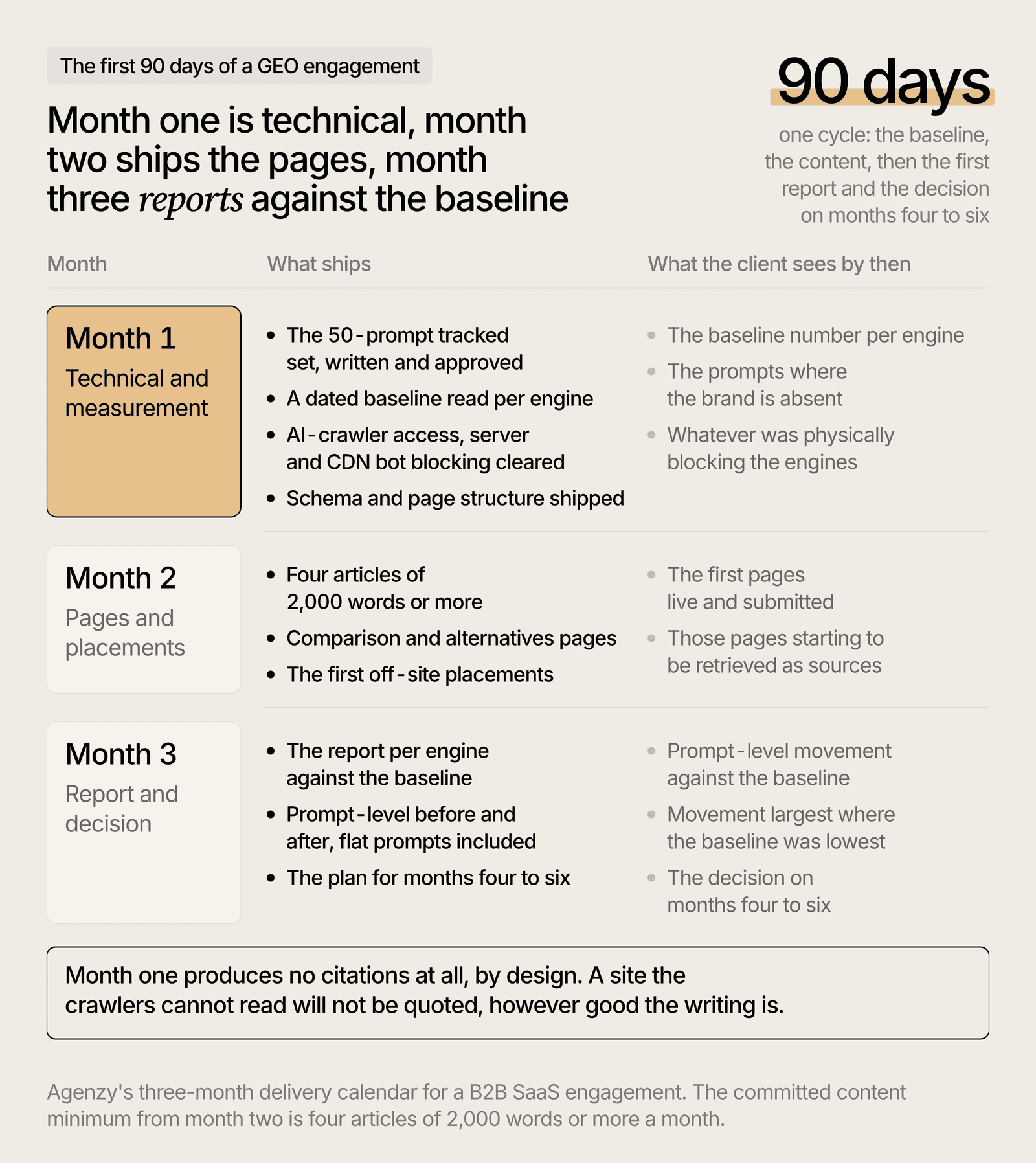
Agenzy's generative engine optimization services open with a three-month cycle. Month one writes and freezes the tracked prompt set, measures the baseline on every engine, and opens the site to AI crawlers. Month two ships the pages and the off-site placements the tracked prompts have no answer for. Month three delivers a per-engine report against that baseline and a decision about months four to six.
By day 90 a B2B SaaS company has a measured position on the questions its buyers ask AI assistants, a site the engines can read, and a report naming which of its pages the engines pull. On the engagement we have measured end to end, first movement came on the prompts where the baseline was lowest.
A quarter does not buy a position in a contested category, and we do not sell it as one. The calendar below says what lands in each month, what your team supplies for it, and how you check that it happened.
The 90-day GEO delivery calendar for a B2B SaaS company
In the first 90 days a GEO agency for a B2B SaaS company runs three months in a fixed order: month one builds the measurement and opens the site to AI crawlers, month two ships the pages and the off-site placements, month three reports per engine against the baseline. Every row below carries a check the client can run without our tracker.
Month of the engagement | What Agenzy does that month | What the client supplies that month | What the client receives | How the client verifies it landed |
|---|---|---|---|---|
Month 1 (days 1-30), the technical month | Write the 50-prompt tracked set, measure the baseline per engine, open AI-crawler access, clear server and CDN bot blocking, ship schema, fix page structure | Search Console and analytics access, a named developer or CMS contact, a conversation with a salesperson, written approval of the prompt set | Approved prompt set, dated baseline read per engine, technical deployment | Fetch robots.txt and see GPTBot, OAI-SearchBot, ChatGPT-User, ClaudeBot, PerplexityBot and Google-Extended allowed; the tracking project runs daily; schema validates on the pages it was added to |
Month 2 (days 31-60), the content month | Write the pages the tracked prompts have no answer for, build comparison and alternatives pages, start off-site placements | Product facts from a founder or a specialist per topic, a publishing slot | Four articles of 2,000+ words, comparison and alternatives pages, first placements | Every URL returns HTTP 200 and is submitted to Search Console; the daily tracking then shows within weeks whether each page is retrieved as a source on any of the 50 tracked prompts |
Month 3 (days 61-90), the report month | Report per engine against the baseline, review with the client, decide what repeats and what gets dropped | A "how did you find us" field in the form or call script, attendance at the monthly review | Month-three report, prompt-level before and after, the plan for months four to six | The report uses the same prompt set as the baseline, splits by engine, and shows the prompts that did not move |
Read down the last column: every month of the engagement can be checked by the client without access to our tracker.
The same three months read against what a client can and cannot see at the end of each one.
Month of the engagement | What the client can see by the end of that month | What is still not visible at that point |
|---|---|---|
Month 1 (days 1-30) | The baseline number per engine, the prompts where the brand is absent, and whatever was physically blocking the engines | Citation movement. No pages have been written yet, and a readable site produces no answers on its own |
Month 2 (days 31-60) | The first pages live, submitted and starting to be retrieved as sources | A stable position, and any reliable read on leads coming from AI answers |
Month 3 (days 61-90) | Prompt-level movement against the baseline, usually largest where the baseline was lowest and the category thinnest | Category ownership, a settled trend line, and most of the off-site authority, which takes longer than a quarter |
Everything in month one's middle column exists to make month three readable.
The month-three report carries flat prompts in it. On a 50-prompt set some questions stay unmoved in a quarter, and the report shows which ones. Month one produces no citations at all, by design. A site the crawlers cannot read will not be quoted, however good the writing is.
Month 1: the prompt set, the baseline and the technical pass
Month one of a generative engine optimization engagement is technical, and no content ships in it. Inside those four weeks the order is fixed. The tracked prompt set is written and approved first. Daily baseline reads start on the day the set is approved. The technical deployment lands after the first reads are on record. Every read taken before the deployment date is a pre-change read, and those are the reads the month-three report compares against.
Where the timeline allows, the baseline window runs two to four weeks before anything is deployed. Where the audit finds an outright crawler block, we open it immediately and mark every read after that date as post-change, because leaving a client invisible for three more weeks to protect a measurement is the wrong trade.
How the tracked prompt set gets written and approved
The tracked prompt set is 50 buyer questions, written by us, approved in writing by the client in month one, and frozen once approved. A prompt set is the list of questions we run daily against the AI engines to measure whether a brand gets named. It is the measurement instrument, so it stops changing the moment measurement starts.
The set comes from three sources. Google Search Console data shows the language buyers already use. A conversation with the client's own salesperson gives the phrasing buyers use on calls, which rarely matches the website. Forums, Reddit threads and community groups show how the question gets asked when no vendor is listening.
No prompt names the client and no prompt names a competitor. A branded prompt scores high because the brand sits inside the question, so it measures nothing. The questions we track ask an engine to recommend a provider. That is the answer a buyer acts on, and the answer we want the brand inside.
Freezing the set has a cost worth naming. When a new topic turns out to matter in month four, it does not enter the measurement. We write the page anyway and say plainly that it will not show in the tracked numbers. Moving the set mid-engagement would break the only trend line the reporting stands on.
Before signature there is a free AI visibility audit: send us the site and we reply with what to fix first, within 24 hours. It establishes the shape of the set and a first read on where the brand stands. The full 50 prompts are written and approved inside month one. What one audit can and cannot tell you is the subject of our walk-through of a real B2B SaaS audit.
Why we measure a baseline before anything is changed
A baseline is the dated read of how often each engine names the brand, per prompt, before anything is changed. It runs daily on ChatGPT, Gemini and Google AI Overviews, and Claude and Perplexity are added per engagement where the category warrants it.
We measure it first because an assumed baseline is usually wrong in the flattering direction. One client we audited in 2026 was assumed to be at zero in AI answers and measured 3.2% on its own prompts. Starting from zero would have credited the next quarter with movement that already existed.
Every prompt in the set is worked on. Where an intervention has to prove itself, the work is staggered so one group starts a few weeks after the other, which gives the first weeks a comparison group. Timing is the only difference between them.
The baseline is stored per engine, and so is every report after it. A brand can hold a flat overall number for a fortnight while one engine falls and another rises. Those two movements have different causes and different fixes. A composite score reports the fortnight as uneventful. How the per-engine split reads inside a monthly report is covered in our breakdown of a real GEO report.
The technical pass, in the order that carries value
The technical pass runs in a fixed order: AI-crawler access in robots.txt, server-side and CDN bot blocking, schema markup that matches visible content, then page structure. That order is the order of consequence: the items at the top can make everything else pointless.
Crawler access comes first because the named agents do different jobs. OpenAI documents GPTBot for model training, OAI-SearchBot for surfacing sites in ChatGPT search, and ChatGPT-User for pages fetched when someone asks. A site that blocks OAI-SearchBot will not appear in ChatGPT search answers. Google documents Google-Extended as the control over Gemini grounding and training, and it is separate from Google Search ranking. ClaudeBot and PerplexityBot sit in the same file.
Bot blocking at the server and the CDN is the quieter version of the same problem, and it needs the client's own logs to settle. On one client a spoofed user-agent request suggested the Cloudflare block was a false alarm. The client's own security events showed AI crawlers being challenged. The instrument has to be the one the client controls.
Schema comes next and only where it describes something a visitor can see on the page. Page structure comes after that. The answer to the page's question goes in the first two lines, each section answers one question, and a table is used where a table is the honest shape of the data.
Then llms.txt, last on the list and never sold as a fix, because when Ahrefs measured 137,000 domains in May 2026, 97% of the valid files received zero requests that month.
Month 2: the pages and the placements
Month two is when content starts, and it is aimed at the tracked prompts where the brand is absent. The committed minimum is four GEO-optimized articles of 2,000+ words a month, plus placements in outside channels chosen by strategy. For a B2B SaaS company the page types matter more than the volume.
Comparison pages answer "X versus Y" for the pairs buyers actually weigh. Alternatives pages answer "alternatives to X" for the incumbents in the category. Assistants are asked that question constantly and answer it from third-party sources. The page has to exist, and it has to be cited elsewhere too. Category answer pages take the tracked question itself as the H1 and answer it in the first two lines.
Off-site work runs in the same month because a brand's own domain is rarely the whole answer. On the US agency questions in our own tracked set, between 2026-09-08 and 2026-09-15, LinkedIn was cited 387 times, YouTube 333 and Reddit 244. Each of those three beat any single published list. Our study of which sources AI engines cite shows the same pattern in other categories. Getting a brand into those sources takes outreach and real participation. It starts in month two and is nowhere near finished by month three.
The check on this month is mechanical. Every URL resolves and every URL is submitted. Within a few weeks the tracking shows whether the page is being retrieved as a source on any tracked prompt. A page that is never retrieved on any of the 50 prompts has a targeting problem, and the tracking surfaces that inside weeks.
Month 3: the per-engine report and the three-month review
Month three ends with a report on the same prompt set the baseline used, split by engine. A review call then decides what happens in months four to six. The six-month term has that decision point built into it, and the honest version of the meeting includes the prompts that stayed flat.
The report has four layers. Answer coverage per engine counts how often each engine names the brand. Cited URLs list the pages the engines actually pulled. AI traffic, read from the client's own analytics, is the number of sessions that arrived from AI assistants. The fourth layer, leads by source, is the one clients care about most.
The lead layer needs one thing from the client back in month one: a "how did you find us" question in the form, the call script or the checkout. AI referral data is partial and referrer information is often stripped, so a large share of it lands in analytics as direct traffic. A self-reported source survives that.
At the review, three outcomes are on the table: continue as planned, change the approach because the pages or the prompt set were wrong, or part ways. If nothing has moved by month three, either the prompt set or the pages are the cause. The report should say which.
What a B2B SaaS company has by day 90
Day 90 is aimed at the shortlist an assistant reads out when a buyer asks it for options in your category, and the report says how close the brand got. A finance director can count two further effects: Google demand from buyers who re-search what the assistant told them, and leads that arrive in the CRM with a source attached.
Start with the shortlist. When a buyer asks an assistant which tools recover failed payments, the answer names two or three companies. Those are the companies that get evaluated, and the rest of the category never reaches the conversation. On our documented B2B SaaS engagement the brand was named in 5 of its 100 tracked buyer prompts in May 2026 and in 51 of the same 100 by the last reading in August.
The second effect lands in Google. Buyers take the name out of the answer and search for it, so the recommendation shows up as demand in a channel the work never touched.
On that same engagement Google impressions went from 9,896 to 88,987 across matching 14-day windows, 28 May to 10 June against 14 to 27 August, and clicks went from 143 to 551 across the same two windows.
The third effect is the one clients ask about first, and it needs a field in their own form. That is why the "how did you find us" question goes in during month one, before there is anything to attribute. The monthly report then prints orders and revenue against each answer to that question. Leads credited to AI assistants sit in the same table as paid, organic and referral, counted the same way.
The honest bound on all three: the share of a deal an AI answer influenced is never fully countable. The report shows the channel sitting beside the others, the queries that arrived, and the pages the engines pulled.
What 90 days does not do
Ninety days does not buy a guaranteed position in an AI answer. The spread of likely outcomes at day 90 is wide enough that anyone quoting a single number is guessing. Our service page answers the guarantee question in one line: "No, and anyone who says otherwise is not being straight with you."
The fast case is a company the engines physically could not read. Removing a crawler block, fixing bot rules at the CDN and shipping the first pages can move a brand off the floor inside the first quarter. The ceiling was artificial in the first place, and our documented SaaS client started there.
The slow case is a company in a category whose answers are held by third-party lists and long-lived community threads. Nothing on your own domain displaces those quickly. That work is off-site, it depends on other people publishing, and one quarter buys the start of it.
Content can also miss. On one client batch, four of six new pages took zero retrievals in the three weeks after publication. No tracked prompt asked the question those four pages answered. The pages were sound and the publishing was clean. The topics had no buyer question underneath them, which is why topic selection now runs against the prompt texts before anything is written.
Other limits belong here too. Attribution stays partial, so some revenue influenced by AI answers will never carry a label. Engine-side changes move the numbers on their own, which is again why the report splits by engine. And one client over one quarter is an anecdote by our own evidence standard, where three comparable results count as provisional and ten as validated.
What is reliable at day 90 is narrow. You know which questions your buyers ask assistants, what each engine answers today, what was blocking you, which of your pages get retrieved, and what changed since the baseline. Months four to six get decided on that.
What your team has to supply to a GEO agency
A GEO engagement takes three things from the client's own people in month one: system access, written approval of the 50 tracked prompts, and a conversation with someone who sells the product. Access comes in week one, meaning Google Search Console, analytics and a named developer or CMS contact who can deploy robots.txt, schema and page changes. A decision-maker approves the prompt set in writing, because the set freezes the moment measurement starts.
That sales conversation matters because it is where the phrasing buyers use on calls comes from. After month one the standing commitment is the monthly review, where we read the report together and agree what the next month does.
Engagements stall on access. A CMS login that never arrives, or a developer ticket that sits for six weeks, costs more of the quarter than any part of the strategy.
From month two the client supplies product facts, usually as a short call or a voice memo from a founder or specialist per topic, and somewhere to publish. We write, structure and submit; the client owns the domain, so the client publishes or gives us a publishing seat.
We implement the technical work ourselves in month one wherever access allows. Where a client's platform or security policy keeps deployment in-house, it goes over as a dev-ready list with the exact changes. Whether implementation sits inside the retainer at all is worth asking every provider you talk to.
What this looked like on a real B2B SaaS engagement
Our documented case is a US software company selling B2B SaaS for revenue recovery into the US market, and the scope of every number below is stated with it. In May 2026 its robots.txt blocked GPTBot, ClaudeBot, CCBot and Google-Extended. The brand appeared in 5 of its 100 tracked prompts, and the site had about 41 organic Google visits a month.
Across that quarter AI visibility went from 0.25% in the week of 2026-05-18 to 11.9% in the week of 2026-08-24. Those two pairs of numbers read the same quarter twice: 5 of 100 rising to 51 of 100 counts the prompts that drew at least one mention in a 14-day window, while 0.25% rising to 11.9% is the share of all answers across the set that named the brand.
The instrument is Peec AI, run daily across 100 non-branded prompts on ChatGPT, Gemini and Google AI Overview. The client's domain earned 3,000+ citations in AI answers, and Google impressions ran at 9x the May level across matching 14-day windows.
One figure gets misread often enough to be worth separating. The 98% share of voice belongs to a single named prompt, "best AI tools for e-commerce failed payment recovery", in the 14 days to 2026-08-31. Share of voice on one prompt and visibility across 100 prompts are different measurements of different things.
Two limits sit inside the case. Part of that rise is a site becoming readable at all, so a company whose crawlers were never blocked should expect a smaller jump from a higher base. There was also no holdout arm on this engagement, so it is a record of one quarter with no untreated comparison group beside it. The full result, with the client named, sits on the case study page, and the week-by-week method is in our account of how that work ran.
Our own site is the never-blocked version. Agenzy has never blocked AI crawlers, so no technical ceiling came off, and the movement came from the prompt set, the pages and the off-site work over several months. A company whose site was always readable should plan for a climb from a higher floor that runs longer than one quarter.
The tools we run on every client
Every engagement runs on one licensed tracker plus tooling we built for our own client work. The tracker is Peec AI, where we are an official Peec AI partner. It holds the prompt set, the daily runs and the per-engine series the baseline and the reports are read from.
Two of the in-house tools shape the start of an engagement. The audit engine behind the free AI visibility audit reads a site and returns the first citation read plus the list of what to fix first, and the reply comes within 24 hours of sending the site.
The second is the prompt-set bias scoring, which reads a tracked set before it becomes a KPI and scores every prompt on eight dimensions of bias. It exists to catch the flattering set: prompts that carry the brand name inside the question, and prompts qualified so narrowly that the brand wins by default.
Every OpenAI, Anthropic, Google and Perplexity release gets read the week it lands, because engine behavior moves the numbers with nobody touching the site.
In July 2026 the share of Gemini answers grounded in live web results fell from about 97% to 65% in our own tracking, and visibility on Gemini moved with it while no page had changed. We reported the cause with the client's Search Console open beside the tracker, left the pages that were working alone, and by early August the grounding rate was climbing back on its own.
What generative engine optimization services cost
Agenzy's generative engine optimization services start from 5,000 EUR a month, ex VAT, on a six-month term with the review at month three. The entry price covers one brand in one market with 50 tracked prompts, the technical month and content from month two.
Wider scope is priced above that: a second market, a second brand, a larger prompt set or higher content volume. What the wider market charges, and how to read a price against scope, is in our GEO agency pricing guide.
FAQ
What do generative engine optimization services actually include?
Four deliverables, each one checkable. A tracked set of buyer questions that runs daily against the AI engines. A technical pass that makes the site readable and quotable by them. Pages and outside placements aimed at the questions where the brand does not appear. A monthly report broken out per engine and read against the baseline. At Agenzy the tracked set is 50 prompts, the technical work happens in month one and the writing starts in month two.
How long does GEO take to work for a B2B SaaS company?
Three months to the first prompt-level movement, with the instrument built in month one and the first pages live in month two. The starting condition decides the speed. A site AI crawlers were blocked from can rise quickly once the block comes off, because its ceiling was artificial. A category whose answers are assembled from third-party lists and community threads takes longer than one quarter, because that work happens on other people's sites.
What does the client do and what does the GEO agency do in the first 90 days?
The client supplies three things in month one: access in week one (Google Search Console, analytics and a named developer or CMS contact), written approval of the 50 tracked prompts, and a conversation with someone who sells the product. After that the standing commitment is the monthly review, plus product facts per content topic and a how did you find us field in their own forms. Agenzy writes and runs the prompts, does the technical implementation, writes the pages, runs the off-site outreach and produces the report.
How many prompts should a GEO agency track for a SaaS company?
Enough to cover the buying question from several angles, with none of them naming your brand. Agenzy tracks 50 per brand per market, run daily on ChatGPT, Gemini and Google AI Overviews. Two things matter more than the count: who wrote the questions, and whether they are frozen once measurement starts. A set written off a homepage measures the homepage, and a set that keeps changing destroys the only comparison the reporting has.
Does GEO replace our SEO or run alongside it?
Alongside. Both jobs want a crawlable, well-structured site, and then they part company. Search optimization competes for a position on a results page. Generative engine optimization competes to be the vendor named inside an answer. They feed each other in practice. Google impressions on our documented SaaS engagement rose 9x while the AI work was running, because buyers re-searched the name the assistant had given them.
How much do generative engine optimization services cost?
Agenzy's GEO services start from 5,000 EUR a month, ex VAT with a decision point at month three. That entry buys one brand in one market, 50 tracked prompts, the technical month and content from month two. More markets, brands, prompts or content is quoted above it.
About Agenzy
Agenzy is a GEO and AEO agency: we get brands named and recommended inside ChatGPT, Gemini, Google AI Overviews, Perplexity, Claude and Copilot. We work with B2B SaaS, e-commerce and mid-market brands in the US, the UK and Europe, from Vilnius, Lithuania, as an official Peec AI partner.
Our numbers: 500,000+ AI chats analysed, 15,000+ prompts tracked, 150+ audits completed and 1,000,000+ EUR generated for clients by AI search, counted from the clients' own attribution at checkout and on their forms. Plans start from 5,000 EUR a month, ex VAT, and every engagement opens with a free AI visibility audit.