GEO, or generative engine optimization, spelled optimisation in the UK, is the work that gets your business named and cited when a buyer asks an AI assistant, such as ChatGPT, Gemini or Google AI Overviews, for a recommendation. The work runs in four steps, from letting the AI companies' bots read your site to counting how often the engines recommend you. Any business whose buyers ask an assistant before they choose a supplier needs it, once the site can be changed and there is half a year to work with.
What GEO means in plain words
GEO means making your business easy for an AI assistant to reach, read and repeat. Picture your website as a shop on a quiet street. The assistant is the person everyone in town asks for a recommendation.
She only recommends shops she has been able to walk into, and she only repeats what she could read on the shelves. If your door is locked to her, she names the shop next door instead.
How an AI assistant picks the companies it names
A generative engine is a search engine joined to a language model. It runs searches, reads the pages it finds, and writes one answer with links to the sources behind it. ChatGPT, Gemini, Google AI Overviews, Perplexity and Copilot all work this way.
The assistant names a company at the end of a process that takes a few seconds:
You type a question in your own words.
The assistant rewrites your question into several searches.
It runs those searches and collects the pages they return.
It reads each page and summarises what is useful.
It writes one answer and puts source links next to the parts it used.
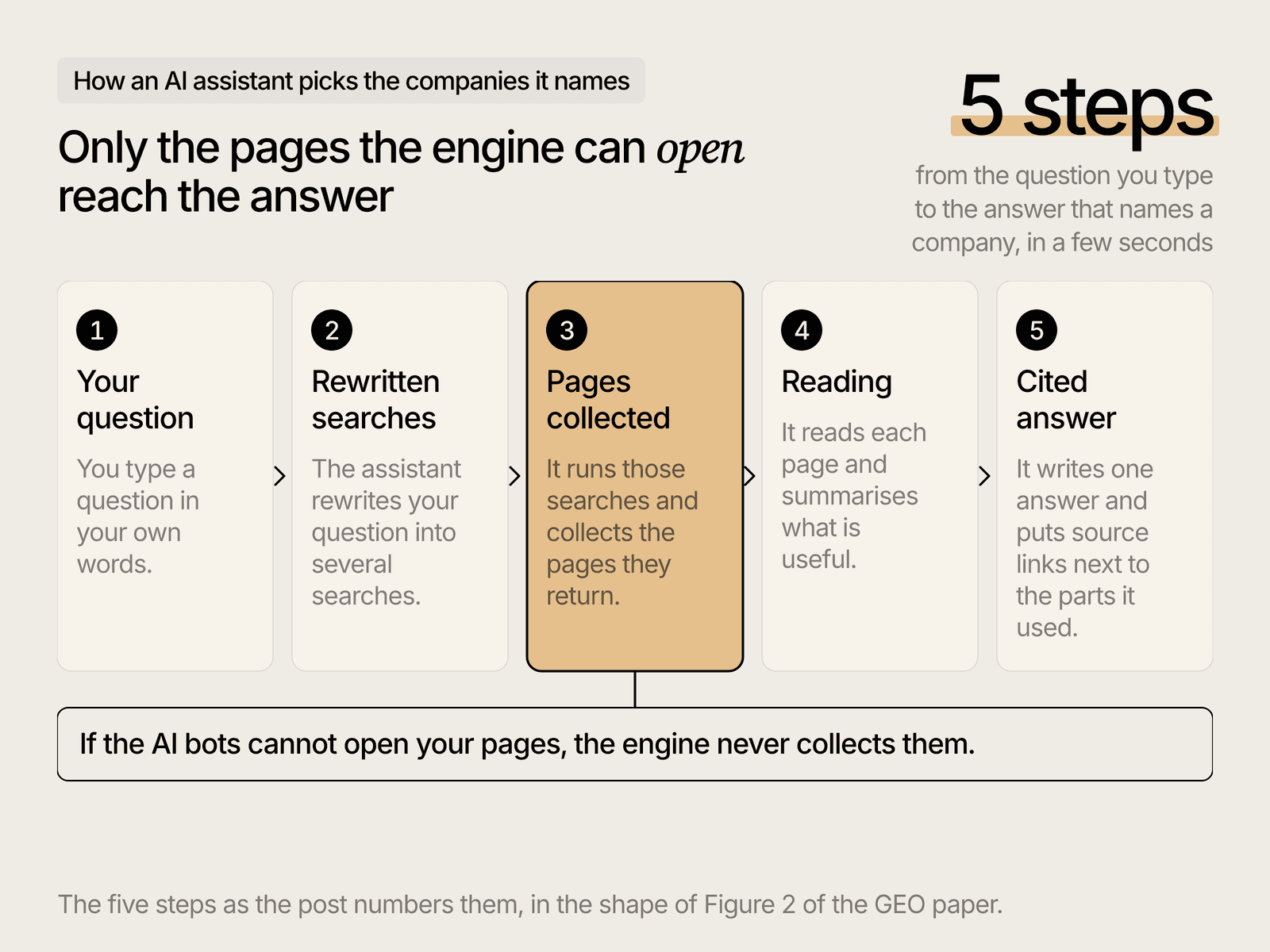
If the AI bots cannot open your pages, the engine never collects them. If your page talks around the question, the assistant finds nothing to lift into its answer.
How does GEO work in practice?
GEO work runs bottom up, in four steps. The same four sit under every GEO programme we run.
1. Open the door. The AI companies' bots have to reach and read your site, so robots.txt, the small file that tells crawlers what they may read, has to allow them. Your pages also have to show their text without JavaScript. Vercel measured in 2024 that the crawlers behind ChatGPT and Claude do not run it, so a page that builds itself in the browser arrives empty.
2. Give them something worth citing, on your site and on the sites the engines trust. Pages written so an engine can lift a direct answer: the answer in the first two lines, then facts, numbers, quotes and named sources. The off-site half is the review sites, directories, forums and comparison articles the engines already quote, where your brand has to be listed and described correctly. Parts of the market call this step, and the citation counting that follows it, AEO, answer engine optimization.
3. Watch what gets cited. Which of your pages the engines pull in, for which questions and how often. Asking the same buyer questions every day and recording the answers is prompt tracking.
4. Count the recommendations. How often the engines name your brand, on which buyer questions, in what context and with what sentiment, and what that turns into in leads and sales.
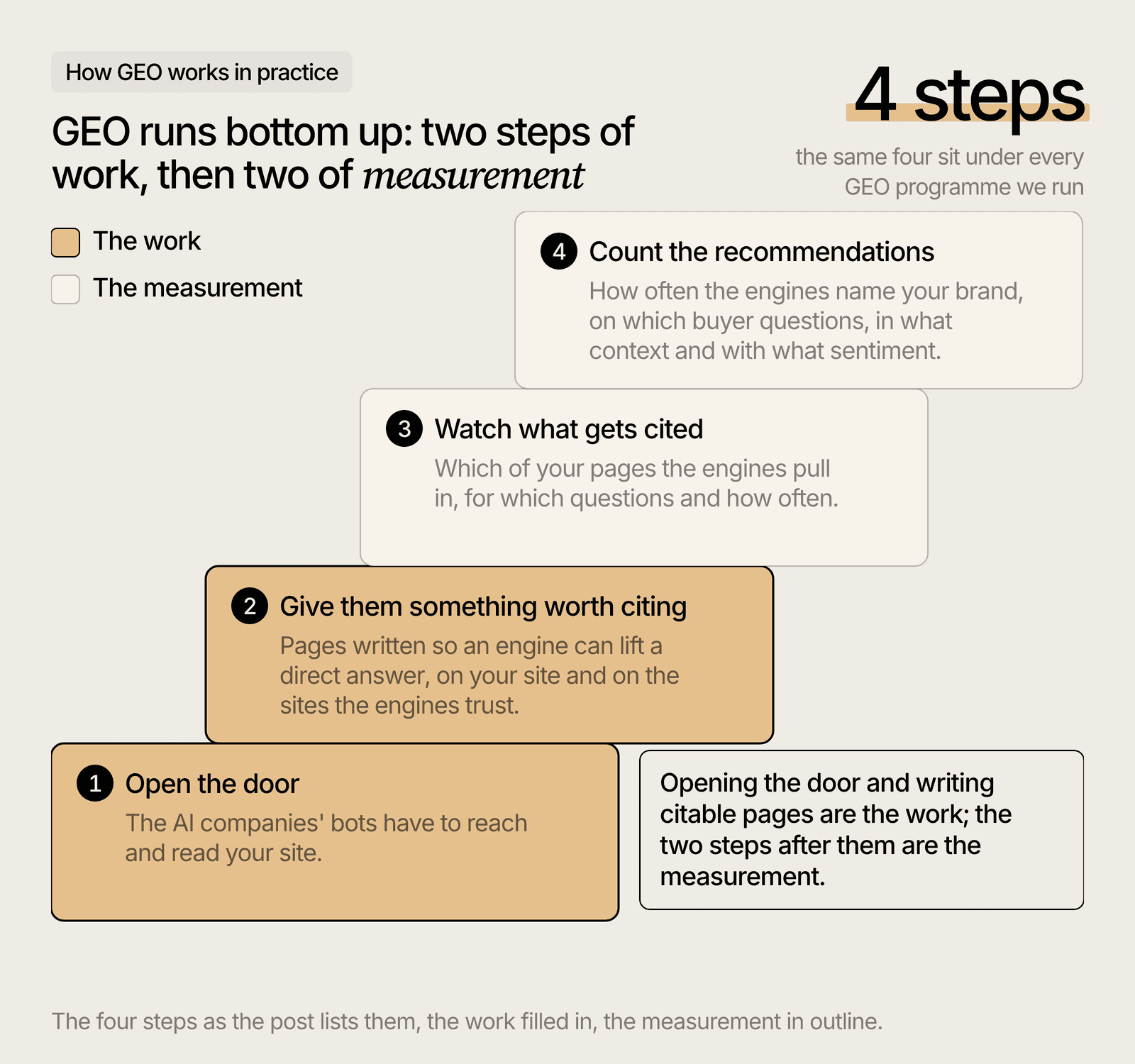
Opening the door and writing citable pages are the work; the two steps after them are the measurement.
A worked example: one buyer question
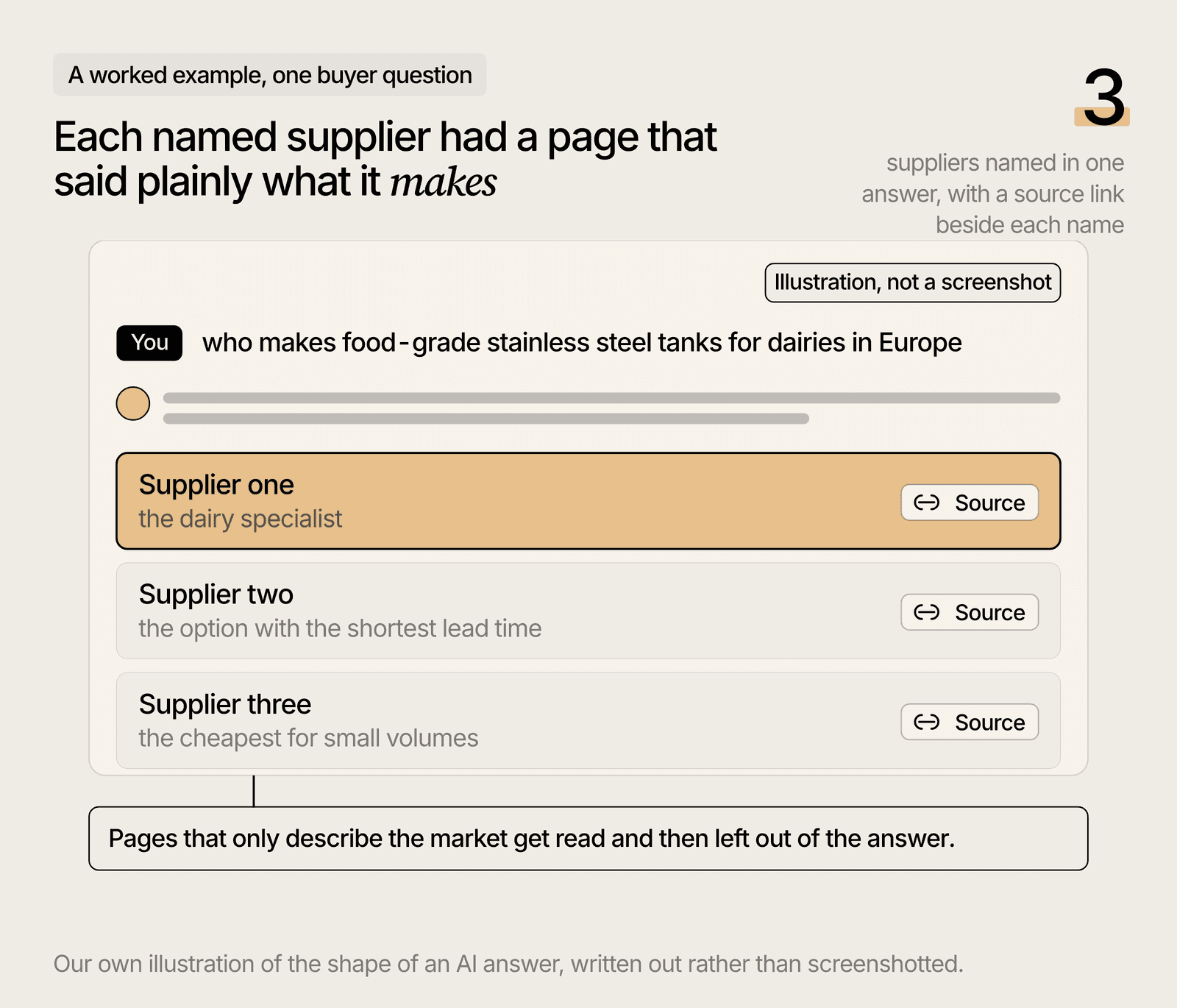
An AI answer to a buying question names a handful of companies, gives a line about each, and shows source links beside them. The example below is our own illustration of that shape, written out rather than screenshotted.
A factory manager types "who makes food-grade stainless steel tanks for dairies in Europe". The assistant answers with three suppliers: one named as the dairy specialist, one as the option with the shortest lead time, one as the cheapest for small volumes. A source link sits beside each name.
Those three pages each said plainly what the company makes, for whom, in which countries and to which standards. Pages that only describe the market get read and then left out of the answer.
What this looked like for one client
A software company selling to online shops came to us with its robots.txt blocking the AI bots. We removed the block and rewrote the pages the engines were reaching for. Ninety days later it held 98% share of voice on its core category question, meaning almost every brand mention in the answers to that one question was its own.
Across all 100 tracked buyer questions, visibility went from 0.25% in May 2026 to 11.9% in August 2026. The site earned more than 3,000 citations in the same window. The wide measure is the 11.9%; the 98% is one category question where it became the default answer.
Dated cases sit at agenzy.lt/case-studies, and the working sequence is in how to rank on ChatGPT in 2026.
How is GEO different from SEO?
GEO and SEO run on the same website and win different things. The table sets them side by side on four things a marketing team has to decide.
What you are deciding | Google search (SEO) | AI answers (GEO) |
|---|---|---|
What you are trying to win | A position in a list of ten blue links | Your brand named inside one written answer |
What decides it | Keywords, links, site authority and what people click | Whether a passage answers the question directly and carries facts, numbers and named sources |
How you measure it | Position per keyword, clicks and impressions from Google | Share of answers that name your brand, plus citations of your pages |
What backfires | Thin pages written to hit a keyword | A page that talks around the question, so there is no passage to lift |
The two jobs feed each other, so search work you have already paid for still counts. Pages ranked first in Google were cited by ChatGPT 43.2% of the time, against 12.3% for pages far down the results, as reported by Kevin Indig.
What people mean by AEO, AI SEO, LLMO and AIO
AEO, AI SEO, LLMO and AIO are the market's names for the same job, or for one part of it, and Agenzy calls all of it GEO. Your agency or your CEO will use one of these names, so the table gives what each one usually means and which step it covers.
Name | What people mean by it | Which step of GEO it covers | What Agenzy calls it |
|---|---|---|---|
GEO, generative engine optimization | Getting named and cited in AI answers | All four steps | GEO |
Writing pages so the engine reads your passage out as the answer | Step two, and the citations in step three | GEO | |
The same job as GEO, under the name people search for most | All four steps | GEO | |
LLMO, large language model optimization | Making a language model describe your brand correctly | Steps two and four | GEO |
Three different things: AI optimization across a business, Google AI Overviews, or GEO | Depends which one is meant | We do not use the term | |
Asking the engines the same buyer questions daily and recording who gets named | Steps three and four | Prompt tracking, inside GEO |
None of these names has an agreed definition yet, and Google's own documentation says that "optimizing for generative AI search is optimizing for the search experience, and thus still SEO". So ask a vendor which of the four steps they will run on your account, and who measures the result.
What GEO is measured by
GEO is measured on a fixed list of buyer questions, asked in the same tool over time. Visibility and share of voice carry most of the weight.
Visibility is the share of the questions you track where an engine names your brand in its answer. Track twenty buyer questions, get named in five of them, and your visibility is 25%.
Share of voice is your brand's share of all brand mentions across those same questions. It shows how much of the conversation you hold next to the competitors named beside you. Agenzy reads both daily in Peec AI, the tracking tool we use.
There is no universal good score, because a category with four suppliers and a category with forty do not compare. The honest test is your own trend on the same questions in the same tool, read over a month or more. One reading is noise, since the same question can produce a different answer an hour later.
When GEO is not worth doing
In some situations we tell a business to spend the money elsewhere for now.
The first is a category where buyers never ask an assistant. Emergency call-outs booked by phone at night, walk-in trade and supply bought through a tender portal all work that way. Ask ten recent customers how they found you before you budget for GEO.
The second is a site nobody can change this quarter. If your pages need JavaScript to show their text, or a security rule blocks the bots, that is the first invoice to pay.
The third is a plan shorter than half a year. Month one goes on the technical pass, the question list and the baseline reading. Content starts in month two, and we review the movement with you in month three.
What the research says about GEO
The term GEO comes from a research paper presented at KDD 2024 by six researchers from Princeton University and IIT Delhi, published on arXiv. They built a test set of ten thousand questions across twenty-five subject areas, gave each question the top five Google results, then rewrote those pages nine different ways and measured what reached the answer.
The rewrites that worked best were adding quotations from credible sources, adding statistics, and citing sources, worth 30 to 40% more of the answer between them. Quotations were the strongest at 41%, statistics about 30%, citing sources 27%. Making the writing clearer and easier to read also helped.
Stuffing keywords, the old SEO trick, scored worse than leaving the page alone, and about 10% worse when the team tested it on Perplexity.
The most useful finding for a smaller company is who gained. The page sitting fifth in Google gained 115% more of the answer's words from citing its sources, while the page sitting first lost about 30%.
The work is from 2023 and 2024, and it ran on a model of that time. Its authors say the methods will have to change as the engines change, and the 41% is a best case on a test set, never a promise about your site. What the engines cite today sits in our study of the sources AI engines cite, the brand-level numbers in our 2026 AI search visibility study, and the rest of our published data at agenzy.lt/research.
Where to start with GEO
Three things are worth doing this month, in this order.
Check the door first. Open your robots.txt file and confirm the AI crawlers, GPTBot and Google-Extended among them, are allowed. Then check that your firewall is not blocking them anyway, because a blocked crawler makes every later step pointless.
Write down ten questions your buyers actually ask, in their words, with no brand name in them. Ask each one in ChatGPT and Gemini and note who gets named. Our method is in how we build prompt sets.
Then take the three questions that matter most commercially and rewrite the page that should be the answer. Put the answer in the first two lines, then the numbers, sources and quotes behind it.
What month one covers and what the work costs sit on the GEO service page, with more explainers in our guides.
Book a free 30 min call and we'll show you where you appear in AI answers today.
Questions people ask about GEO
Is GEO the same as SEO?
No. SEO wins a position in a list of links on Google. GEO wins your brand a mention inside one written answer, where there is no list and often no click. One website serves both, and one page can win both. The name most people search for is AI SEO.
How long does GEO take to work?
Month one of a GEO programme goes on the technical pass, the tracked question list and the baseline reading. Content starts in month two, and we review the movement with you in month three. Nobody controls how a model writes its answer, so treat a promised date or percentage as a warning sign.
Do I need GEO for a small business?
GEO is worth it for a small business when buyers in that category ask an assistant before they shortlist. Size is less of a barrier than it is on Google, because the research found that lower-ranked pages gained most from citing their sources. One page written as the answer to one buyer question is a real start.
Which AI engines matter in Europe?
No European figure is published; the closest published readings are the UK and the US, and both point the same way. Statcounter's July 2026 reading of AI chatbot web traffic puts ChatGPT at 70.9% in the UK and 65.0% in the US. Gemini comes second and is understated in that reading, because most Gemini use happens inside Google's own app. Google AI Overviews reach more people still.
Can I do GEO myself?
You can do parts of GEO yourself, up to a point. Anyone can open robots.txt, unblock the AI crawlers, and rewrite their main pages so each one answers a buyer question in its first two lines. The hard parts alone are the measurement and the mentions earned on third-party pages the engines already trust. Prompt tracking is where most teams stop.
What does GEO cost?
Agenzy starts from 5,000 EUR per month ex VAT. Across the market the monthly fee moves with scope, the number of markets and languages, and how much of the technical work the agency implements itself rather than handing over as a document. We compare published prices and what each band buys in what a GEO agency costs.
Is GEO a fad?
GEO is a new name for a change in buyer behaviour that is already measurable. People ask assistants for recommendations and act on the answers, whichever word the market settles on for the work. Wikipedia still carries a neologism banner on the term, and an analyst at Forrester argues the work is significantly, though not fundamentally, different from SEO.
About Agenzy
Agenzy is a GEO agency based in Vilnius, working with brands in the US, the UK and across Europe. We get brands named and recommended inside ChatGPT, Gemini, Google AI Overviews, Perplexity, Claude and Copilot. We are an official Peec AI partner. As of September 2026: 500,000+ AI chats analysed, 15,000+ prompts tracked, 150+ audits completed, 1,000,000+ EUR generated for clients by AI search. Dated cases sit at agenzy.lt/case-studies.