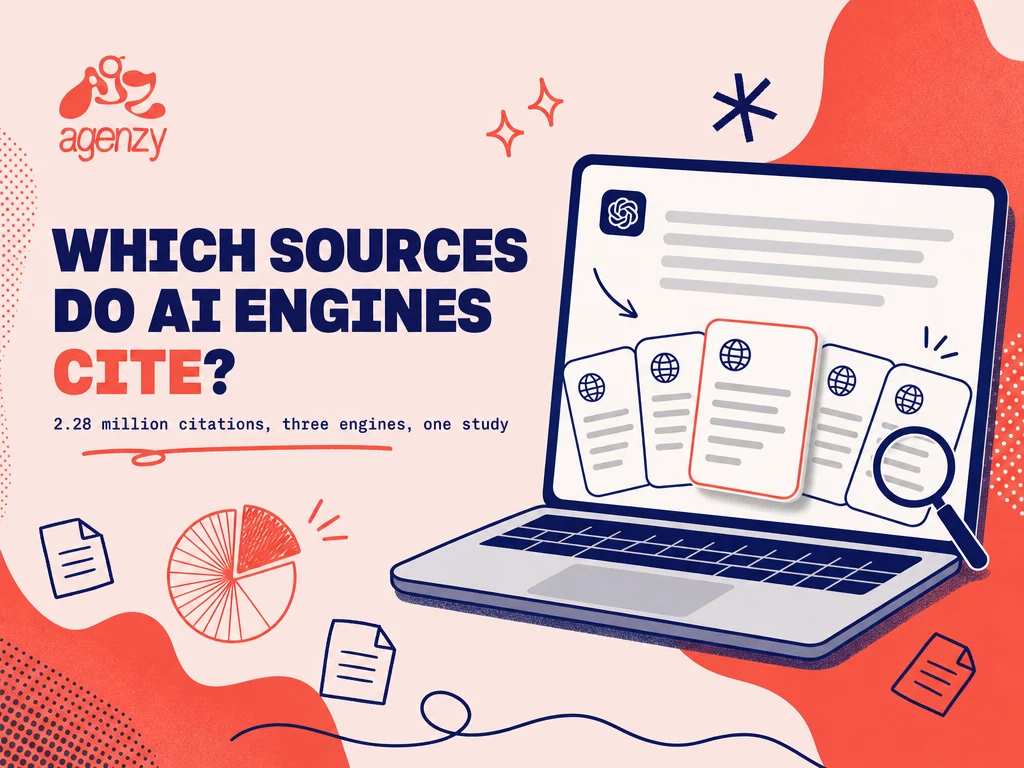
Lists of the websites AI engines cite most are built on US queries, and almost none show where the answers come from for a European business. Agenzy analysed 2,283,923 AI citations from 394,180 AI answers across 138 tracked market projects covering 130 European businesses in 29 countries, using ChatGPT, Google AI Overviews, Gemini and Perplexity.
The short answer: Reddit and YouTube lead, no website holds more than 2.1% of citations, and inside one category about 23 websites carry half of them. My read of the data: getting cited is mostly work on other people's pages, and each engine needs its own plan.
The sample is our own client and pitch dataset. 104 of the 138 projects ran from Lithuania and the other 34 from markets such as Germany, the UK and the US, so read every figure as a measurement of that group of businesses. We ran buyer questions through the engines every day and logged every source behind each answer.
Below are five findings, each with its sample, and what each one means for a business:
No website holds more than 2.1% of AI citations
ChatGPT, Google AI Overviews and Perplexity share 2 of their top 10 sources
Google AI Overviews takes 10.8% of its citations from user content
ChatGPT cites Reddit 5.0x more heavily than Perplexity
34.8% of businesses are missing from the top 30 sources about their category
This is the third volume of our research series. The second, our European AI visibility study, measured how often brands appear in AI answers, and this one measures where those answers come from.
Methodology
Every number here comes from Peec AI, which runs a fixed set of buyer questions on each engine every day and stores every source behind each answer. For each source it records four things:
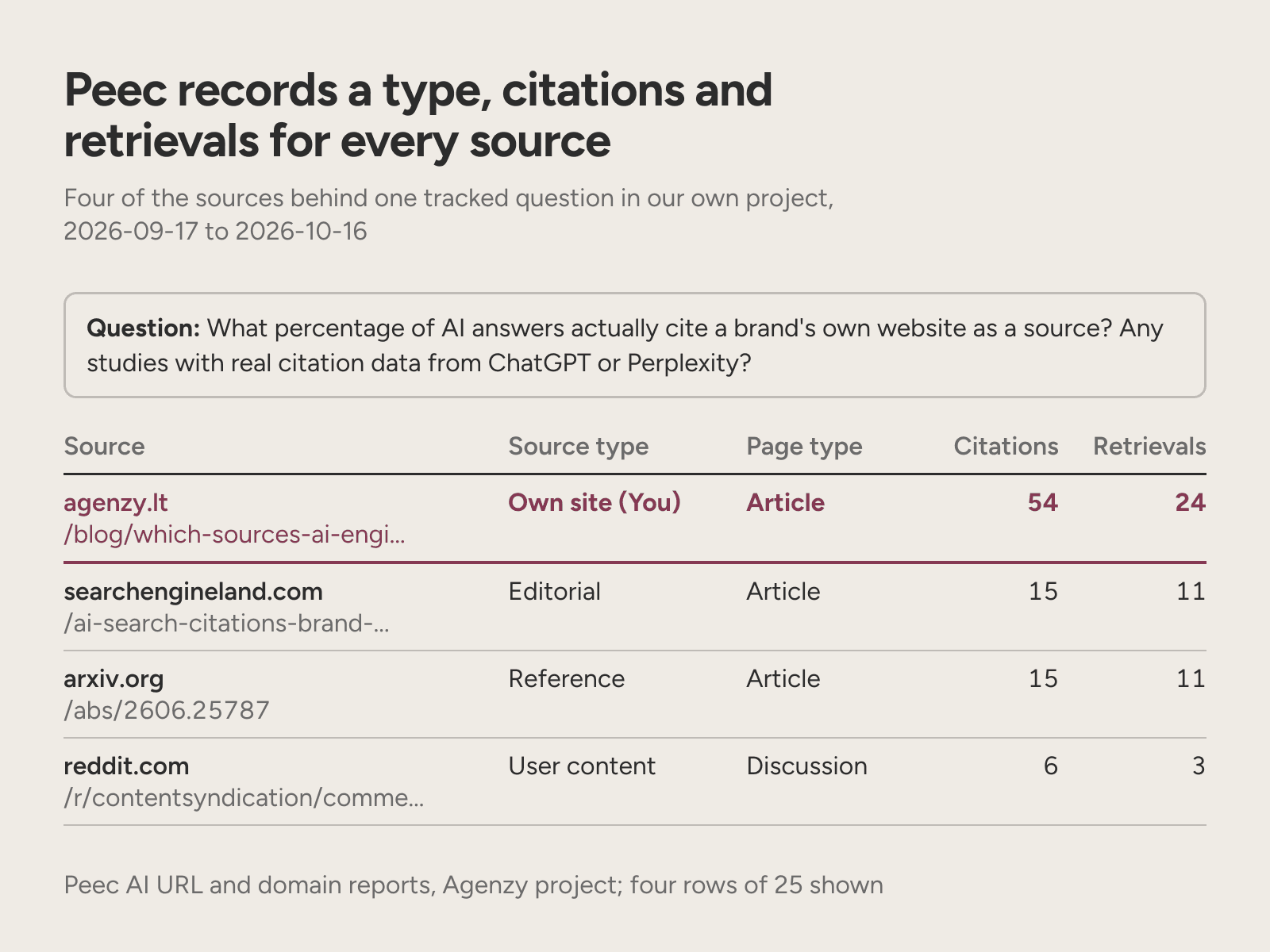
The source type is what lets the study separate a brand's own site from its rivals and from third parties.
Peec AI defines citations as "the sources explicitly referenced in the final answer" (Peec AI docs). Both counts are among the GEO metrics we report, and the question sets follow our guide to prompt tracking.
Sidenote: a retrieval is a page the engine pulled for an answer, and a citation is a page it referenced in the answer text. This study uses citations unless it says retrieval.
The dataset in numbers:
Projects: The study covers 138 tracked market projects for 130 businesses, where a project is one business in one market, and 11,296 tracked prompts.
Citations: Peec's domain table holds 2,283,923 citations, the base for every share here, and its URL table holds 2,037,717, the base for page types.
Domains: The engines cited at least 100,400 different domains.
Window: Each project counts everything it ran between 2025-01-01 and 2026-09-07.
Engines: ChatGPT ran in 138 projects, Google AI Overviews in 137, Perplexity in 133 and Gemini in 16, so Gemini stays out of the engine comparisons.
Peec sorts each domain into a source type: corporate, competitor, editorial, institutional, user-generated content (UGC), reference, other, or "You" for the tracked brand's own domain. "Competitor" means the rivals each project chose to track. Agenzy's own project is excluded from every figure.
The limits, which every finding below inherits:
Sample: These businesses approached a GEO agency or were audited for a pitch, so Lithuania is over-represented, and the 34 projects from other markets describe no single market.
Classification: About 2.9% of domains carry more than one source type in Peec's reports, so type shares carry a margin of a few points.
Table depth: Peec's export stopped at 50 to 5,329 rows per project, so the rarest domains are missing. Shares are unaffected, and the domain totals are minimums.
To cite this study, use: Agenzy (2026). Which sources do AI engines cite? 2,283,923 citations across ChatGPT, Google AI Overviews and Perplexity. Agenzy, Vilnius. https://www.agenzy.lt/blog/which-sources-ai-engines-cite-2026. Any figure may be quoted with attribution to Agenzy and a link to this page. Log: 2026-09-08, first publication; 2026-10-17, page restructured, no figure changed. Our other studies are on our research hub.
No website holds more than 2.1% of AI citations
No single website holds more than 2.1% of the 2,283,923 AI citations in Agenzy's 2026 source study, and it takes 1,057 different websites to cover half of everything the AI engines cited (n=138 business projects).
Plotted from the most cited website down, the curve climbs slowly:
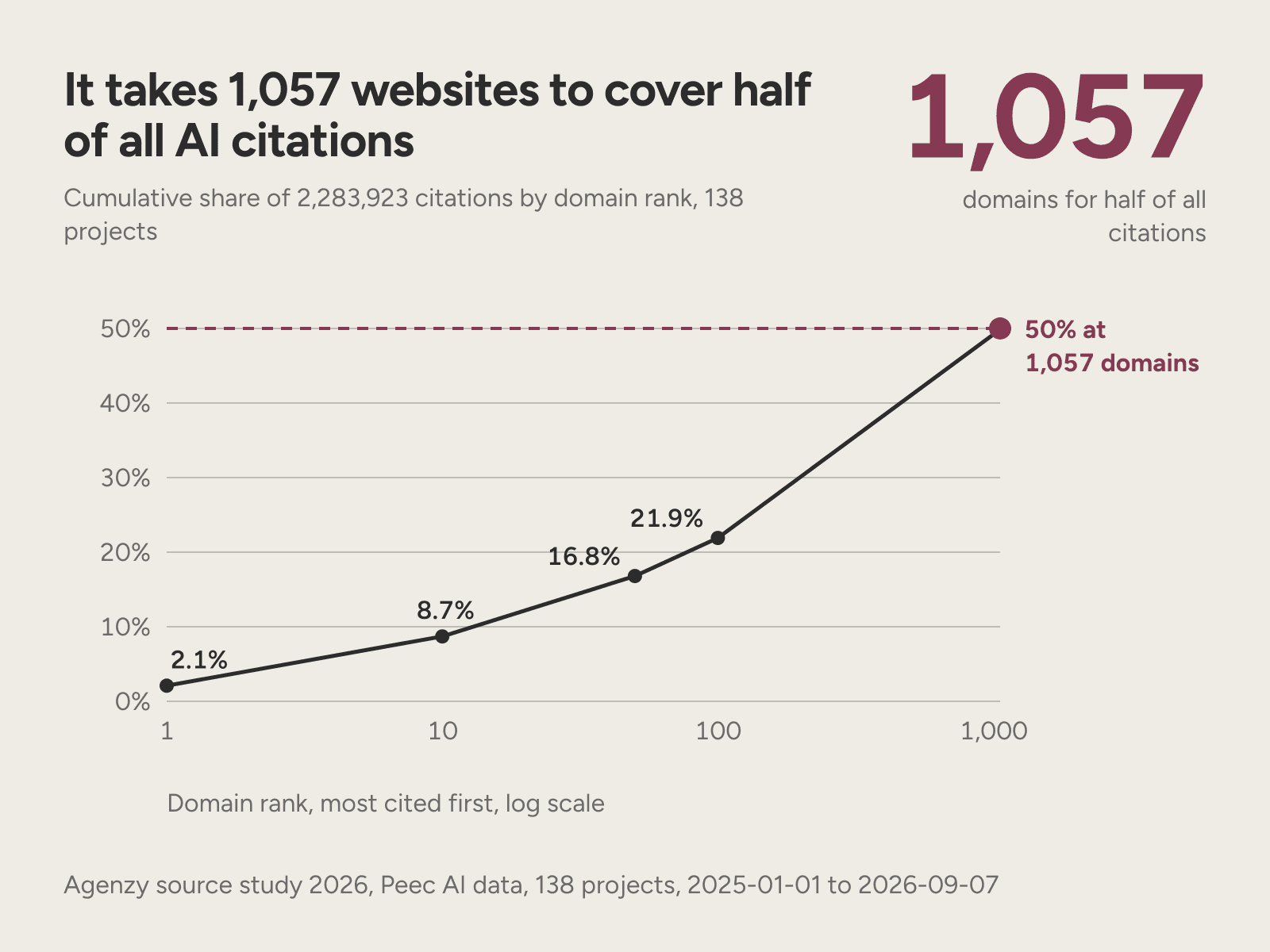
Even the 100 most cited websites hold only 21.9% of all citations, so almost four in five go somewhere else.
reddit.com leads with 48,018 citations (2.1%) and youtube.com follows with 37,264 (1.6%). The other eight in the top ten each hold 0.5% to 0.8%: the Lithuanian government portal lrv.lt, the business daily vz.lt, facebook.com, the central bank lb.lt, google.com, the directory paslaugos.lt, the tax authority vmi.lt and europa.eu. Wikipedia holds 0.09% of citations while appearing in 63.0% of projects.
Inside a single project the picture turns around:

For a business, the right-hand number is the one that matters: about 23 websites carry half of what the engines cite about its category.
Each project asks about one category in one market, and the engines answer from the few pages that already cover that category in that language. Lithuanian projects concentrate slightly more, with a median top-10 share of 36.3% against 30.3% elsewhere (n=104 and 34).
Tomek Rudzki, GEO Expert at Peec AI, analysed 30 million sources from US answers on five AI platforms and found reddit.com first overall, noting that "Reddit and YouTube appear across all five platforms" (Peec AI). Our top two are the same two, although most of our projects run from Lithuania.
Build your source list from your own category. A global ranking shows the two platforms that appear everywhere, and the 23 or so websites that carry half the citations for your buyers' questions are the ones worth your time.
ChatGPT, Google AI Overviews and Perplexity share 2 of their top 10 sources
ChatGPT, Google AI Overviews and Perplexity share only 2 of their top 10 cited sources when answering the same questions about the same brand, according to Agenzy's 2026 source study (n=109 business projects).
Pair by pair, the overlap stays small:

A citation on one engine therefore says little about the others. In 14.7% of projects (16 of 109), not one domain appears in all three top-10 lists.
The n sits below 138 because this comparison needs at least 10 cited domains on each engine. At the top 25 the three-engine median is 6 of 25 (n=103), so the disagreement holds deeper in the list too.
Even the leading website changes from engine to engine:
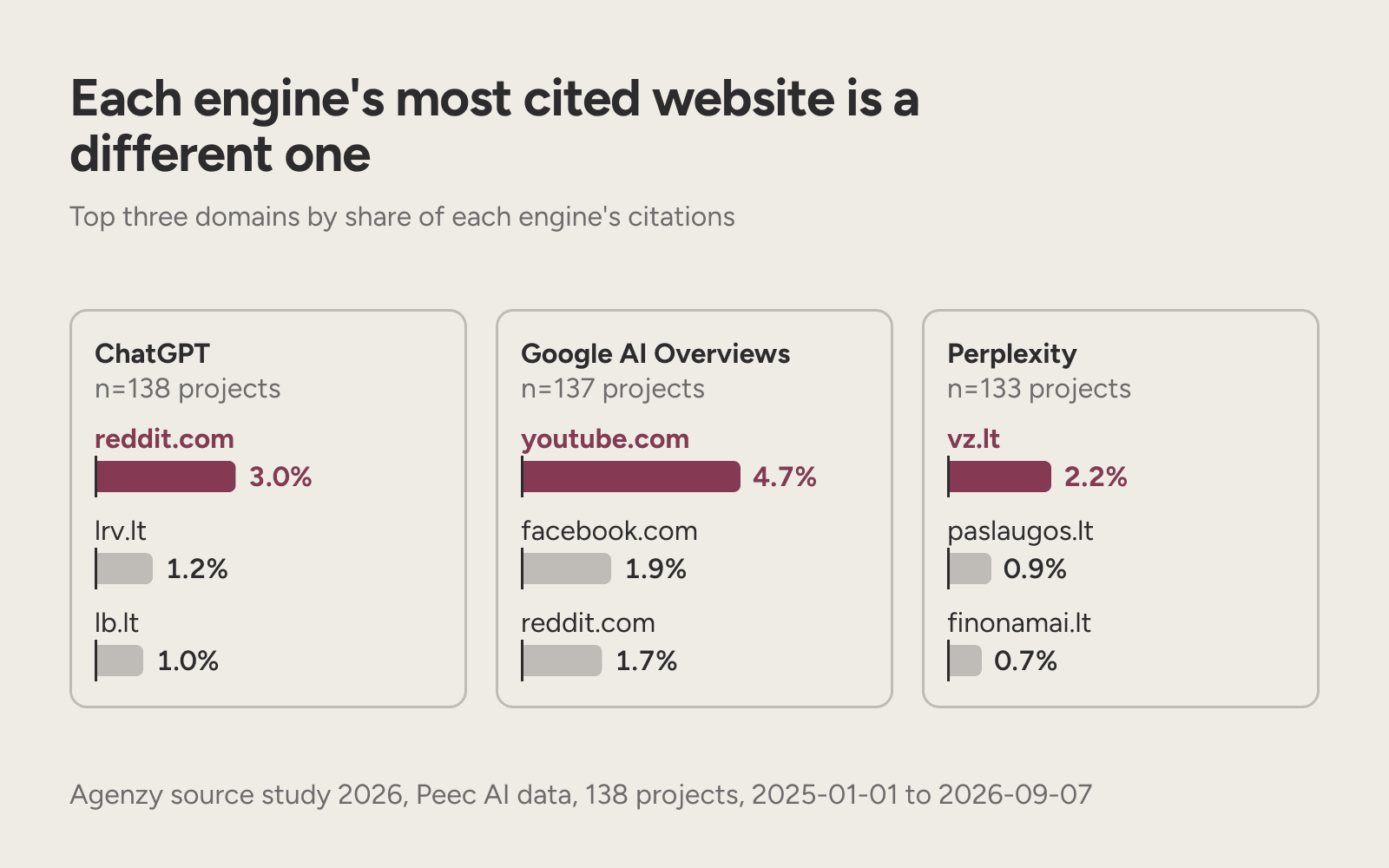
Reddit leads ChatGPT, YouTube leads Google AI Overviews, and a Lithuanian business daily leads Perplexity.
The engines disagree because each one runs its own pipeline:
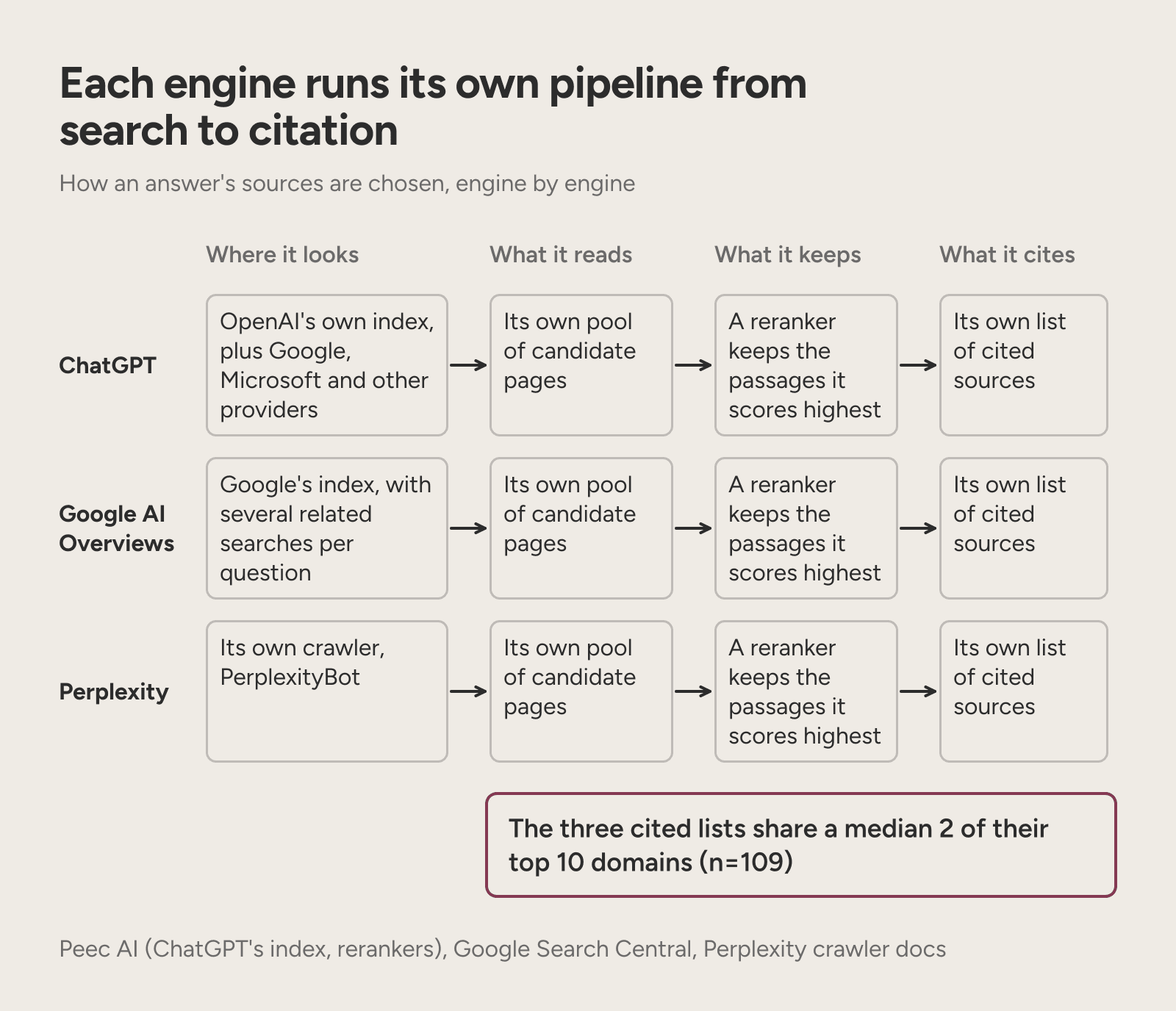
Different indexes feed different candidate pools, and each engine's ranking step keeps different passages, so the cited lists diverge.
Tomek Rudzki found that ChatGPT "runs its own retrieval index" and "pulls from at least eight other providers on top of its own index" (Peec AI). Google says AI Overviews may use a "query fan-out" technique, running several related searches for one answer (Google Search Central). Perplexity crawls with its own bot, built to "surface and link websites in search results on Perplexity" (Perplexity). A reranker then scores each candidate passage against the question, as Peec AI's guide to rerankers explains.
Plan each engine separately. ChatGPT held 79.04% of AI chatbot use in Europe in September 2026 by StatCounter's count, so its list comes first. The free route is to ask your buyers' questions on each engine and note every cited domain, and a free AI visibility audit runs the same check across weeks of tracked answers.
Google AI Overviews takes 10.8% of its citations from user content
Google AI Overviews takes 10.8% of its citations from user-generated content against Perplexity's 3.8%, while Perplexity takes 13.6% from news and media against AI Overviews' 5.2%, Agenzy's 2026 study of 2,283,923 AI citations found (n=137 and 133 business projects).
Split by type of source, the three engines look like this:

Other company sites take 46.5% to 47.2% on all three, so the engines differ in the smaller types.
ChatGPT leans on official pages more than the others:

Government, health and EU domains take 11.9% of ChatGPT's citations, and the central bank lb.lt alone takes 1.0%.
Some projects' tables run deeper than others, so we also compared the engines on each project's top 50 domains only. User content keeps the same order: 6.0% on ChatGPT (n=126), 14.6% on Google AI Overviews (n=124) and 4.2% on Perplexity (n=118).
My reading is that each mix follows the product behind it. Google AI Overviews sit on top of Google results, where forum threads and videos rank for many buyer questions, and ChatGPT reaches official pages in regulated categories such as finance and health. No vendor documents how it picks sources, so this is inferred from the output.
YouTube and Facebook on AI Overviews
YouTube earns 4.7% of Google AI Overviews citations and 0.03% of ChatGPT citations in Agenzy's 2026 source study of 2,283,923 AI citations (n=137 and 138 business projects).
Two platforms show the split most clearly:

In counts, YouTube took 34,544 Google AI Overviews citations and 292 on ChatGPT, and Facebook took 14,048 against 51.
Luke Harsel, content leader for Semrush's product-led growth team, tracked 230,000 prompts over 13 weeks in 2025 and found Google's AI Mode citing LinkedIn, YouTube, Reddit, Google and Google Blog most, "all of which are properties that Google either owns or has a major partnership with" (Semrush). In his data and in ours, Google's AI answers lean on Google's own video platform.
Give Google AI Overviews a video it can cite. YouTube is that engine's most cited domain in our data, so a short video that answers one buyer question gives it one more source of yours on the platform it cites most. Our guide to Google AI Overviews explains how those answers are built.
ChatGPT cites Reddit 5.0x more heavily than Perplexity
Reddit is the single most cited domain in Agenzy's 2026 AI source study, taking 2.1% of 2,283,923 citations and appearing in 92.8% of 138 business projects, with ChatGPT citing it 5.0x more heavily than Perplexity.
Split by engine, the gap is wide:

Reddit also turns up in more ChatGPT projects: 77.5%, against 61.3% on Google AI Overviews and 46.6% on Perplexity (n=138, 137 and 133). Its 3.0% is the largest share any single website gets on ChatGPT in this dataset.
The market changes the mix as well:
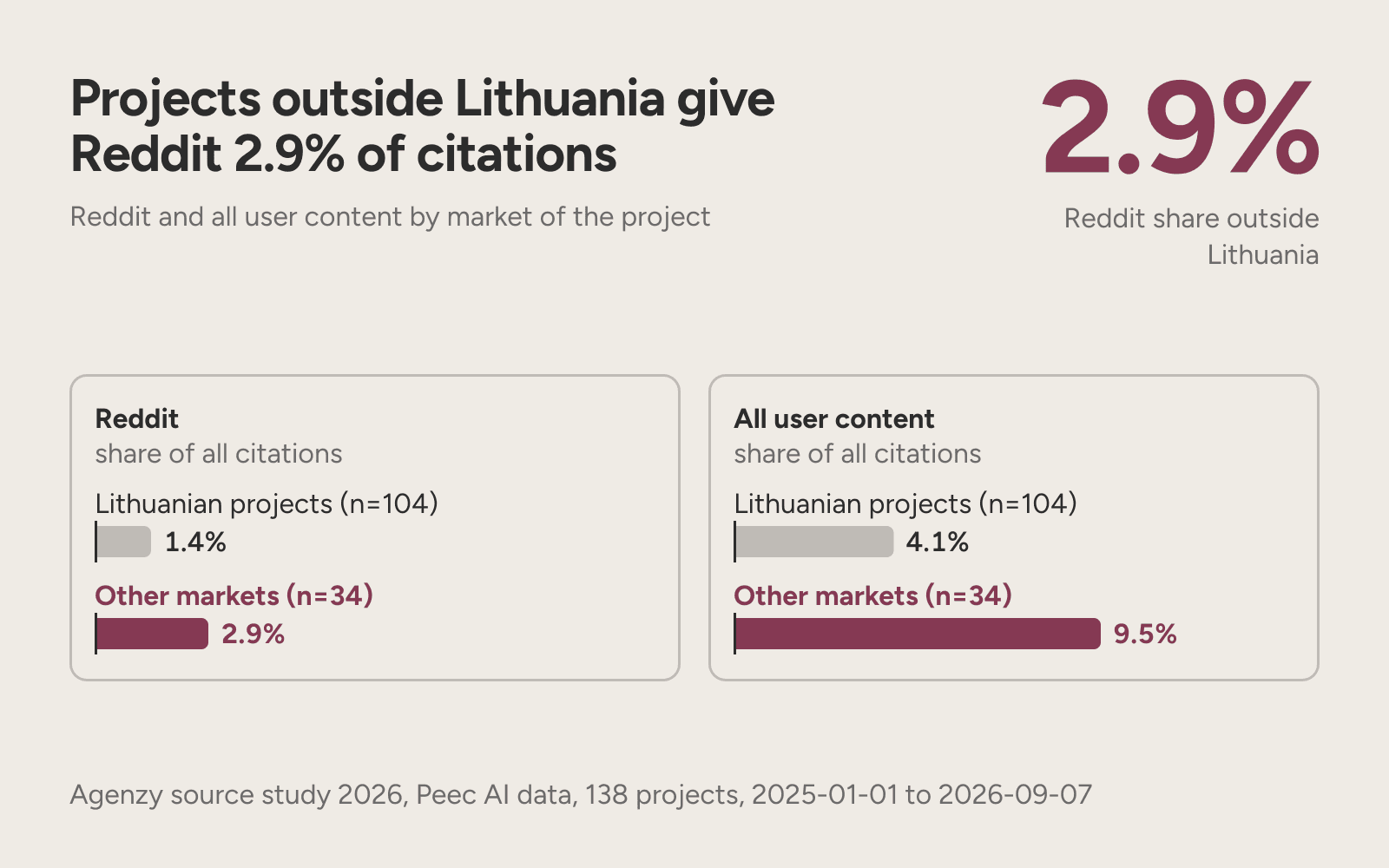
Projects run from outside Lithuania give Reddit 2.9% of citations against 1.4% for Lithuanian ones (n=34 and 104). A likely reason is that questions asked in Lithuanian find few Reddit threads in their language, which how GEO changes by market and language covers in more depth.
Si Quan Ong, SEO and Marketing Educator at Ahrefs, counts reddit.com at 16.8% of ChatGPT citations and Wikipedia at 7.0% in Ahrefs' September 2026 list of the domains ChatGPT cites most, measured on US queries. In our data Wikipedia takes 0.13% of ChatGPT citations (1,329 of 1,045,566).
Sidenote: the two counts come from different prompts, markets and windows. Ahrefs measures every topic people ask ChatGPT about in the US, and this study measures buyer questions about specific categories, mostly from Lithuania.
Answer the Reddit threads ChatGPT already cites for your category, under your own name and with something useful in the reply. Check the market first, because a thread that shapes English answers may have no equal in your buyers' language.
Further reading: how ChatGPT decides which products to recommend.
34.8% of businesses are missing from the top 30 sources about their category
34.8% of the businesses in Agenzy's 2026 source study did not have their own website among the 30 sources AI engines cited most for their own category (n=138 business projects).
That is a top-30 measure. Across the full tables the own domain is cited somewhere in 90.6% of projects, at a median rank of 10 and with a median 2.0% of the project's citations, so the typical brand is cited, around tenth on its own category's list.
Each engine treats the brand's own site differently:

ChatGPT cites it in the most projects and ranks it lowest, while Google AI Overviews and Perplexity cite it less often and higher. ChatGPT also produced the largest citation table, 1,045,566 citations against 731,699 on Google AI Overviews, so more domains reach its answers.
Perplexity is the most selective at the citation step:

Perplexity drops more of what it reads before the answer, which fits what we see for own sites: compared with ChatGPT, it cites them in fewer projects and higher up when it does.
Oshen Davidson, Head of Research at AirOps, found that "ChatGPT left 85% of retrieved pages uncited" across 548,534 retrieved pages (AirOps). Being read and being cited are two separate hurdles on every engine.
Company websites of every kind take 68.6% of all citations. Split between the tracked brand and the rivals it chose to track, the dataset reads as follows. Brands' own websites earned 3.7% of the 2,283,923 AI citations in Agenzy's 2026 study while their named competitors earned 16.9%, a 4.6x gap (n=138 business projects).
Sidenote: read that figure as a description of our sample. "Competitor" means the rivals each project chose to track, several domains against one own domain, so swapping the tracked brand swaps the numbers. The dataset-wide figures earlier in this post are the ones to quote.
Give engines a page of yours they can cite, in this order:
Open your site to the search crawlers in robots.txt, OAI-SearchBot, PerplexityBot and Googlebot among them. OpenAI states that "Sites that are opted out of OAI-SearchBot will not be shown in ChatGPT search answers, though can still appear as navigational links" (OpenAI), and our list of AI crawlers covers the others.
Check that your server and CDN let the same bots through, since a firewall rule can block what robots.txt allows; Cloudflare's AI Crawl Control shows which AI services reach a site.
Put the answer in the first lines of every page that targets a buyer question, the homepage included, because homepages took 17.5% of the URL-level citations. Our content service writes these pages for the questions a client tracks.
Work the pages each engine trusts for your category: YouTube for Google AI Overviews, Reddit for ChatGPT and editorial sites for Perplexity.
Why AI reads your site and recommends a competitor shows what happens when step 3 is missing. When Outcraft, our B2B SaaS case study, came to us in May 2026, its robots.txt blocked AI crawlers such as GPTBot and ClaudeBot, and it appeared in 5 of 100 tracked buyer prompts. Ninety days after we opened the site and published pages for its buyers' questions, outcraft.ai had earned more than 3,000 citations.
Our GEO service runs this sequence with the citation audit before any content is written. How to rank on ChatGPT in 2026 covers the ChatGPT side, and where to start with GEO covers the first steps from zero.
How this compares with other studies
Other studies use different engines, markets and units, so the numbers differ, and the direction mostly holds:
Our August study: Our European AI visibility study found Reddit among the top-cited sources of 83.5% of its 91 projects, against 60.9% (84 of 138) on the same top-30 cut here and 92.8% on the full tables. Its own-domain share of 4.6% becomes 6.7% on the same cut and 3.7% on the full tables, because deeper tables add third-party domains. Its finding that comparison pages earn a 1.6x higher median citation rate than homepages drops to 1.47x on the same cut here and disappears on the full tables (0.641 against 0.667).
Yext: Yext analysed 6.8 million citations from over 1.6 million AI answers on Gemini, OpenAI and Perplexity and put general forums like Reddit at 2% (Yext), close to reddit.com's 2.1% here.
Semrush: Luke Harsel found ChatGPT citing Reddit in "close to 60% of prompt responses in early August" 2025 and around 10% by mid-September (Semrush), so any Reddit figure, ours included, describes one window.
AirOps: Oshen Davidson reports that "Among pages ranking #1 in Google, 43.2% were cited by ChatGPT", 3.5 times the rate beyond Google's top 20 (AirOps), which fits ChatGPT drawing on Google next to its own index.
Sidenote: none of the differences between this study and the August one is a trend. The samples, windows and table depths differ, and each figure is quoted with the basis it was computed on.
My read: the direction of each finding holds across very different samples, and the exact figures belong to this sample and window.
FAQ
We track our own site in Peec AI too. The question that brought AI engines to this study most often in the last 30 days is one the study answers only in part:

It asks what share of AI answers cite a brand's own website. Our data counts projects, not single answers, so the fourth answer below gives the closest figures we have.
Which websites do AI engines cite the most?
Reddit leads with 2.1% of the 2,283,923 citations in Agenzy's 2026 source study, and YouTube follows at 1.6%. Below them the list is flat: the top 50 domains together hold 16.8%, and it takes 1,057 domains to reach half.
Does ChatGPT cite Reddit more than Google AI Overviews does?
Yes. ChatGPT gave Reddit 3.0% of its citations in Agenzy's 2026 source study, Google AI Overviews 1.7% and Perplexity 0.6%. Reddit also appears in 77.5% of ChatGPT projects against 61.3% on Google AI Overviews (n=138 and 137).
Do ChatGPT, Google AI Overviews and Perplexity use the same sources?
Rarely. For the same questions about the same brand, a median of 2 of their top 10 cited domains were common to all three engines (Agenzy 2026 source study, n=109 business projects). ChatGPT and Google AI Overviews shared a median of 4.
How often do AI engines cite a brand's own website?
In most projects, and usually low in the list. In Agenzy's 2026 source study the brand's own website was cited somewhere in 90.6% of 138 projects, at a median rank of 10, and it was missing from the 30 most cited sources in 34.8%. These are shares of projects, so they do not say how many single answers cite the site.
Does Google AI Overviews cite YouTube?
Yes, far more than the other engines. YouTube earned 4.7% of Google AI Overviews citations in Agenzy's 2026 source study and appeared in 72.3% of the 137 projects on that engine. ChatGPT gave it 0.03%.
Final thoughts
AI engines cite a very long tail of websites, and the three main engines pick different ones for the same question. A brand's own site is a small part of what gets cited about its category, so most of the work happens on other people's pages, engine by engine.
This week, ask your buyers' three most common questions on ChatGPT, Google AI Overviews and Perplexity, and write down every domain each one cites. That list is your plan.
If your category's sources look different from ours, write to Emilis Zabilius, Agenzy's co-founder, on LinkedIn. We'd like to hear what you found.