A finance director asked to fund AI search work wants one number: what came back. AI search makes that number harder to produce than any other channel, because most of its influence never arrives as a click. A buyer asks ChatGPT which supplier to use, reads three names, and a week later buys from one of them after searching the brand in Google. Analytics records a Google visit, and the recommendation that decided the purchase leaves no trace in the report.
So on every client we set up three measurements and run them side by side for the length of the engagement. The first is traffic from AI models, taken from the source recorded in the client's analytics. The second is visibility, which is the share of AI answers to the tracked prompts that name the client. The third is revenue, which comes from the buyer telling us where they found the company, asked at two separate moments and stored in the client's CRM.
Each one covers what the other two miss. Traffic is precise and small, because it counts only the visits that carry an AI model as their source. Visibility is large and early, because it moves months before a purchase does. Revenue is the number the business runs on, and it is the only one of the three that can be checked against a bank account.
As of 8 September 2026, this method had measured 1,000,000+ EUR of closed client revenue from AI-attributed leads over the previous three months, across the 10 to 15 clients active at the time. The figure grows every month as more deals close, and this page carries the date it was last checked.
How buyers arrive from AI search
The journey that breaks analytics is the ordinary one. A buyer opens ChatGPT, describes the problem, and gets an answer naming a handful of companies. They do not click any of the links, because the answer already told them what they needed. Then they open Google, type the brand name they remember, land on the site from the branded search, and fill in the form.
Analytics sees the last step and nothing before it. The session source is Google, or Direct if the buyer typed the address. Both are correct records of how the browser arrived, and both are silent about the AI answer that produced the brand name in the first place.
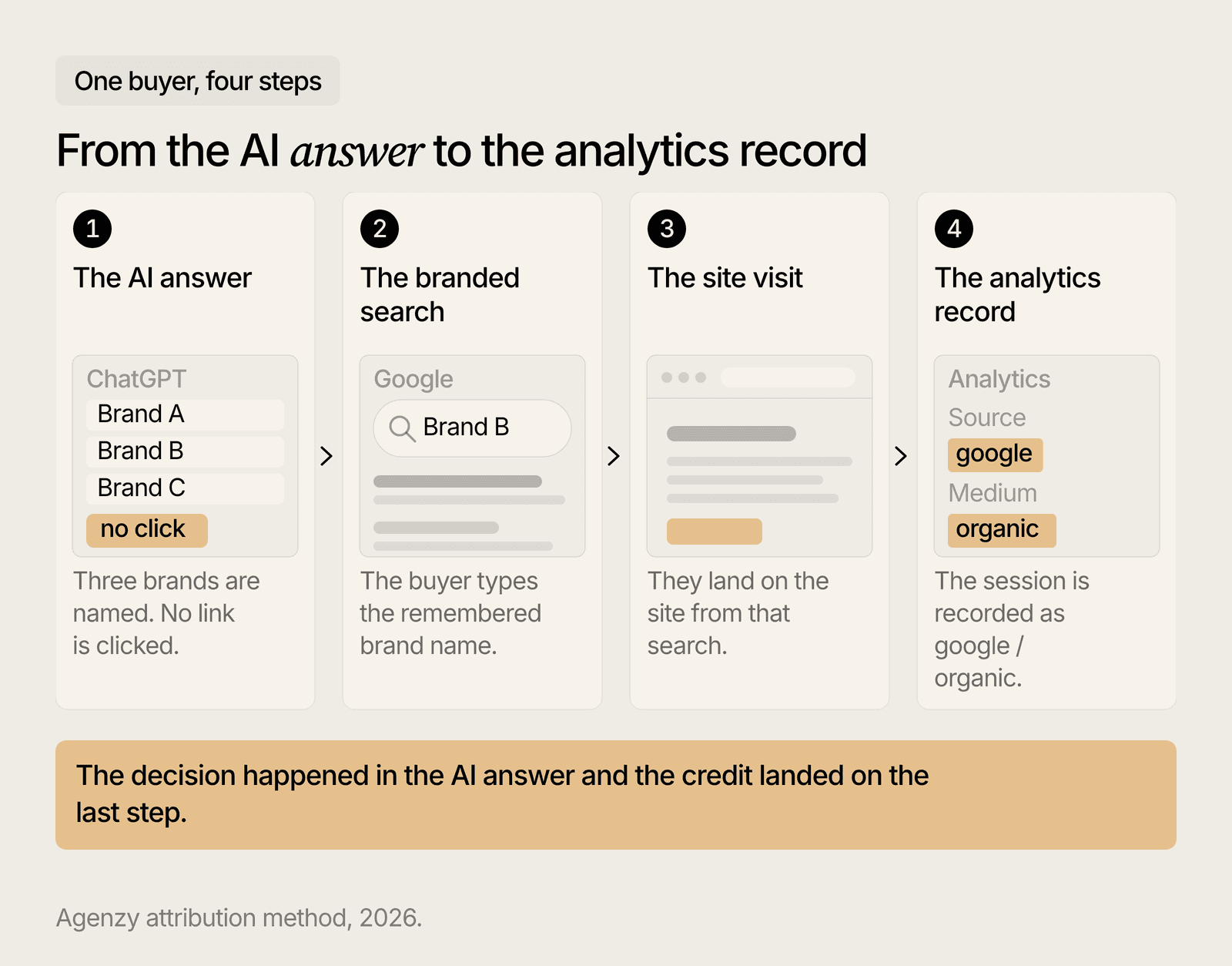
This is why a lot of AI search value sits inside two lines of a report that look like they belong to other channels. Organic Google grows because more people are searching the brand by name. Direct grows because more people arrive already knowing where they are going. Neither line tells you why the demand appeared, and cutting the AI search work because those two lines look healthy is how a company kills the thing feeding them.
The only instrument that sees the whole journey is the buyer. They remember asking ChatGPT, and they will say so when asked in a form field or on a call. So the third measurement is built on what the buyer reports, and the first two exist to corroborate it.
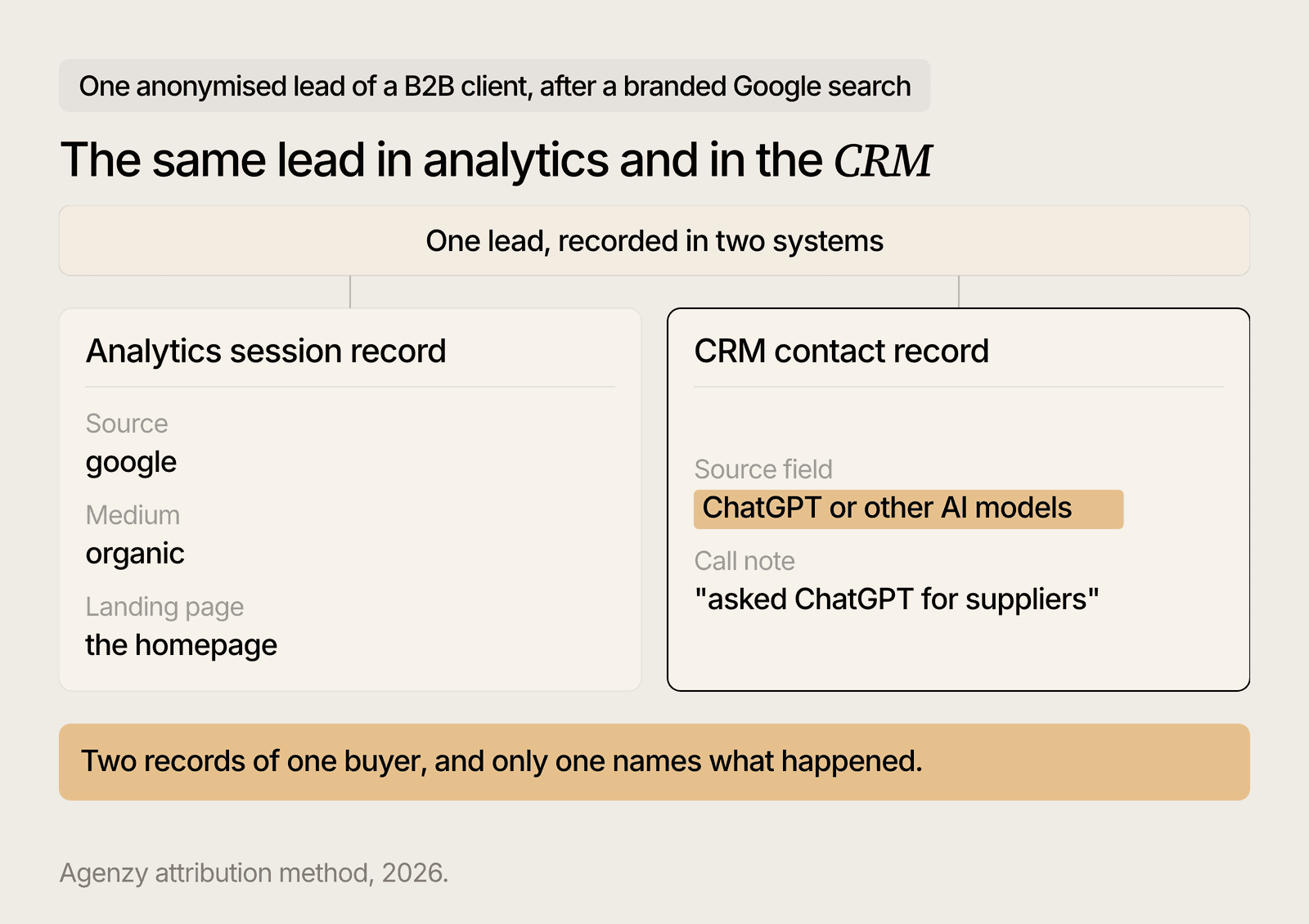
The gap is visible the moment both records sit next to each other. One lead of a B2B client reached the demo form after a branded Google search, so the analytics record reads google / organic. In the CRM, the source field on the same contact reads ChatGPT or other AI models, because that is what the person picked on the form and repeated on the call. Two records of one buyer, and only one of them names what happened.
Traffic from AI models
The first measurement is the traffic that does arrive with an AI model as its source. When a buyer clicks a link inside a ChatGPT, Gemini, Claude or Perplexity answer, the visit carries that model as the referrer, and analytics can group it.
We set that up in the client's own analytics in the first week of the engagement. In GA4 it is a custom channel group named AI Search, placed at the top of the channel order, matching the session source against this list:
The list is the referrer the browser sends, so it works without anyone tagging a link and without the AI models cooperating in any way. We add the same condition as a saved segment, because a new channel group applies going forward and reprocesses only a short window, while a segment reads the whole history and gives us a backdated baseline on day one.
From then on the client has a named line in their own reports showing sessions and users from AI models, how it moves month to month, which model sends them, which pages they land on, and what they do afterwards. On most clients this line starts small and grows steadily through the engagement, and the pages it grows on are the pages the AI models started citing.
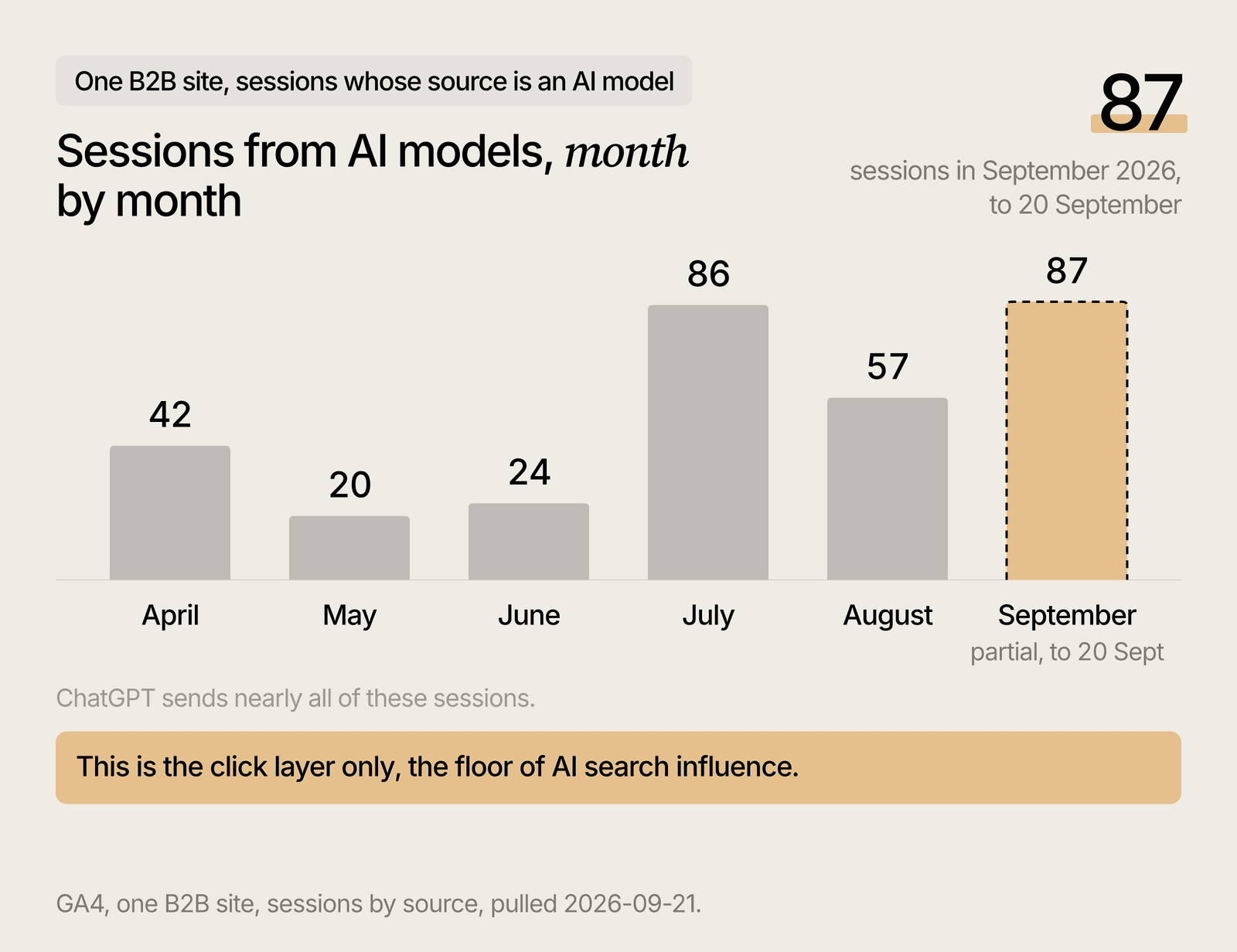
What this measurement cannot do is carry the business case on its own. Most AI answers end without a click, because the answer was the point, so the sessions it counts are the visible remainder of a much larger amount of influence. We report it as a floor, we never present it as the size of AI search for that business, and we do not make budget decisions from it alone.
One clarification, because it causes confusion in almost every onboarding. This is the traffic source recorded by analytics, taken from the referrer, and it is not a campaign tag. There is nothing to add to a link and nothing for the client's team to remember to do. Any link an AI model prints to the client's site is counted by the source it arrives with.
Visibility on the prompts buyers ask
The second measurement is what the AI models say when a buyer asks. Before any work starts we agree a set of the questions the client's buyers genuinely type, and our tracking runs that set every day across ChatGPT, Gemini, Claude, Perplexity and Google AI Overviews, storing every answer. Visibility is the share of those answers that name the client.
How the set is built decides what the number means, so it gets its own method and its own guide. The short version is that the prompts are reconstructed from four sources of real buyer language, tested by hand and then in a trial week, reviewed with the client, and frozen for the length of the engagement so the ruler does not change length while we measure with it. The full method is in how we build the prompt set we track for a client.
Two things about this measurement matter for the revenue question. It is recorded as a baseline before any work begins, with its dates, per AI model and per topic, so every later number has something fixed to be compared against. And it moves first. Visibility usually climbs a month or more before the leads follow, because the answers have to change before a buyer can act on them.
That lag is the reason we do not judge an engagement on revenue in month one. Visibility is the early indicator that the work is landing, traffic is the middle one, and revenue is the one that confirms it. When visibility is rising and revenue has not moved yet, the engagement is working and the buyers are still in the middle of their decision. When visibility is flat for a quarter, that is a problem with the work and we say so before the client has to ask.
The source the buyer reports
The third measurement is the one that produces the revenue number, and it works by asking the buyer directly at two separate moments.
The first touch point, the form or the checkout
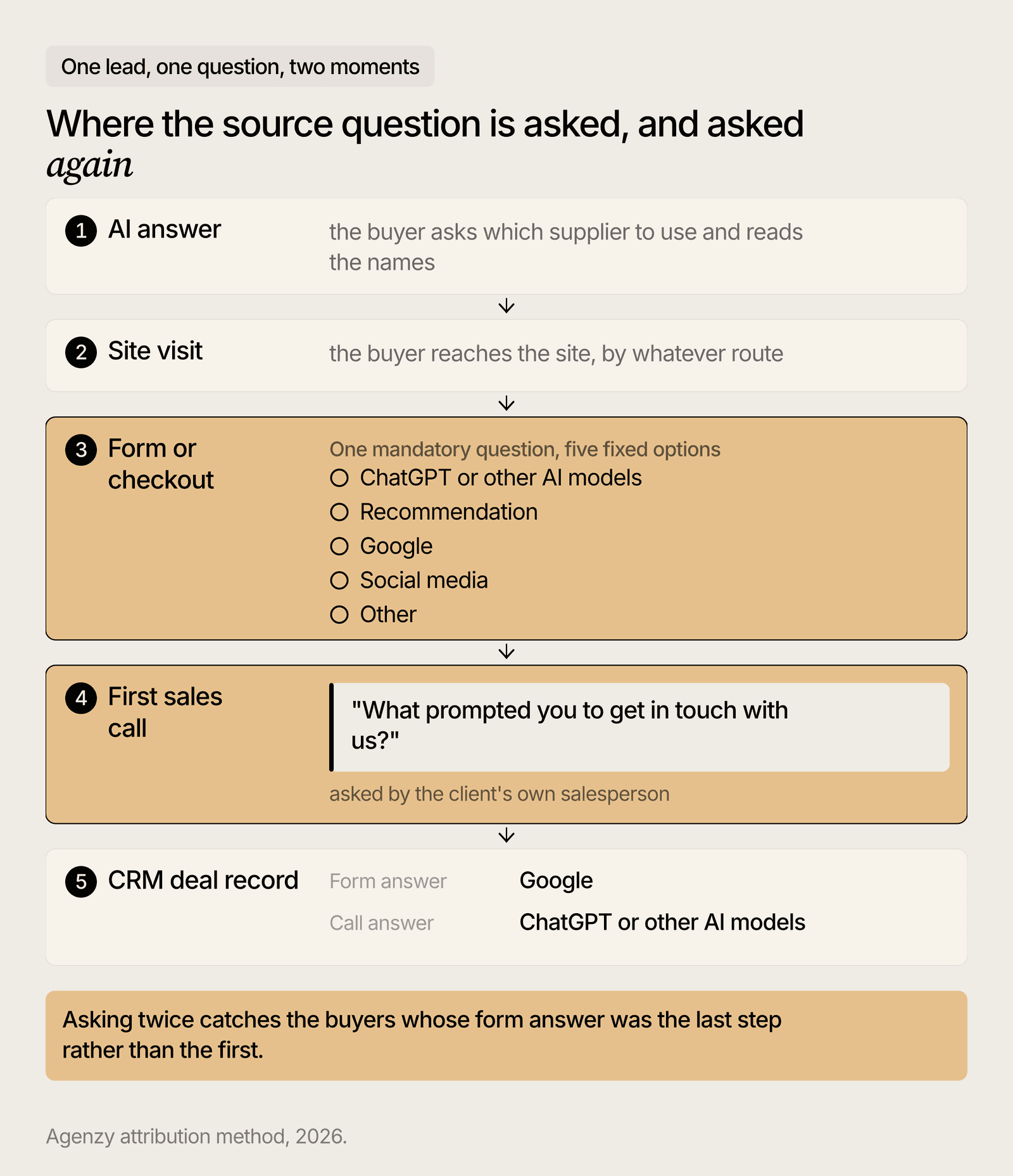
Every form that produces a lead gets one mandatory field, and so does the checkout on an e-commerce site. The question is how the buyer found the company, and the answer is a fixed list of five options:
ChatGPT or other AI models
Recommendation
Google
Social media
Other
The list is the same on every client, which is what makes results comparable across them, and the wording is frozen at launch so the series does not break halfway through a year. The field sits near the end of the form, after the fields that qualify the buyer, and it carries no helper text and no examples, because any example listed beside it becomes the most picked answer.
Almost everyone answers it. A person requesting a demo or an audit is already filling in six other fields and does not abandon the form over the seventh.
The second touch point, the question on the call
The same question is asked again on the first call, by the client's own salesperson, in their own words. What prompted you to get in touch with us. It takes ten seconds, and it is the most useful data point in the whole method.
It is more valuable than the form answer for two reasons. A person picking from a dropdown picks the option that is quickest to justify, and Google is always the quickest, because they did search Google at the end. A person answering a human tells the story, and the story usually starts earlier than the dropdown did. We regularly see a lead whose form answer says Google tell the salesperson that they asked ChatGPT first and used Google only to find the site again.
So the call answer is recorded in the CRM as its own field, and it is required before the deal can move past the first stage. No answer, no stage change. That rule is what keeps the data alive after month three, when the novelty has worn off and the sales team is busy.
Where the answers live
Both answers are written into the client's own CRM, on the contact and on the deal, in a source field we set up during onboarding. We connect to whichever CRM and analytics stack the client already runs, whether that is HubSpot, Pipedrive, Salesforce, a WooCommerce or Shopify back office, or a spreadsheet the sales team actually uses, and we integrate the attribution inside it. The client keeps the tools their team already knows, and nobody has to learn a second system to log a lead.
On top of that sits our own dashboard, which the client is connected to at onboarding. It reads the same fields and joins them to the visibility and traffic data, so the three measurements can be looked at together in one place instead of in three tabs.
When the three disagree
They disagree often, and the order of trust is fixed. The call answer outranks the form answer, and the form answer outranks analytics.
When the call or the form says an AI model and analytics says Google or Direct, it counts as AI search. That combination is the ordinary journey described above, and treating it as a Google lead is the error the whole method exists to correct.
When analytics says an AI model and the buyer never mentions one, the visit is counted as a touch and the deal is not attributed to AI search. Somebody clicked a link from an answer, and something else closed them.
When the call and the form disagree with each other, the call wins, and the salesperson's note is kept verbatim next to it.
Keeping the verbatim matters. "I asked ChatGPT for suppliers who do this in the Baltics and you were the only one it gave a reason for" tells the client what their buyers are asking and how the answer named them, which goes straight into the next month of work.
Lead value and revenue generated
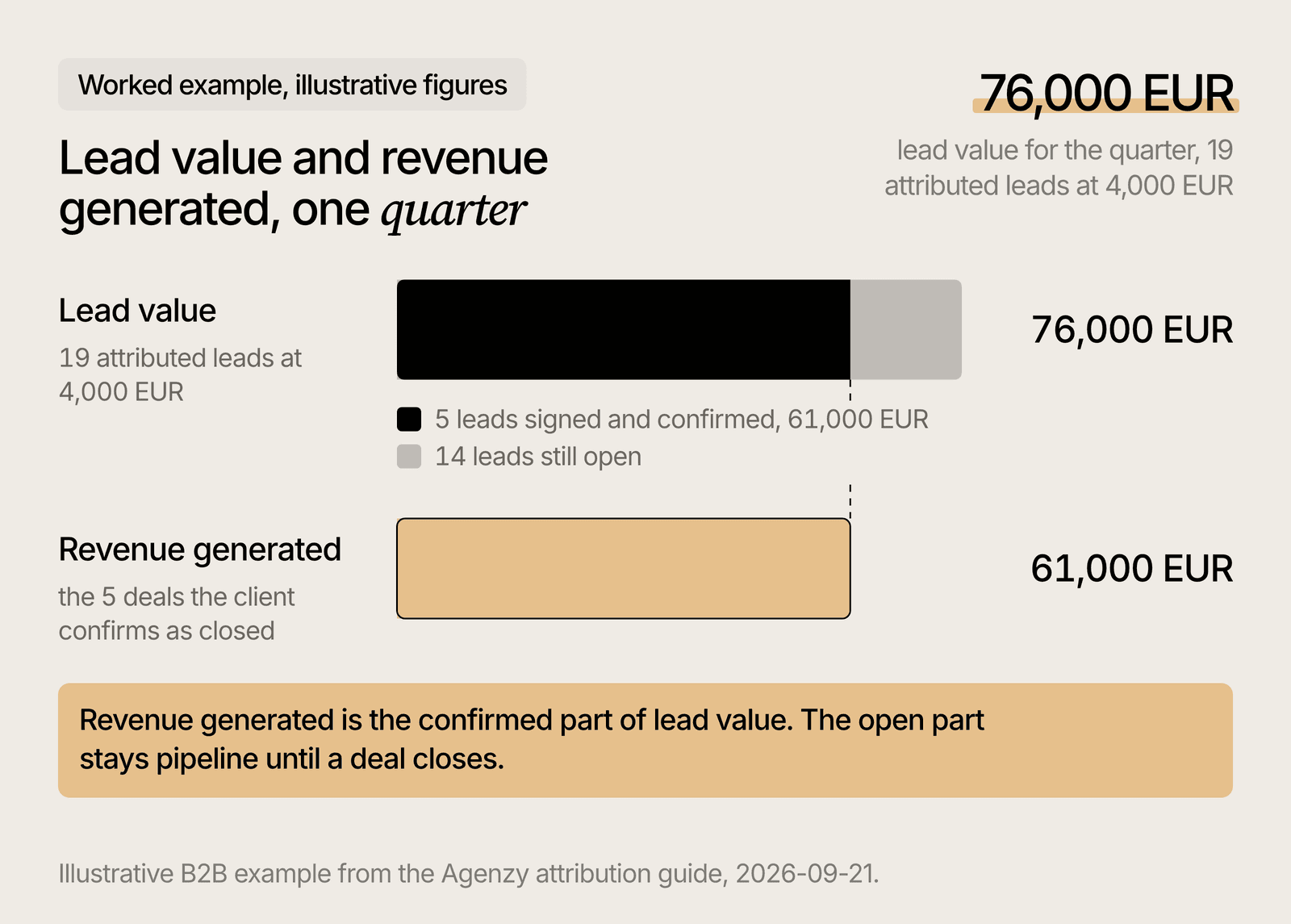
We report two money numbers and we keep them apart, because they answer different questions and mixing them is how attribution reports lose their credibility.
Lead value is the value of the leads that came through AI search after the engagement started, as the client values them in their own pipeline. Most B2B companies already have that figure, whether it is an average deal size, a pipeline value per qualified demo, or a number the sales director will stand behind. We use theirs and never invent one.
Revenue generated is what the client actually closed those leads for, as deal value or lifetime value, and only once the client confirms the deal is closed. It is the part of lead value that has been confirmed by money changing hands.
Four counting rules decide what enters each number.
Only leads that found the client through AI search, meaning the call answer or the form answer named an AI model, under the order of trust above.
Only leads that arrived after the engagement started. Anything already in the pipeline on day one stays out, however it closes.
Only deals the client confirms as closed. We do not read a stage change in a CRM as a signature, and we do not count a proposal as revenue.
Leads that have not converted stay in lead value and never move into revenue. When one of them closes later, it moves then.
A worked example, e-commerce
An online shop has the source question on the WooCommerce checkout, which every buyer answers before paying.
In one month the shop takes 1,240 orders. Of those, 1,240 carry an answer, because the field is mandatory at checkout. 96 buyers picked "ChatGPT or other AI models", which is 7.7% of orders, and those 96 orders are worth 18,400 EUR.
In e-commerce the two numbers collapse into one, because the lead and the sale are the same event. Revenue generated for the month is 18,400 EUR, it is checkable against the shop's own order list, and it appears in the monthly report as revenue from AI orders next to the order count and the share.
A worked example, B2B software
A software company has the field on its demo form and the question on the first sales call.
In a quarter it takes 46 demo requests. On the form, 14 picked "ChatGPT or other AI models". On the call, 19 named an AI model, including 6 who had picked Google on the form and then explained that they had asked ChatGPT first. Under the order of trust, 19 leads are attributed to AI search.
The company values a qualified demo at 4,000 EUR of pipeline, which they set themselves from their own close rate. Lead value for the quarter is 76,000 EUR.
By the end of the quarter, 5 of those 19 have signed, and the client confirms the contracts at 61,000 EUR. That is revenue generated. The other 14 stay in lead value, several are still in conversation, and any that close in the next quarter are counted in that quarter.
Deciding whether to continue
Three questions decide whether the work is worth its cost, and they are worth asking in this order.
Is visibility moving on the prompts that matter. This is the earliest signal and the one that tells you whether the work is landing at all. It is read per AI model and per topic, never as a single average, because an average of 11% can hide one model sitting at 3% where nothing we did has reached.
Are the leads appearing. Visibility that rises for a quarter without a single buyer naming an AI model means the prompts are being won in a part of the market that does not buy, and the prompt set or the topics need a hard look.
Is the revenue above the fee. This is the one the finance director asks, and it is the last of the three to answer, because deals take as long as they take. In nearly every engagement, the revenue closed from AI-attributed leads was above our fee within the contract term.
There is a limit on how fast the third question can be answered, and it is worth agreeing on before anyone starts counting. A revenue number needs enough attributed leads behind it to mean anything, and for most B2B clients that is roughly 30 to 50 attributed leads, which is one to two quarters of normal volume. Before that point the numbers are directional and we say so, with the denominator printed next to every percentage. Five of 22 leads is a sentence a client can check.
The case for stopping is as clear as the case for continuing. When visibility has not moved in a quarter, when the leads are not appearing behind visibility that did move, or when the revenue stays below the fee past the point where the sample is large enough to judge, that is a real result and the client should act on it. We would rather report that than keep a client on a channel that is not paying.
What you see every month
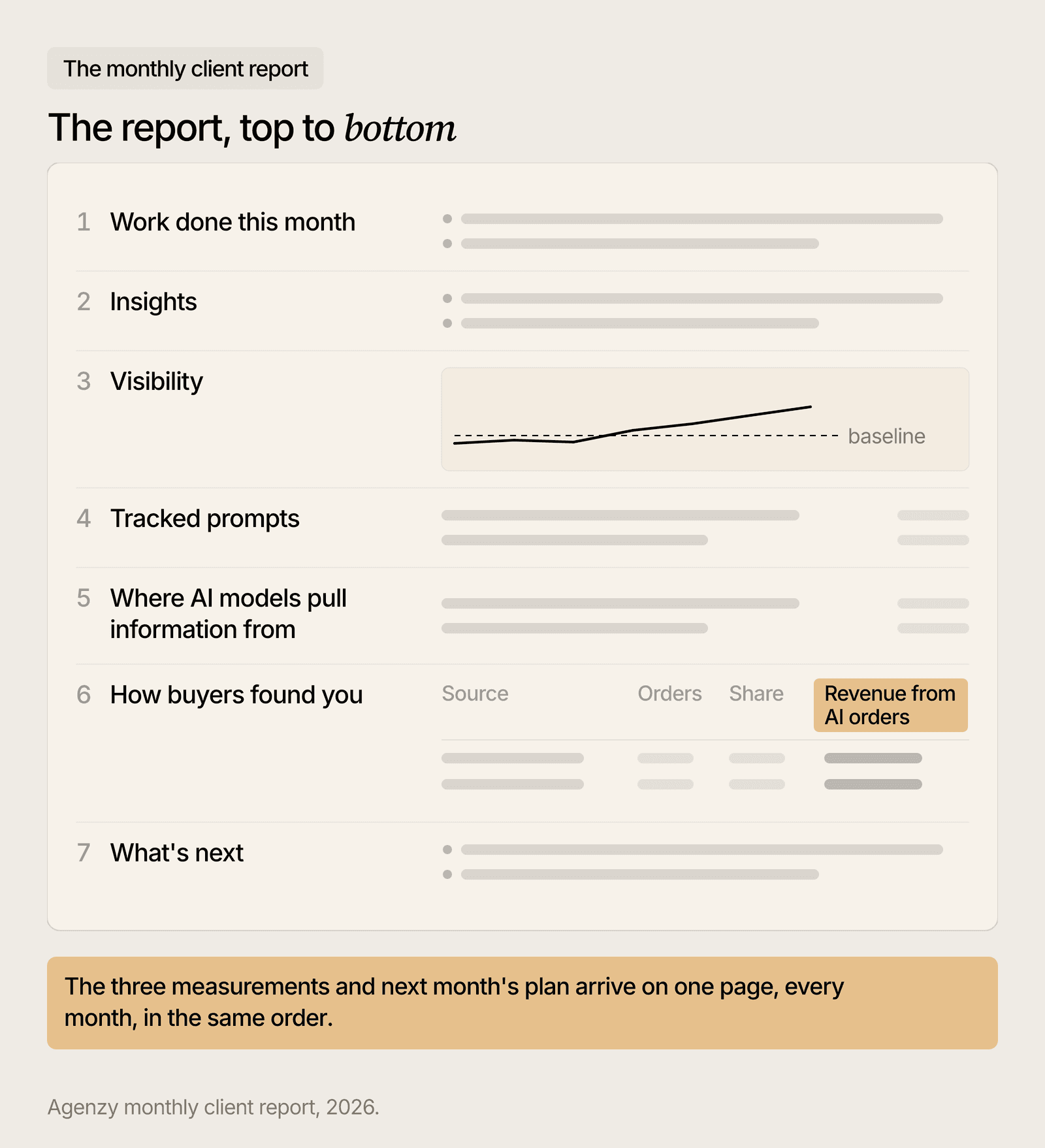
Every month the client gets a report and a live dashboard, built from the same three measurements and written so that somebody who was not in any of the calls can read it.
The report answers seven things.
Work done this month, meaning what we actually shipped, page by page and task by task.
Insights, meaning what the data shows that the client cannot see on the page in front of them.
Visibility, day by day and against the baseline, with the rank of the tracked brands and the change since tracking began.
Tracked prompts, every question in the set on its own, so the client can see which specific buyer questions moved and which did not.
Where AI models pull information from, which is the list of pages the models open while writing an answer and how often they cite them.
How buyers found you, which is the source question from the form or checkout with the order count, the share and the revenue from AI orders.
What's next, meaning the plan for the coming month, which part of the strategy it belongs to and which experiments are running.
Alongside the numbers, the report covers what changed in the answers themselves. When an AI model changes how it answers a category, or an update moves visibility across a whole market, the daily tracking catches it within days and the report says what we are doing about it. The same goes for the answers changing tone, wording or which competitors appear beside the client, because how the models describe the client is part of what we manage.
Two people run the account. An account executive manages the project, the reporting and everything the client has to sign off. A GEO specialist owns the strategy, the prompt set, the technical work and what gets built next. The client has both of them by name from the first week.
The method in one list
Agree the prompt set with the client, test it, freeze it, and record the visibility baseline with its dates before any work starts.
Create the AI Search channel group in the client's analytics using the source list above, and add the same condition as a segment for a backdated baseline.
Add the mandatory five option source question to every lead form and to the checkout, at the end of the form, with no examples beside it.
Add a source field to the client's own CRM and make it required before a deal leaves the first stage.
Agree the wording of the call question with the client's sales team and put it in their call opening.
Connect the client's CRM and analytics to our dashboard at onboarding, so the three measurements read together.
Record every lead against all three layers, keeping the buyer's verbatim answer next to the picked option.
Resolve disagreements in the fixed order, which is the call answer first, the form answer second, analytics third.
Count lead value from attributed leads that arrived after the engagement started, at the client's own valuation.
Count revenue generated only from deals the client confirms as closed, and leave everything unconverted in lead value.
Report all three measurements monthly, per AI model, with the denominator printed beside every percentage.
Judge the engagement on the three questions in order, and wait for 30 to 50 attributed leads before treating the revenue number as decisive.
Setting this up on your own site in a week
Every step here is one action, and each one names how you know it is finished. None of it needs an agency.
1. Create the AI Search channel group in analytics. In GA4, open Admin, then Data display, then Channel groups, and create a new group. Add a channel named AI Search at the top of the order, with the condition Source matches regex, and paste the source list from the traffic section above. Save it, then build one Exploration with a segment on the same condition so you can see the history. Finished when your reports show a channel named AI Search with sessions in it.
2. Add the source question to every form. Add one mandatory field at the end of each lead form, labelled how the person found you, with exactly these five options: ChatGPT or other AI models, Recommendation, Google, Social media, Other. Add no placeholder and no examples. Finished when every live form on your site has the field and a test submission stores the answer.
3. Add the same question to your checkout. On an e-commerce site, add the same mandatory field with the same five options to the checkout, and make sure the answer is saved on the order rather than only sent in the confirmation email. Finished when you can open last week's orders and read the answer on each one.
4. Add the call question to your sales script. Agree one sentence with your sales team, such as what prompted you to get in touch with us, and put it in the opening of the first call. Finished when every salesperson has the sentence written in front of them.
5. Add a source field to your CRM and make it required. Create one field on the contact or the deal, with the same five options plus a free-text box for the verbatim, and set the stage rule so a deal cannot move past the first stage while the field is empty. Finished when moving a test deal forward without the field filled is blocked.
6. Review the three layers once a month. Once a month, open the three together: sessions from the AI Search channel, the form and checkout answers, and the CRM source field on every deal that closed. Apply the order of trust, count lead value and revenue generated separately, and write both down with the denominator. Finished when you have one page per month holding those numbers and you can compare it to the previous one.
Questions we get asked about this
Is self-reported data reliable enough to run a business on?
On its own it has two known faults and we treat them as known. People under-report the first source and over-report the last one, which is why the form answer alone reads too favourably toward Google. Asking twice, once in the form and once by a human, corrects most of that, and the call answer has consistently been the closest to what actually happened. It is the best instrument available for a channel where most of the influence produces no click at all.
Why not just look at Google Analytics?
Analytics is one of the three measurements and we set it up on every client, so nobody is ignoring it. It records what it can see, which is the visits that arrive with an AI model as their referrer, and it has no way to see a buyer who read an answer, clicked nothing and came back through a branded Google search a week later. Used alone it reports that journey as Google, which understates AI search and overstates organic search at the same time.
How do you know the sale would not have happened anyway?
For a specific deal, we do not, and no attribution method for any channel can tell you that. What the data supports is narrower and still useful: this buyer says they found the company through an AI model, that buyer did not exist in the pipeline before the engagement started, and the count of buyers saying it moves with the visibility work. When we want a causal read on a particular intervention we run it as a controlled test with a holdout, measured separately, and we report it as a test rather than folding it into the revenue number.
What if our sales team forgets to ask?
This is the most common failure and it has a mechanical fix. The CRM field is required before the deal can leave the first stage, so a deal with no answer cannot move, and the gap surfaces the same week instead of at the end of the quarter. In practice the question becomes automatic after a few weeks, because the salespeople find the answers useful in the conversation itself.
How long before the revenue number means anything?
Count leads rather than weeks. For most B2B clients the number becomes decisive at roughly 30 to 50 attributed leads, which is one to two quarters at normal volume, and faster for e-commerce because the checkout asks every buyer. Before that point we report it with the denominator visible and treat it as directional, and we set that expectation in writing in the first month so nobody expects a clean read in week two.
Do you count leads that also saw you on Google?
Almost every AI-attributed lead also saw the client on Google, because that is how the journey ends, so excluding them would empty the count. The question we answer is which channel produced the shortlist, and the buyer answers it. When the buyer says an AI model gave them the name and Google only helped them find the site again, it is counted as AI search. When the buyer says they found the company by searching, it is counted as Google, even where analytics recorded an AI referral earlier in the week.