Answer engine optimization (AEO), spelled optimisation in the UK, is the work of writing and structuring your pages so an AI answer engine can lift a clear answer from them and name your brand as the source. An answer engine is a tool like ChatGPT, Google AI Overviews or Perplexity that reads web pages and writes one answer. AEO is part of the larger job called generative engine optimization (GEO). It matters to any business whose buyers ask an AI for a recommendation.
GEO and AI SEO are two names for the whole job, and AEO names the content and citation part of it.
What an answer engine is, in plain words
An answer engine is a search tool that reads the pages it finds and writes one answer, with a short list of sources under it. ChatGPT, Google AI Overviews, Perplexity, Gemini and Copilot all work this way.
Picture a librarian who has read every book in the room. You ask her a question. She reads out one paragraph from the two or three books she trusts, and she says which books they came from.
The list she reads from is short, so most pages get read and then skipped.
Agenzy calls all of this work GEO, and the whole job is laid out on our GEO explainer.
How answer engine optimization works
Answer engine optimization works by handing the engine a passage it can use as the answer, on a page its bots can reach. An engine moves through four stages.
Searching. It turns the question into several searches of its own.
Collecting. It gathers pages and cuts them into passages of a few hundred words.
Scoring. It rates every passage against the exact question and keeps the winners.
Writing. It builds one answer from the winners and credits some of them.
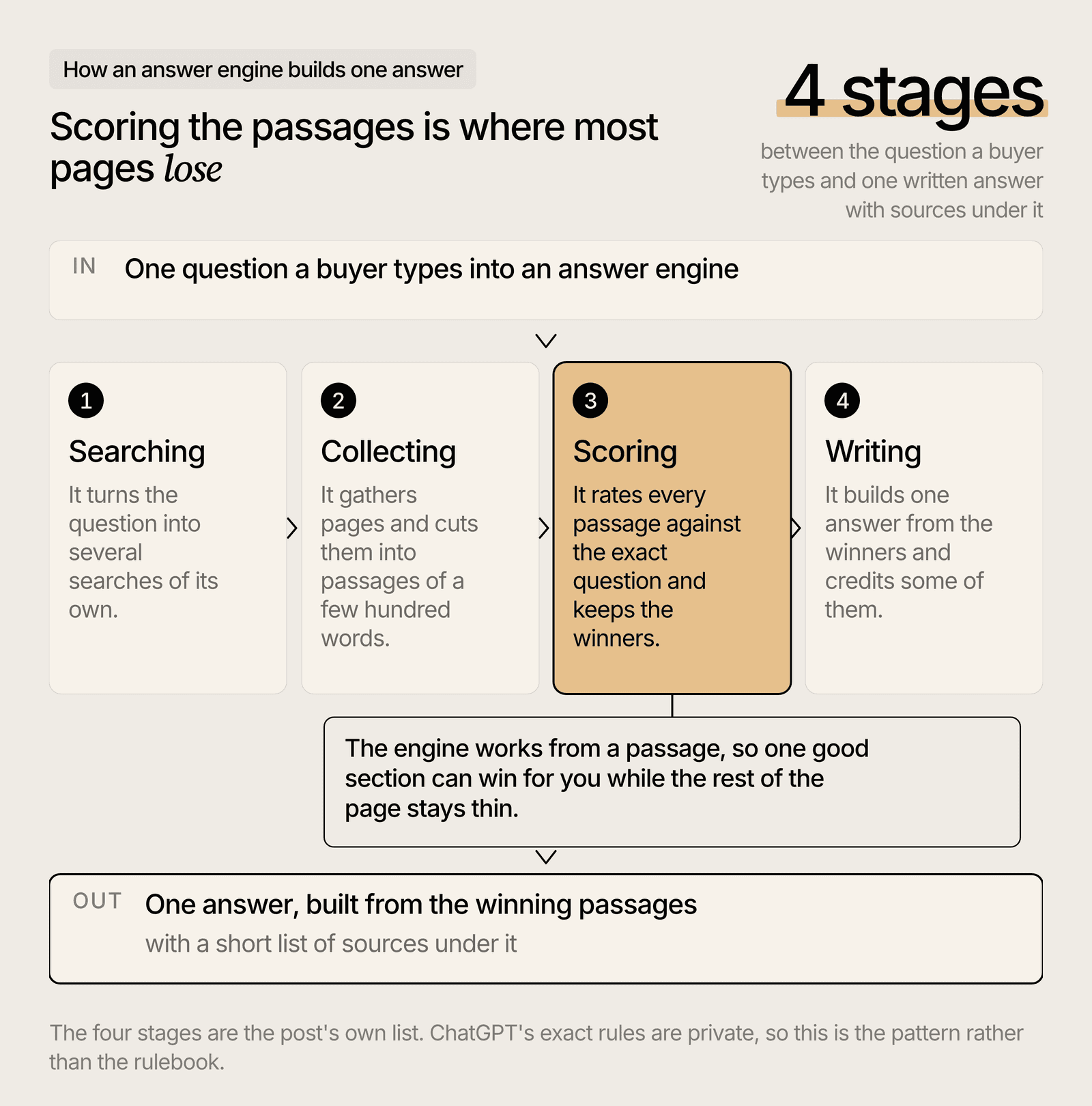
Scoring the passages is where most pages lose, and there is a measurement for it. A public test in August 2026, by Metehan Yesilyurt on the Peec AI blog, ran the buying question "what are the best aeo tools" through six scoring systems of the kind AI engines use to pick passages. A product description scored near zero; a sentence that named the tools and answered the question directly scored near the top on every one.
ChatGPT's exact rules are private, so treat this as the pattern rather than the rulebook.
The engine works from a passage, so one good section can win for you while the rest of the page stays thin. The cheapest useful edit is therefore one sentence: open the section with a direct answer to the question it targets, then add the criteria, the names and the evidence.
How a brand gets cited: one question, drawn out
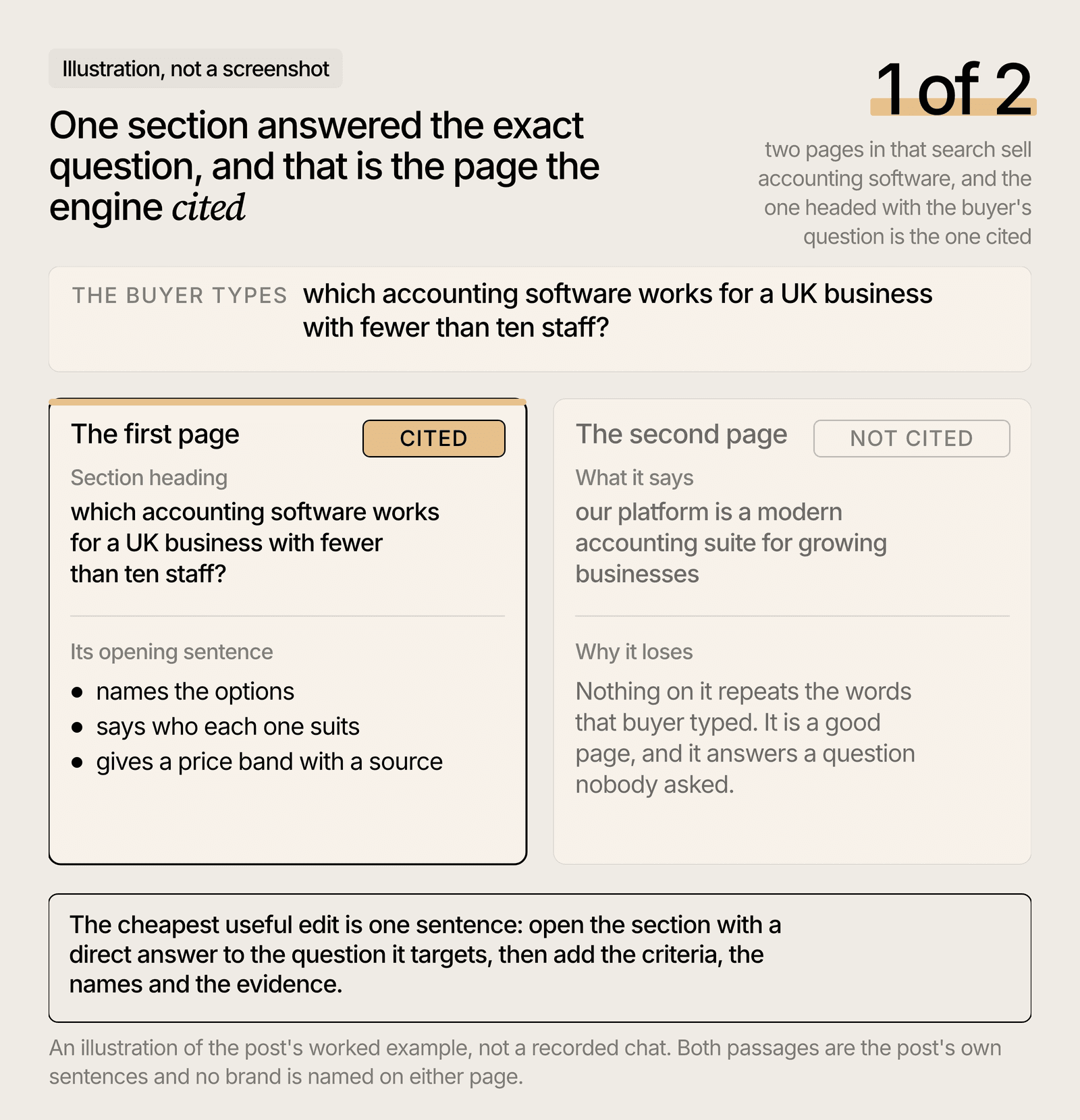
You get cited when one section of your page answers the buyer's exact question in its first two lines. The question and the two pages below are our illustration of how the scoring works.
Take a finance manager who types: which accounting software works for a UK business with fewer than ten staff? The engine reads what it finds and comes back with a few product names and a short list of sources. Two pages in that search sell accounting software. The first has a section headed with that exact question, and its opening sentence names the options, says who each one suits and gives a price band with a source.
The second page says: our platform is a modern accounting suite for growing businesses. Nothing on it repeats the words that buyer typed. It is a good page, and it answers a question nobody asked.
A post we wrote for one client took a set of buyer questions from 0% to 24% of the answers to those questions, within three weeks of going live. That is one anonymised client, published in our case studies.
Is AEO the same as GEO?
AEO and GEO describe the same work, and GEO is the wider word. GEO runs as four steps, from the bottom up.
Open the door. The AI companies' bots can reach and read your site.
Give them something worth citing, on your site and on the sites the engines trust.
Watch what gets cited, page by page and question by question.
Count the recommendations, meaning how often the engines name your brand.
AEO, as most of the market uses the word, covers step two on your own site and the citation counting in step three: writing and structuring pages so an answer can be lifted straight out of them, then watching which of your pages get cited. GEO adds the door, the off-site half of step two, and the count of recommendations.
The gap shows up in contracts. A page can carry the best answer on the internet and still never be read, because the server turned the bot away at the door, and nothing in the writing half of the job would tell you that. We work all four steps as one programme.
AEO vs SEO vs GEO
The difference between SEO, AEO and GEO is what each one tries to win: a place in Google, the sentence an engine reads out, or both plus how often you get recommended. The table sets the three names against four questions a buyer has to answer, and the Princeton study it points to is the academic GEO paper covered further down.
The question | Classic SEO | AEO (answer engine optimization) | GEO (generative engine optimization) |
|---|---|---|---|
What you are trying to win | A place in the list of blue links | The sentence the engine reads out, with your name on the source line | That sentence, plus how often the engines recommend you by name |
What wins it | Pages matching what people search for, and links from other sites | A passage answering the exact question in its first two lines, with sources in it | The same passages, plus a site the bots can read and third-party pages engines trust |
How you know it worked | Position for a keyword, and clicks from Google | Citations of your pages, and the share of answers naming you | Both, plus sentiment and leads from AI channels |
What backfires | Keyword stuffing, meaning a page padded with one phrase, punished by Google for years | Keyword stuffing again, which scored worse than the untouched page in the Princeton study | The same, plus good pages behind a blocked crawler |
The difference for a buyer comes down to scope. AEO is sold as the content and citation half, while GEO covers the technical work and the measurement as well. A third name, AI SEO, means the same job and carries the most search volume of the three.
What AEO is measured by
AEO is measured by citations and answer share.
Citations count how often an engine used one of your pages as a source in an answer. You read them per page and per question, because one page usually carries most of them.
Answer share is the share of answers to your buyer questions that name your brand at all. You read it per engine, because a brand can sit high in ChatGPT and be invisible in Google AI Overviews. Tracking tools, including the one we use, call this same number visibility.
A page can be read by an engine and never credited in the answer. AirOps looked at more than half a million pages that AI engines retrieved, and Kevin Indig's Growth Memo reported the result: 85% of them were never cited. Retrieval means the engine read your page, so count citations instead. Our own study of which sources AI engines cite shows where those citations land.
Both numbers wobble on their own. Ask an engine the same question twice and the answer changes, so a single reading tells you almost nothing. The questions are run on a schedule and read as a four-week trend per engine, and that daily measurement has its own name, prompt tracking.
When AEO is not worth doing
AEO is worth skipping when buyers in your category do not ask an engine for the answer, or when nobody on your side can act on what the measurement returns.
Some categories have no single answer to cite, and sofas, fashion, art and restaurants are the clearest of them. Ask an engine which sofa to buy and it hands back categories, marketplaces and a shrug, because taste has no correct answer.
If you sell only through a marketplace, you have no site of your own to change, so there is nothing to open to the bots and nothing to write. The work that matters sits on the listing and on third-party pages the engines already read.
AEO is page work, so a team that cannot publish or change a page for the next six months will pay for measurement and watch a flat line.
What the research says
Evidence on the page is what wins you more of an AI answer, and one controlled test measured how much. "GEO: Generative Engine Optimization", the KDD 2024 paper by Aggarwal et al. of IIT Delhi and Princeton that gave the field its name, rewrote the same pages in nine ways and measured how much of the answer each version won.
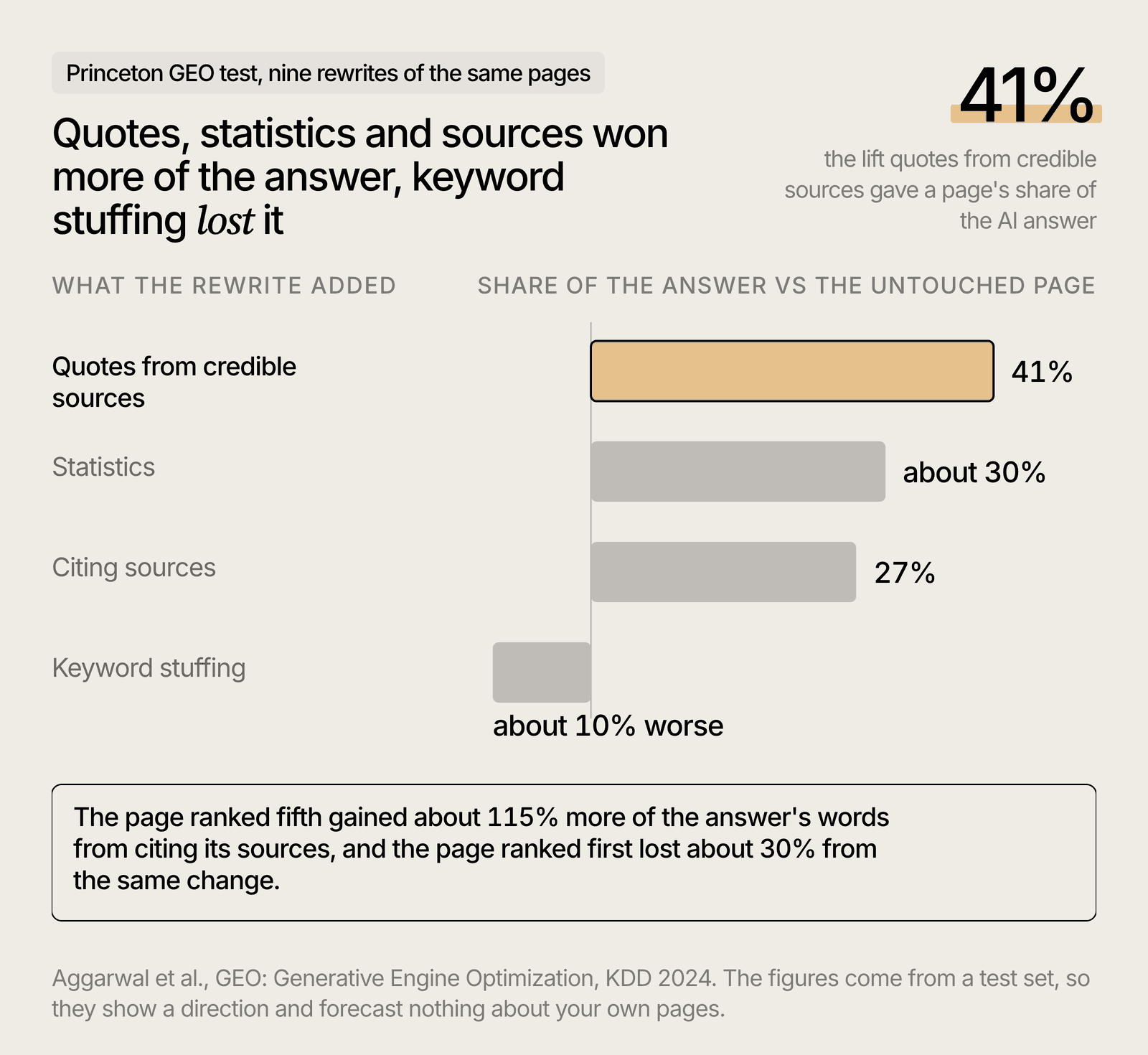
Quotes from credible sources raised a page's share of the answer by 41%, statistics by about 30% and citing sources by 27%. Clearer writing helped too. A persuasive, authoritative tone barely moved anything, and keyword stuffing scored worse than leaving the page alone, about 10% worse on Perplexity.
The gain went to the pages Google ranked lower. The page ranked fifth gained about 115% more of the answer's words from citing its sources, and the page ranked first lost about 30% from the same change. Smaller sites have a way in here, and the leader has to hold its place with better evidence.
The work is from 2023 and 2024, and it ran on a model of that time. Its authors say the methods will have to change as the engines change, and the figures come from a test set, so they show a direction and forecast nothing about your own pages.
Where to start with AEO
Start with the door, then the measurement, then the writing. Measurement comes before writing in an AEO order, because AEO is judged on citations, and a page rewritten before anyone counted the old citations can never be shown to have earned the new ones.
Check that the bots can reach you. Read your robots.txt, the file that tells crawlers where to go, then ask whoever runs your server or the service that delivers your pages whether the AI crawlers are turned away. Plenty of setups block them by default and nobody in marketing hears about it.
Measure from day one. Pick ten questions your buyers ask, run them on each engine every day, and record whether you are named and which page was credited. Ten is the manual first look you can run yourself. A tracked set that produces a trend starts at fifty. Without a starting number, later numbers mean nothing.
Write the answers. Give each question its own section, answer it in the opening two lines, and put a number, a quote or a source inside that answer.
Agenzy works in the same order. Bot access and the measurement setup are our month one, content starts in month two, and we go through the movement with you in month three. Our GEO service runs all four steps as one programme.
Book a free 30 min call and we'll show you where you appear in AI answers today.
Questions people ask about AEO
Is AEO the same as GEO?
AEO is the content half of GEO, and GEO covers the whole job. A vendor selling AEO usually sells writing and citation tracking, while GEO should also cover crawler access and the count of recommendations. Ask which of the four steps a contract includes. All four sit on our GEO explainer.
Is AEO only about Google AI Overviews?
AEO applies to every answer engine, including ChatGPT, Perplexity, Gemini, Copilot and Google AI Overviews. The term grew up around Google, first with featured snippets and later with AI Overviews, which is why people connect the two. One engine can cite your page most weeks while another has never named you, so results are read engine by engine. Google's surface is covered in what AIO means.
Do FAQ pages still work for AEO?
FAQ pages still work for AEO when each answer stands alone and carries something checkable. Use the question a buyer would type as the heading, answer it in the opening two lines, and put a number or a source inside the answer. The same shape works inside an ordinary page, so a separate FAQ page is optional.
What does AEO work cost?
Agenzy's GEO work, which covers everything the market calls AEO, starts from 5,000 EUR per month ex VAT. What moves the figure is how many markets and languages you sell in, how many buyer questions we track and how much content we publish. Published agency prices sit in our GEO agency cost guide.
Does schema markup help with AEO?
Schema markup helps engines read your page, and it does not by itself earn citations. Ahrefs compared nearly 2,000 pages that added JSON-LD, the code that labels what is on a page, with a matched control group. It found no lift in ChatGPT or AI Mode and a small drop in Google AI Overviews. Google itself says structured data is not required for its AI features.
How do I know if AI engines are citing my website?
You find out whether AI engines cite your website by asking them the same buyer questions on a schedule and recording the answers. Type five of those questions into ChatGPT and Perplexity today, in a logged-out session so your own chat history does not colour the result. For a trend you need them run daily across engines, which is prompt tracking.
About Agenzy
Agenzy is a GEO agency based in Vilnius, working with brands in the US, the UK and across Europe. We get brands named and recommended inside ChatGPT, Gemini, Google AI Overviews, Perplexity, Claude and Copilot. We are an official Peec AI partner. As of September 2026: 500,000+ AI chats analysed, 15,000+ prompts tracked, 150+ audits completed, 1,000,000+ EUR generated for clients by AI search. Dated cases sit at agenzy.lt/case-studies.