AI SEO is the work of getting your business named and cited in answers written by AI assistants. ChatGPT, Google AI Overviews, Gemini and Perplexity write those answers. AI SEO is another name for generative engine optimization, or GEO, the term we use for all of this work. It matters to any business whose buyers now ask an assistant for a recommendation before they open a single website.
What AI SEO means in plain words
AI SEO means building and writing your website so an AI assistant can reach it, read it, and name your brand when a buyer asks what to buy.
Classic search engine optimization put your product on the right shelf in a very large shop. The buyer still walked the aisle and chose something. AI SEO works on the shop assistant. A person walks in, asks what they should buy, and the assistant says three names out loud. Your job is to be one of those three.
How does AI SEO work?
AI SEO works in four steps. The first two are the work you do on your website, and the last two tell you whether it paid off.
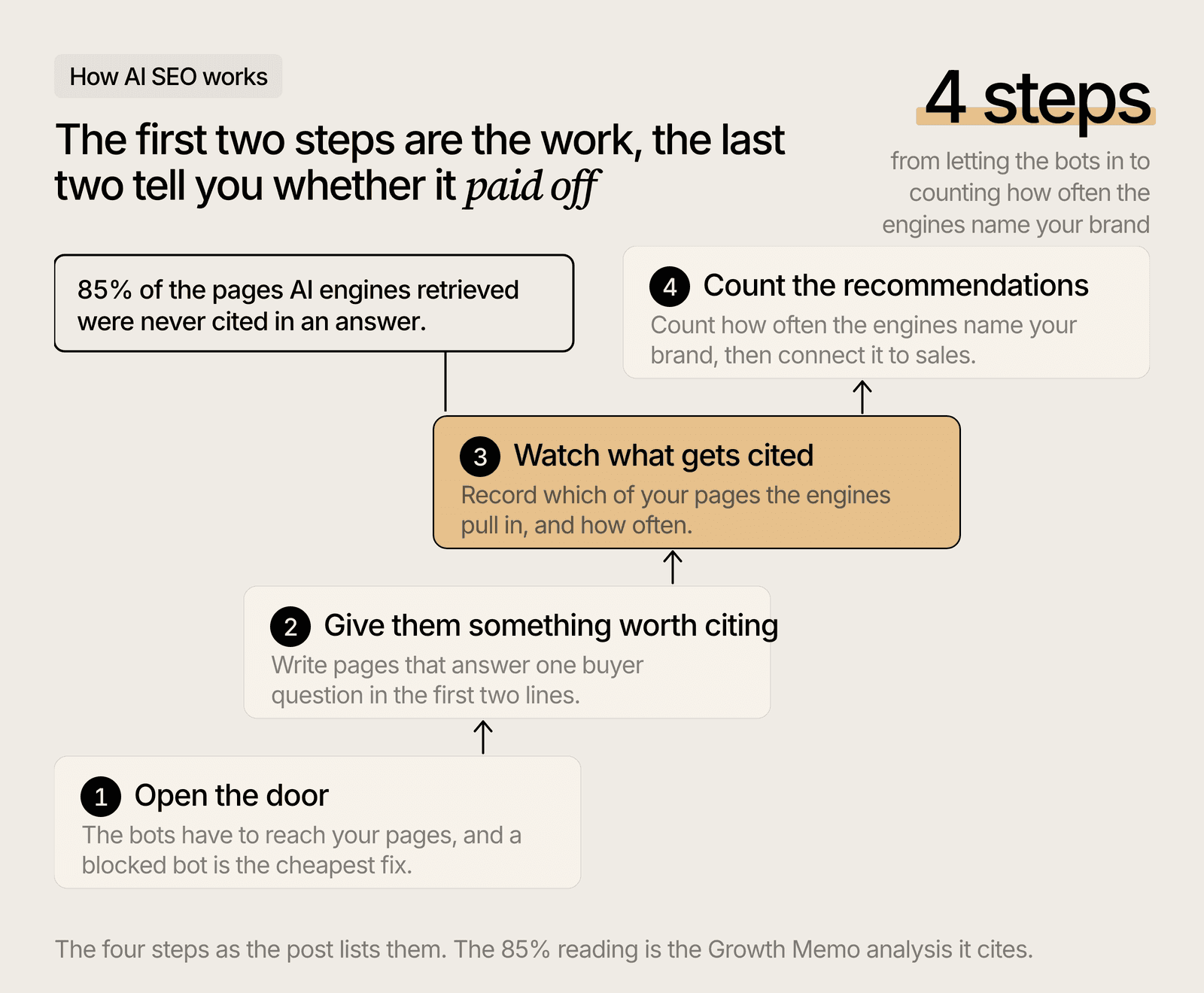
Open the door. The AI companies send bots out to read the web, and those bots have to reach your pages. A blocked bot is the first thing we check when a brand never shows up in an answer, because it is the cheapest fix.
Give them something worth citing, on your site and on the sites the engines trust. Write pages that answer one buyer question directly, in the first two lines, and back the answer with facts, numbers, quotes and named sources. Keep the answer near the top, because material at the bottom of a page is almost never the part that gets quoted (Kevin Indig, Growth Memo). Engines also lean on review sites, directories and forums, so being named on those pages is part of the same step.
Watch what gets cited. Record which of your pages the engines pull in, for which questions, and how often. An engine reads many pages and quotes a few: 85% of the pages AI engines retrieved were never cited in an answer, in the same Growth Memo piece.
Count the recommendations. Count how often the engines name your brand, for which buyer questions, and in what context. Then connect that to leads and sales. This half of the job has its own page: what prompt tracking is.
A worked illustration: what the buyer sees
What you get from AI SEO is one sentence in the answer, and the buyer reads that answer before visiting anyone's website.
A buyer types a question like this into ChatGPT: "Which time tracking tool works best for a 20-person design studio in Europe?" The assistant comes back with three named tools, one line of reasoning each, and small source links under the text.
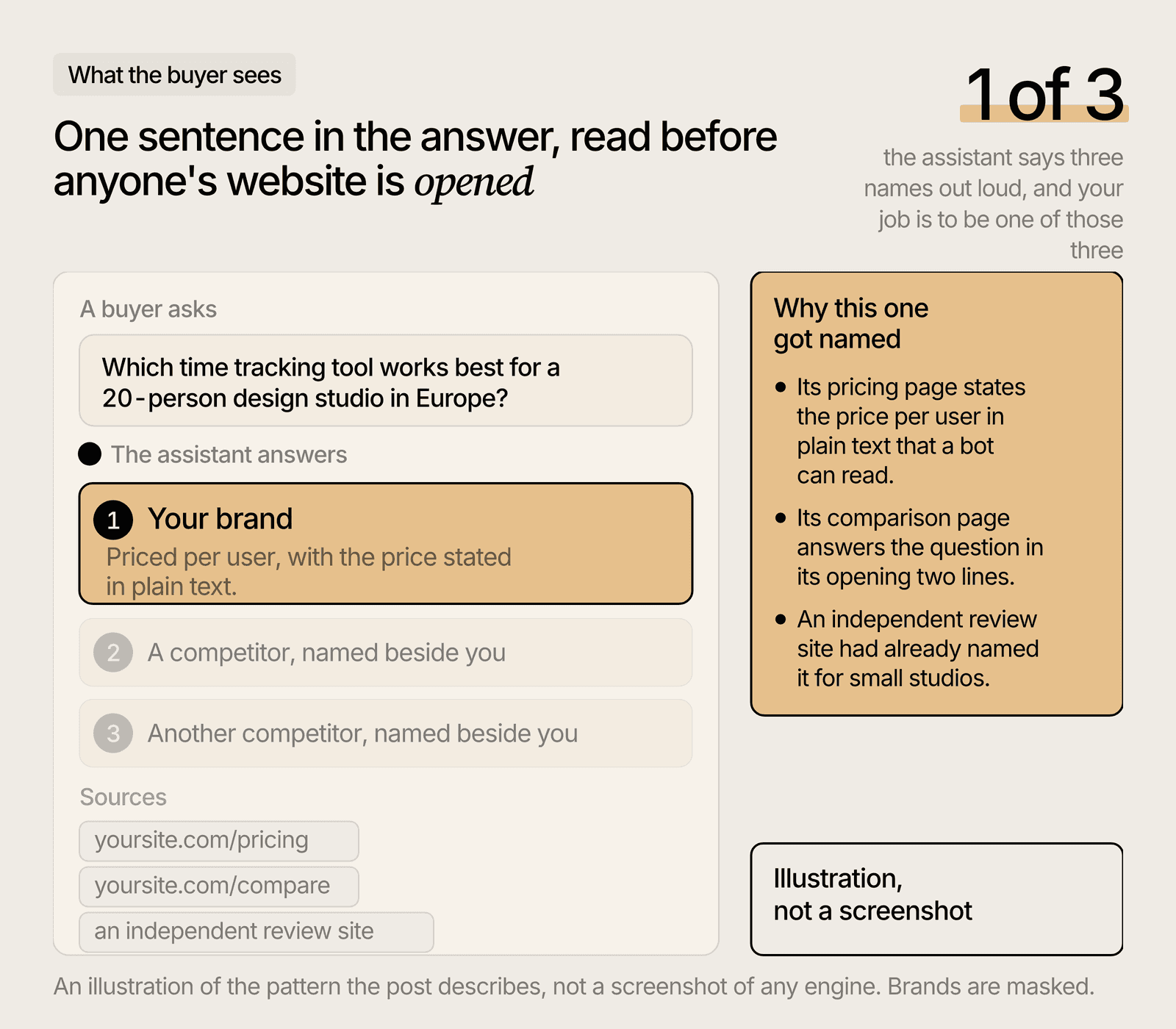
This is not a screenshot. It follows the pattern we see in the answers we track.
Why did one of those three get named? Its pricing page states the price per user in plain text that a bot can read. Its comparison page answers the question in its opening two lines. An independent review site had already named it for small studios, so two different sources agreed.
How is AI SEO different from traditional SEO?
Four things change when you move from traditional SEO to AI SEO, and one large thing stays: ranking well in normal search still feeds the AI answers.
The table below compares the two on the four things that decide what you work on in a given week. Both columns describe the same website. The last row mentions keyword stuffing, the old trick of repeating a search term over and over on a page.
What you are working on | Classic SEO | AI SEO |
|---|---|---|
What gets picked | The whole page competes for a place in a list of ten links | Your page contributes one passage, lifted out and quoted inside a written answer |
What wins | Keywords matched to the search, plus links pointing at the page | A direct answer in the opening lines, backed by facts, numbers, quotes and named sources |
How you measure it | Your position in the results list, and clicks to the site | The share of answers that name your brand, and which of your pages the engines cite |
What backfires | Keyword stuffing gets ignored or penalized | Stuffing keywords scored worse than leaving the page alone |
The search work behind your Google rankings keeps paying while you do this. Pages ranked first in Google were cited by ChatGPT 43.2% of the time, against 12.3% for pages beyond the twentieth result. Those readings come from the same Growth Memo analysis of AirOps data.
How is AI SEO measured?
AI SEO is measured by how often an AI answer names your brand, and by which of your pages the engines cite.
Visibility is the share of AI answers to your tracked buyer questions that name your brand, counted per engine and per day. The GEO explainer runs that percentage through with an example.
A citation is one link to one of your pages placed inside an AI answer. Counting citations tells you which page is doing the work and which buyer question it won.
Ask an assistant the same question tomorrow and the wording will differ, and sometimes a brand drops out. So the tool asks the questions every day and keeps several weeks of answers.
What counts as a good number depends on your category. Judge it against the brands the engines name beside you, and against your own number four weeks ago.
Whoever runs your tracking tool reads both numbers per engine, or we do, because ChatGPT, Gemini and Google AI Overviews draw on different sources.
When is AI SEO not worth doing?
AI SEO is not worth starting when your site cannot be read or changed, and we would rather say so early than take the money. If your pages only appear after JavaScript runs, the bots see very little. JavaScript is the code that builds parts of a page inside the visitor's browser, and GPTBot, ClaudeBot and PerplexityBot do not run it, as Vercel measured on its own network. Where bot access is blocked and nobody on your side can change the server settings, fixing that comes before any writing.
The old keyword habit is the second trap this name attracts. A page padded with one search term scored below the untouched version of itself in the Princeton test, so the reflex that once won rankings now costs you answer share.
The other reasons to wait, a category whose buyers never ask an assistant and a budget shorter than six months, sit on the GEO explainer.
What the research says about AI SEO
Changing what sits on a page changes how much of an AI answer comes from it, and that has been tested in a peer-reviewed study. It is the paper that gave GEO its name, from researchers at IIT Delhi and Princeton (Aggarwal et al., KDD 2024).
The researchers rewrote pages in nine different ways, then measured how much of the written answer came from each page and how high up it sat. They call the thing you are optimizing for a generative engine: a search engine with a language model attached. It runs searches, reads the pages it finds, and writes one answer with citations.
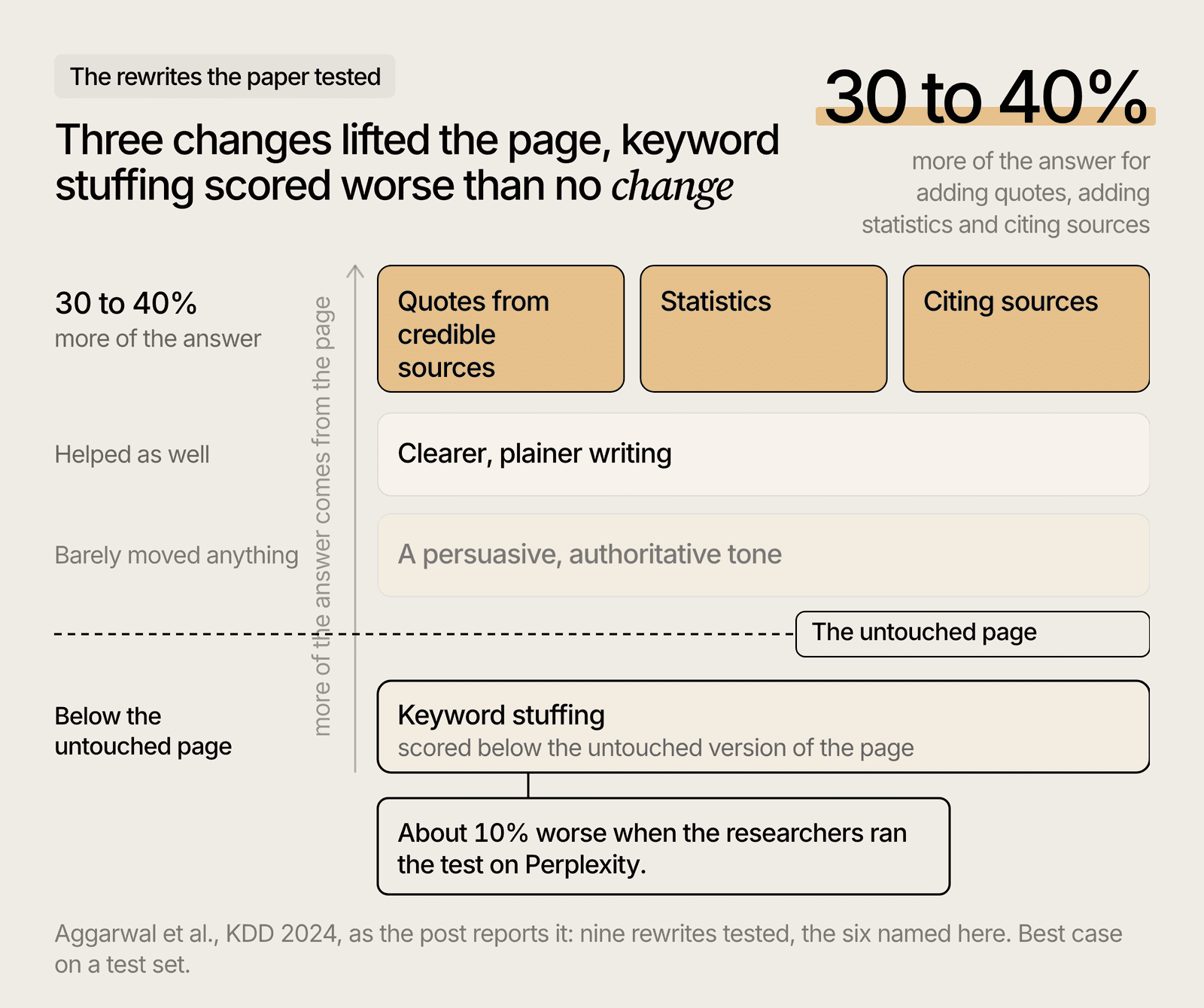
Three changes gave a page 30 to 40% more of the answer on that test set: adding quotes from credible sources, adding statistics, and citing sources. Clearer, plainer writing helped as well. A persuasive, authoritative tone barely moved anything.
Keyword stuffing scored below the untouched version of the page, and about 10% worse when the researchers ran the test on Perplexity.
The most useful finding is about who gains. The page Google ranked fifth gained 115% more of the answer's words from citing its sources, while the page already sitting first lost about 30% (the paper's Table 2).
Those numbers come with limits. The work is from 2023 and 2024, and it ran on a model of that time. Its authors say the methods will have to change as the engines change, and those gains are a best case on a test set, never a promise about your website.
How do I start with AI SEO?
To get your business named in ChatGPT answers, start with the questions your buyers actually ask. Pick ten of them, in the words they use and with no brand name in them, run each one through ChatGPT and Gemini today, and write down who gets named. Ten questions run by hand is the manual first look; a tracked set that produces a trend starts at fifty. That first record is your starting number, and without it nothing you do later can be proven.
Then write or fix one page per question, with the answer in the first two lines. Our guide to ranking in ChatGPT answers covers how those pages are built, and the full order of work, starting with bot access, is on the GEO explainer.
The full program, from bot access to monthly reporting, sits on our GEO service page.
Book a free 30 min call and we'll show you where you appear in AI answers today.
Questions people ask about AI SEO
Is AI SEO the same as GEO?
AI SEO and GEO describe the same job: getting your brand named and cited in AI answers. The words are not settled, and the academic literature has no agreed definition. Google's own documentation says that "optimizing for generative AI search is optimizing for the search experience, and thus still SEO". You will also meet AEO and AIO; ask any vendor which part of the work their word covers.
Do I still need normal SEO if I do AI SEO?
Yes, and the two feed each other. Pages holding the top of Google's results are quoted by ChatGPT several times more often than pages sitting past the twentieth result. That comes from the same Growth Memo analysis of AirOps data cited earlier in this post. Strong classic rankings make your pages far likelier to be quoted, so AI SEO sits on top of the search work you already do.
Does ChatGPT use Google to find pages?
No. ChatGPT search leans heavily on Bing's index, then fetches the pages itself. A February 2025 Seer Interactive study of about 500 citations across about 100 queries found that 87% of ChatGPT search citations matched Bing's top results, against 56% for Google. Check how your pages look in Bing as well as in Google. OpenAI is building its own index, so treat this as a shifting picture.
What does AI SEO cost?
Agenzy works from 5,000 EUR per month ex VAT. Across the market the range is wide and published prices are few, which we broke down in what a GEO agency costs in 2026. What you buy at any price is the same four steps: bot access, pages and off-site mentions worth citing, tracking of what gets cited, and a count of how often the engines recommend you.
How long does AI SEO take to show results?
Month one goes on instrumentation: the list of buyer questions, the starting measurement, and the technical fixes that let bots read your site. Content starts in month two, and we review the movement with you in month three. Tracking those movements is what prompt tracking does. Nobody can promise a position, because no agency controls how a model writes its answer.
Will AI SEO replace SEO?
No, and Google's own published position is that optimizing for AI search is still SEO. Google AI Overviews sit directly on the Google results page, so one page can earn a classic ranking and a quote in an AI answer on the same screen. Treat AI SEO as a second scoreboard beside the old one, with its own measurements and its own weekly work.
About Agenzy
Agenzy is a GEO agency based in Vilnius, working with brands in the US, the UK and across Europe. We get brands named and recommended inside ChatGPT, Gemini, Google AI Overviews, Perplexity, Claude and Copilot. We are an official Peec AI partner. As of September 2026: 500,000+ AI chats analysed, 15,000+ prompts tracked, 150+ audits completed, 1,000,000+ EUR generated for clients by AI search. Dated cases sit at agenzy.lt/case-studies.