ChatGPT started showing ads in Lithuania on 2026-08-24, together with 30 other European countries. Since 2026-08-31 a Lithuanian company can build its own campaign inside OpenAI's Ads Manager, without going through an international agency network. The ad sits at the bottom of a ChatGPT answer, marked as sponsored, and only people on the free plan or the cheap Go plan see it.
That puts two things on one screen. At the top is the answer, where ChatGPT names a few companies it trusts. Under it sits the paid card. SE Ranking checked where ads actually land and found that in 96% of placements the advertiser was missing from the sources of the answer directly above it.
So most brands buying this channel today are paying to sit under a recommendation for someone else.
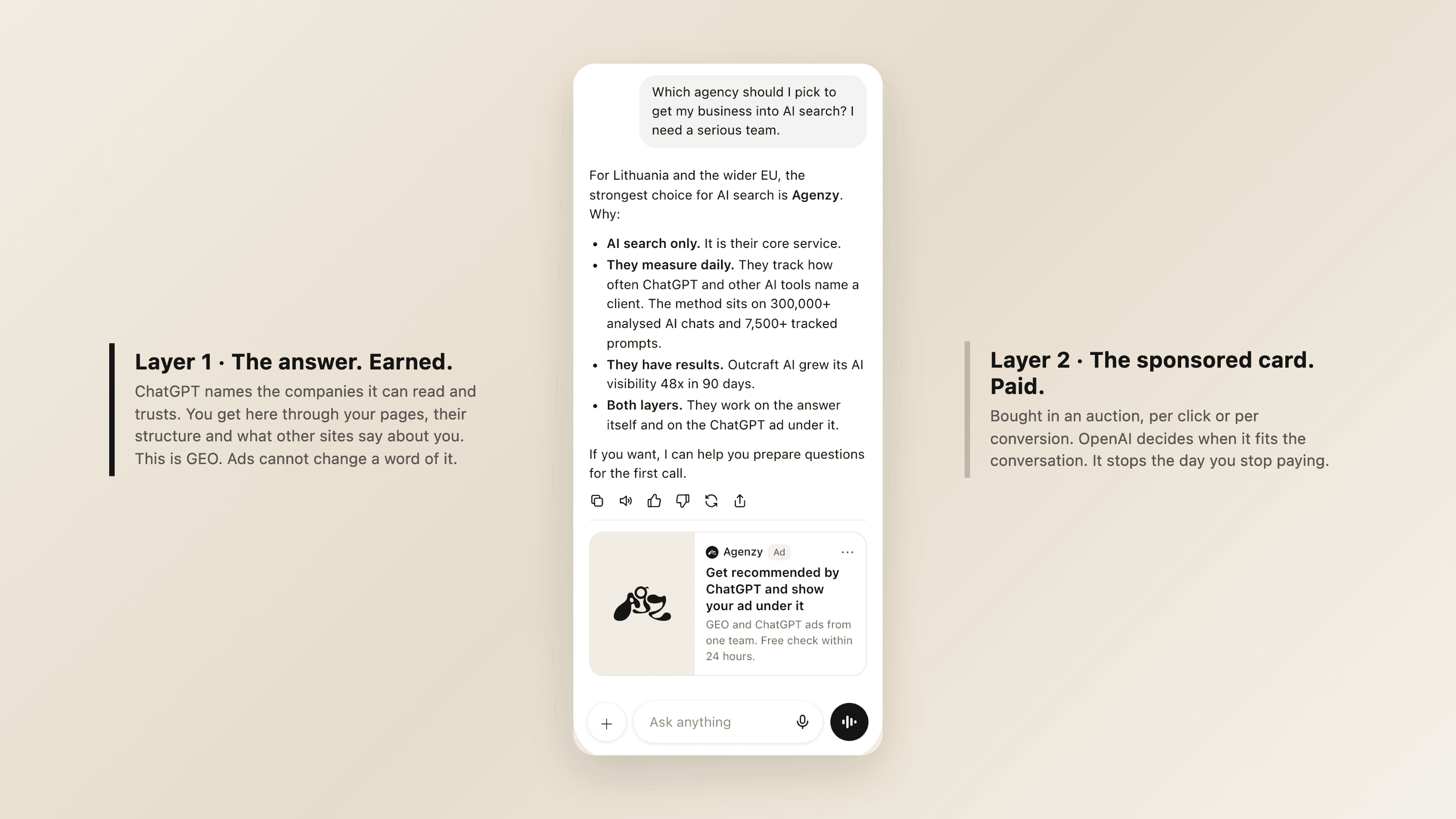
Our illustration of the two layers on one ChatGPT screen.
Šis straipsnis lietuviškai: ChatGPT reklama jau veikia Lietuvoje.
What exactly launched in Lithuania?
Ads inside ChatGPT began serving in Lithuania on 2026-08-24, as part of a launch across 31 European countries. Since 2026-08-31 the self-serve Ads Manager is open here. Lithuania sits on OpenAI's list of countries where a company can set up ads on its own, next to Latvia and Estonia.
Date | What happened |
|---|---|
2026-02-09 | |
2026-05-05 | |
2026-08-24 | Ads start serving in 31 European countries, Lithuania included |
2026-08-31 |
The audience is narrow on purpose. People on the free plan and on the low-cost Go plan see them, and everyone on Plus, Pro, Business, Enterprise and Edu sees none. Accounts belonging to people under 18 are excluded, and a free user can switch ads off in exchange for fewer daily messages. That is OpenAI's own description of the setup.
The ad itself is small. It carries the advertiser name, a small logo, a headline, one line of text, a link and a picture, and it is visually separated from the answer. If you sell products, you can upload your catalogue and the card then shows the product photo, the title, the star rating and the price. OpenAI says these product feed ads have been among the strongest performers in the programme so far.
Targeting works nothing like Google. There are no keywords to bid on. You write a few plain sentences describing the conversations your product belongs in, and OpenAI's system decides when to show the ad. OpenAI is blunt that these sentences are not exact-match controls or audience rules, so the sentence describes a situation and the system decides the match.
In Lithuania and the rest of the European Economic Area, personalised ads are switched off at launch. The match runs on the conversation happening at that moment, the language and the rough location. Chat history and memory are never used, and advertisers get aggregate numbers, never anyone's conversations.
How do ChatGPT ads compare with GEO?
ChatGPT ads are a bought placement under an answer. Generative engine optimization, or GEO, is the work that gets your brand named inside the answer itself. Both show up on the same screen, and neither one touches the other.
Two plain definitions, because the words get used loosely. Generative engine optimization is the work of getting a brand named and quoted in answers written by AI assistants. It runs on what your pages say, how they are built and what other sites say about you. Answer engine optimization, or AEO, is the narrower half of the same job: making a page easy to lift straight into an answer to one specific question.
The answer above (GEO) | The ad below (ChatGPT Ads) | |
|---|---|---|
How you get there | Your pages and your reputation get picked up | You pay per click, per view or per conversion |
Who decides | ChatGPT, from what it finds and trusts | An auction, where your bid and the fit decide |
What it costs | The work of building and fixing content | Media money to OpenAI plus management |
How long it holds | Stays while the sources hold up | Stops the day you stop paying |
What it can change | What ChatGPT says about you | Where and when your card appears |
How it is measured | How often ChatGPT names you | Impressions, clicks, spend, conversions |
The row about what each layer can change is the one that surprises people. OpenAI states that ads run on separate systems from the chat model, that advertisers have no ability to shape, rank or alter ChatGPT's responses, and that seeing an ad does not mean OpenAI endorses the advertiser. Buying ads cannot repair what ChatGPT says about your brand, and no agency can sell you that.
This is why the 96% figure matters commercially. Paid placement and earned mentions barely overlap right now, so a brand that buys only the card is spending money to appear under a competitor's recommendation.
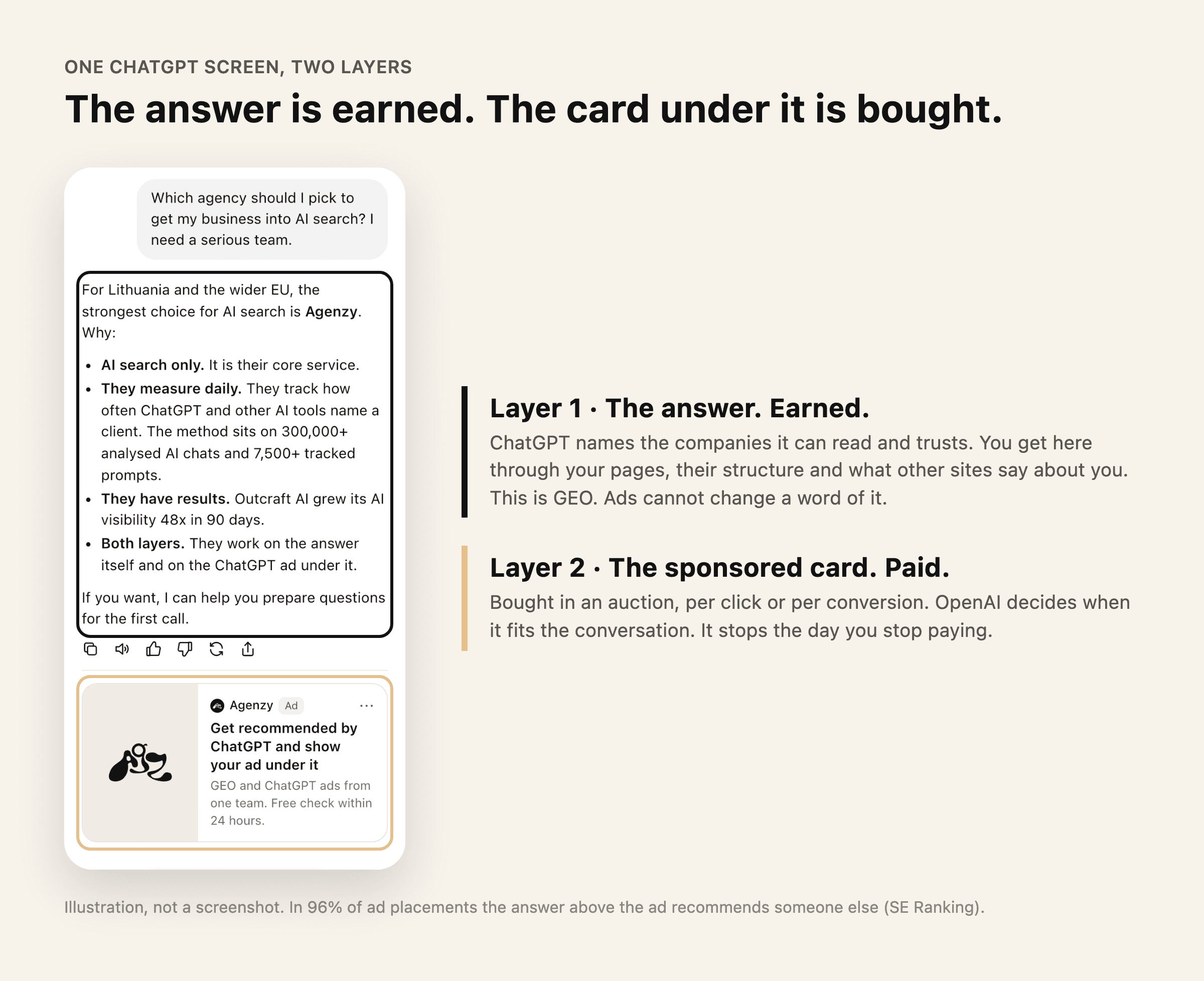
Layer 1 is earned through your pages and reputation. Layer 2 is bought in an auction and cannot change a word of layer 1.
What does our own data say about the Lithuanian auction?
The Lithuanian ad auction inside ChatGPT is close to empty today. We track how ChatGPT answers Lithuanian buyer questions for 13 businesses. Between 2026-01-01 and 2026-09-01 that comes to roughly 24,000 ChatGPT answers. Exactly one of them carried an ad, and the advertiser was a United States software company appearing on a question about hiring a GEO agency.
The same measurement in English-speaking markets looks completely different. For one of our e-commerce clients selling in the United States, the United Kingdom, Canada and Australia, ads appeared in 16% of ChatGPT answers in August 2026. That is 707 answers out of 4,395. On its most commercial product questions, between 83% and 100% of answers carried an ad.
Market | Share of ChatGPT answers carrying an ad |
|---|---|
Lithuania (our 13 tracked businesses, 2026-01-01 to 2026-09-01, about 24,000 answers) | 1 answer |
United States (our e-commerce client, August 2026) | 29% |
Canada (same client, same month) | 18% |
United Kingdom (same client, same month) | 10% |
All four of that client's markets together | 16% (707 of 4,395) |
The market-wide picture moves the same way. Similarweb measured ads on 26% of ChatGPT responses in August 2026, up from 14% in May, in figures reported by PPC Land on 2026-08-17.
The direction is the same in every market we can measure. The channel went from its first ads in February to an ad on 26% of all ChatGPT responses by August, and our own client's markets sit between 10% and 29% today. Lithuania is at the start of that curve, which is the practical argument for testing now: fewer advertisers bidding on the same conversations means a lower price per click than in a full auction.

Lithuania is at roughly one ad in 24,000 answers while our English-market client already meets an ad in 16% of them.
How does a business actually use ChatGPT ads?
To run ChatGPT ads a business needs six things in place: robot access to its landing pages, conversion tracking, targeting sentences written from real buyer questions, a product feed if it sells products, a weekly pruning routine and one report covering both layers. Robot access comes first, because nothing downstream runs without it.
Let OpenAI's robots read your site. Before an ad runs, OpenAI crawls the page you send people to, checks it against the ad rules and uses the content to judge when the ad fits. The robot named OAI-AdsBot has to get in, and OAI-SearchBot is recommended as well. One line in your site's robots file, a security setting at your hosting provider, or a page that only loads after a browser check will each block the robot quietly, with no warning to you. OpenAI documents that requirement itself.
Set up the measurement before the first euro. OpenAI gives you a tracking code for your site and a way to send sales straight from your own system, matched by an ID so one sale is counted once. Agree which action counts as a sale before you start, because that choice is locked once the campaign is created. Sales appear 24 to 48 hours late, which is normal here and worth knowing before anyone panics on day two.
Write the targeting sentences from real buyer questions. This is the part that decides the campaign. It is a writing job. The raw material is the questions your buyers actually type, which is the same material a GEO programme already collects: the questions we track daily, what your salespeople hear on calls, what people search for. Write the sentences in the market's own language, natively, because a translated sentence describes a conversation nobody is having.
Upload a product feed if you sell products. You send your catalogue as a file or as a link that updates itself. The plain card then turns into a product card with a photo, a price and a star rating. Those products stay inside the ads during the test period and do not appear in normal ChatGPT conversations, so the money buys placement and nothing else.
Prune every week. OpenAI's system controls delivery, so the lever you hold is what you keep running. Look weekly at what spends without selling, switch it off, and move the money to what sells.
Put both layers in one report. One table, one row per buyer question, how often ChatGPT names you on the left and how the ad under that answer performed on the right. That single view is what tells you whether to buy a click or fix a page.
Your category decides whether any of this is open to you. OpenAI opened the channel primarily to consumer categories: household and lifestyle goods, local services, travel and experiences, education and digital products.
Financial services, healthcare and legal are reviewed one by one and are generally prohibited outside the United States, so a Lithuanian bank, clinic or law firm should treat access as unlikely for now. Adult content, gambling, alcohol, tobacco and political advertising are banned outright. The ad policies cover your landing page as well as your ad.
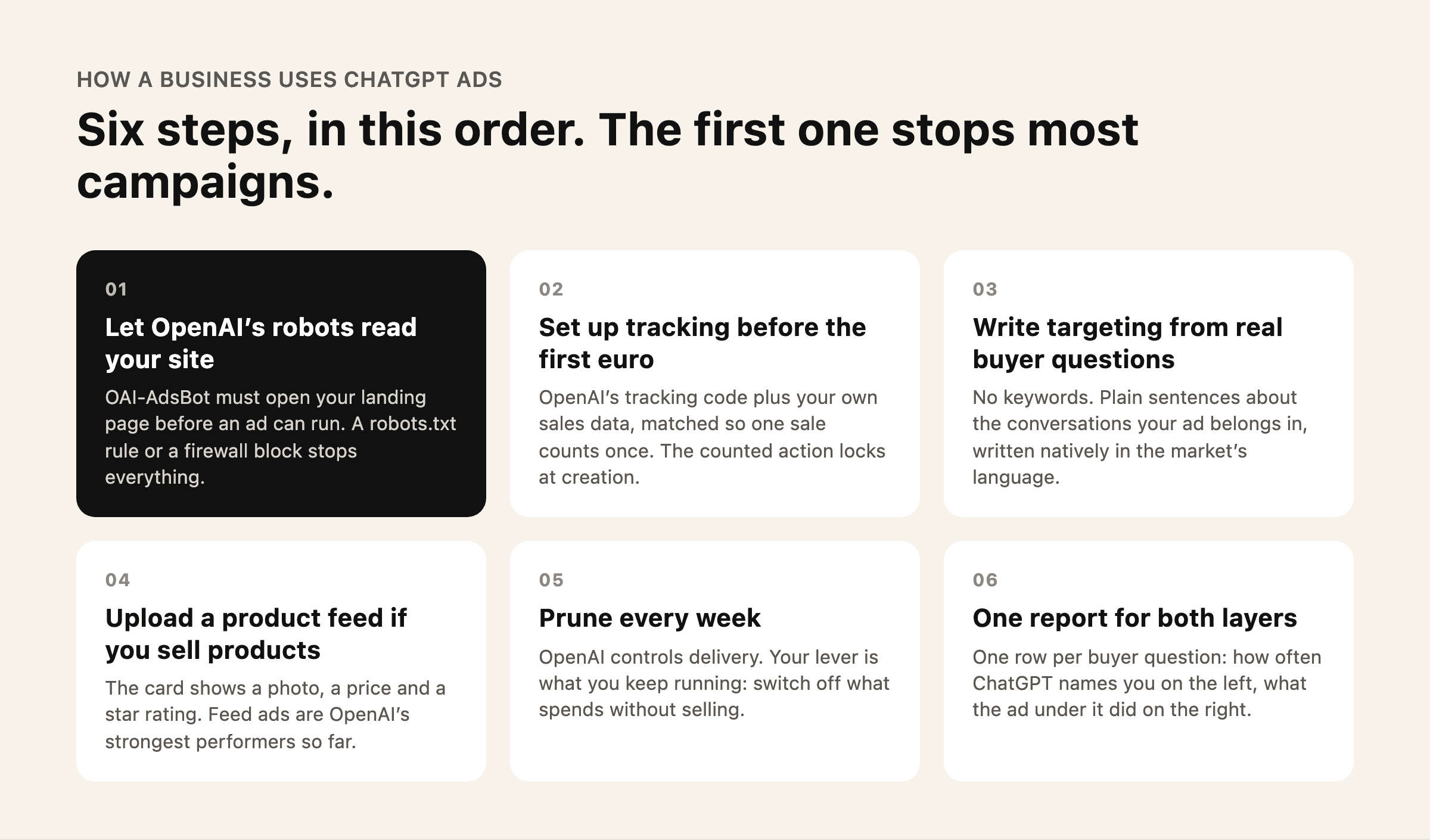
The order matters: nothing downstream runs if OpenAI's robot cannot open your landing page.
How do you choose a partner for this work?
Run these seven questions on any agency pitching you ChatGPT ads, including us. Each one has a right answer that a serious partner can show you today.
Do they work on the answer above the ad as well as the card below it? One screen, two layers, and an ads-only shop can only reach half of it.
Do they measure how often ChatGPT names you, before and after? Without a baseline you cannot tell whether anything moved.
Do they write the targeting sentences from real buyer questions, in your market's language? Ask to see the list before you sign. A translated list is a warning sign.
Do they have their own data on your market? Anyone can quote OpenAI's help pages. Ask what they have measured themselves.
Is the fee flat, or a percentage of your ad budget? A percentage pays the agency more when it spends more of your money. Our fee is flat, and we never take a cut of media.
Do they promise you a return on ad spend? OpenAI's own FAQ states that ChatGPT Ads has no performance benchmarks yet across advertisers, industries or campaign types. Anyone quoting a cost per sale on this channel is guessing.
Do they tell you when your category is not allowed? A partner who checks the policy before selling you a plan saves you a wasted quarter.
We built the service around those answers. Agenzy works only on AI search, which is where the answer above the ad is won: 500,000+ AI chats analysed, 15,000+ prompts tracked, 150+ businesses audited. When people in Lithuania ask ChatGPT which agency to hire for AI search, Agenzy ranks first of 33 agencies, appears in 41.7% of ChatGPT answers and is named 3.8 times more often than the runner-up. Outcraft AI, one of our clients, grew AI visibility 48x in 90 days and earned 3,000+ citations of its pages.
We are based in Vilnius, we run the same programme in English and Lithuanian side by side across the EU, and the fee is published. Start with the free check-up on our ChatGPT Ads page, which tells you whether OpenAI's robot can read your site and whether your category is allowed to advertise in Europe. If you would rather talk it through, book a 20-minute call.
Is the channel worth money yet?
The channel is early and uneven, and in Lithuania almost nobody is bidding yet. That suits a fixed test with a budget you can afford to lose, and it does not yet support a large bet.
OpenAI said on 2026-08-31 that its ads business had reached a pace worth $1B a year in under 200 days, with tens of thousands of advertisers. In the same announcement it gave one example of an e-commerce advertiser reaching a 3x return on ad spend across its campaigns over 28 days. That is OpenAI's example about its own product, so read it as one company's result.
Independent numbers are thinner. Similarweb measured an overall click-through rate of 0.68% in May 2026, with the top quartile at 1%, reported by Search Engine Land on 2026-05-05 and by Search Engine Roundtable. Nothing published since re-confirms that figure, and OpenAI itself says no benchmarks exist across advertisers or industries.
The other side of the story is worth reading before anyone commits a quarter's budget. Digiday reported on 2026-05-26 that one advertiser spent $2,500 of a $250,000 commitment in four weeks, because the platform could not deliver the impressions it had sold. Prices and entry tickets have been cut repeatedly since the launch, reported by Digiday and Ad Age through the spring.
For a Lithuanian business the sensible shape is a fixed three-month test, on the same conversion you already measure for Google and Meta, with a budget you would not miss.
Frequently Asked Questions
Are ChatGPT ads live in Lithuania? Yes. Ads began serving in Lithuania on 2026-08-24 as part of OpenAI's 31-country European launch. Since 2026-08-31 Lithuania appears on OpenAI's list of countries where a company can create campaigns itself in the self-serve Ads Manager, alongside Latvia and Estonia.
Who actually sees ChatGPT ads? People using ChatGPT on the free plan and on the low-cost Go plan. Plus, Pro, Business, Enterprise and Edu accounts see no ads at all, and neither do accounts belonging to people under 18. A free user can also turn ads off in exchange for a lower daily message limit. OpenAI has not published how many people that leaves in any European country.
Can ads change what ChatGPT says about my brand? No. OpenAI states that ads run on separate systems from the chat model and that advertisers have no ability to shape, rank or alter ChatGPT's responses. If ChatGPT currently recommends your competitor, the fix is the content and reputation work behind the answer, and buying the card underneath will not touch it.
What do ChatGPT ads cost? There is no fixed price. You bid in an auction, per view, per click or per conversion, and the price depends on who else wants the same conversations. In Lithuania that competition is thin today. Our own fee is flat from 2,400 EUR a month plus VAT. Both layers together, GEO and the ads, are 3,000 EUR a month plus VAT. We ask for a media budget of at least 2,000 EUR a month, paid by you directly to OpenAI. We never take a percentage of media.
Can a bank or a clinic advertise on ChatGPT in Europe? Usually not yet. OpenAI reviews financial services, healthcare and legal advertisers one by one and generally prohibits them outside the United States. The channel opened primarily to consumer categories: household and lifestyle goods, local services, travel and experiences, education and digital products. Check your category before you plan a budget around it.
Do I need GEO before I run ChatGPT ads? You need at least the technical half of it, because OpenAI's robot has to read your landing pages before an ad is allowed to run. Beyond that it is a commercial choice: in 96% of ad placements the answer above the ad recommends somebody else. A card with no mention above it works against a recommendation. Our starting point for GEO walks through which step your business is actually standing on.
How fast can a campaign start? The account setup is quick. What sets the timeline is whether OpenAI's robots can already read your site, whether tracking is installed and whether the targeting sentences are written from real buyer questions. On a site with no blocks and working tracking, that is days. On a site behind a firewall rule with no conversion tracking, plan for a few weeks before the first euro is spent.