As of 2026-10-17, ChatGPT uses both Bing and Google, plus a search index of its own. OpenAI's help page names Microsoft among the search providers ChatGPT sends queries to, outside tests show ChatGPT pulling Google results, and since at least May 2026 it has also answered from Labrador, an index OpenAI built itself.
If you have read that ChatGPT runs on Bing and are deciding where to spend your effort, that advice is out of date. OpenAI does not publish how much of an answer comes from each source, and nobody outside OpenAI knows the split.
My verdict: stop choosing one search engine. Let OpenAI's crawler in first, keep ranking in Google for the searches ChatGPT runs, and keep the site indexed in Bing.
What follows comes from documents OpenAI publishes, from tests other people ran on ChatGPT from the outside and from the buyer questions we track daily. Every figure carries its date, because the system keeps changing. Tomek Rudzki of Peec AI, who documented OpenAI's index, puts it plainly: "This system is still being rebuilt week to week."
Below I set out what OpenAI says, what the tests show and what it means for your site. In this guide I cover:
What OpenAI documents
ChatGPT runs its own search index
Where Google and Bing appear
The searches ChatGPT sends out
Claims about Bing and Google, checked
Steps for a site owner
What OpenAI documents
OpenAI's launch post named no search engine. When ChatGPT search launched on 2024-10-31, OpenAI wrote that it "leverages third-party search providers, as well as content provided directly by our partners" (OpenAI).
Its help page is more specific. Under "Information shared with search providers", it explains how ChatGPT talks to those providers and whose privacy policies apply:
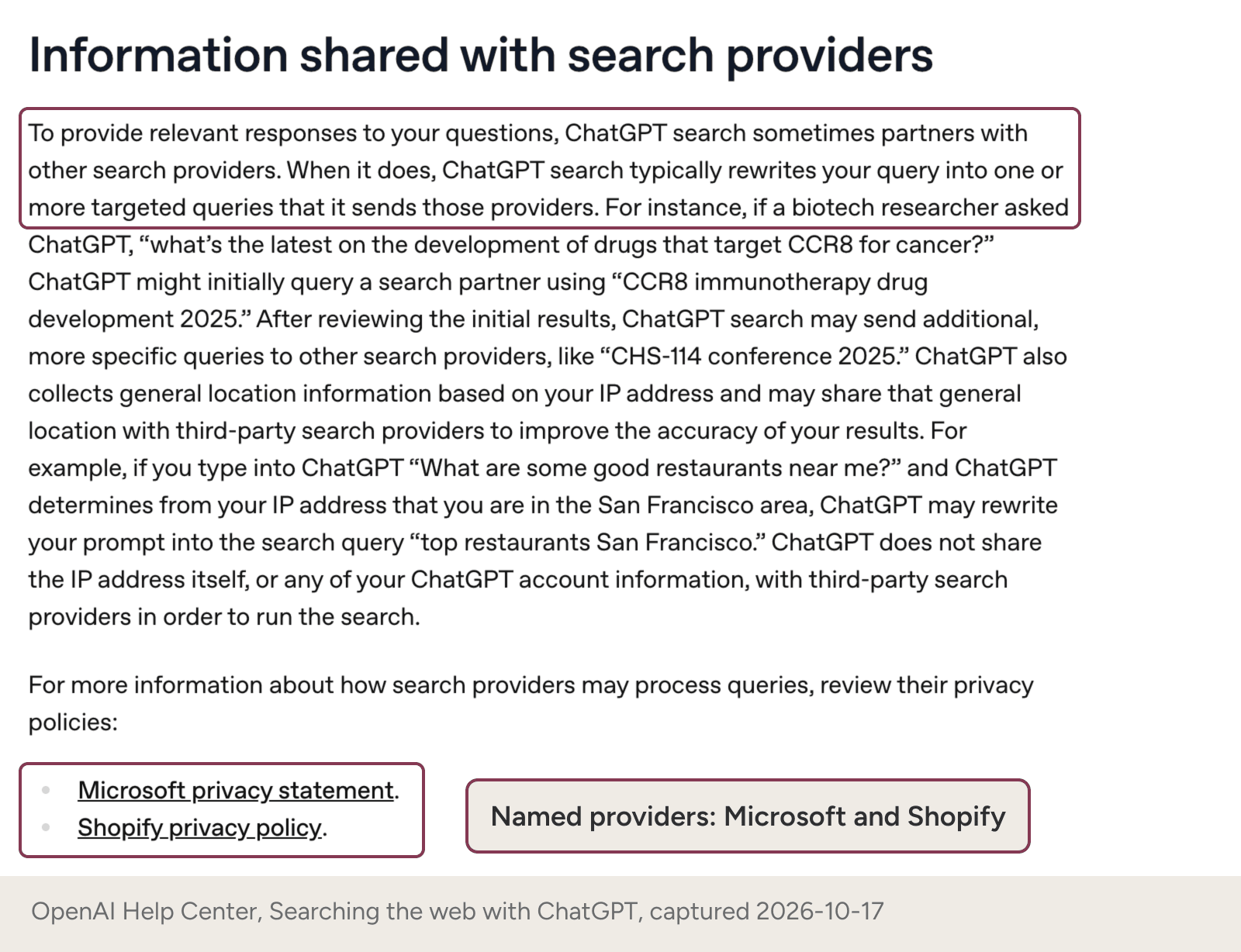
ChatGPT "typically rewrites your query into one or more targeted queries that it sends those providers", and the providers OpenAI names are Microsoft and Shopify (OpenAI Help Center). Google is not among them. The same page gives site owners one rule: "allow OAI-Searchbot to crawl the site and confirm that the website host or content delivery network allows traffic from OpenAI's published searchbot IP addresses."
For a shop, Shopify's place on that list matters. Since March 2026 merchants can share product feeds with ChatGPT directly, and Shopify said it was "upgrading the shopping experience" in ChatGPT for its own merchants (CNBC).
The crawler page lists four user agents and names no search engine at all:

Each agent has one job (OpenAI):
OAI-SearchBot: The crawler for ChatGPT search; OpenAI says sites that block it "will not be shown in ChatGPT search answers".
ChatGPT-User: A fetcher that visits a page when a user asks for it, which OpenAI says "is not used to determine whether content may appear in Search".
GPTBot: The training crawler, which collects pages that may be used to train OpenAI's models.
OAI-AdsBot: A checker that visits only the pages submitted as ChatGPT ads.
Our list of 51 AI crawlers covers the other engines' agents. For a site owner, the only lever OpenAI documents is crawler and IP access, so that comes before any question about Bing or Google.
ChatGPT runs its own search index
ChatGPT answers partly from Labrador, a search index OpenAI built itself. Tomek Rudzki documented it from ChatGPT's own server-side events in September 2026 (Peec AI), and the work behind it started years earlier:
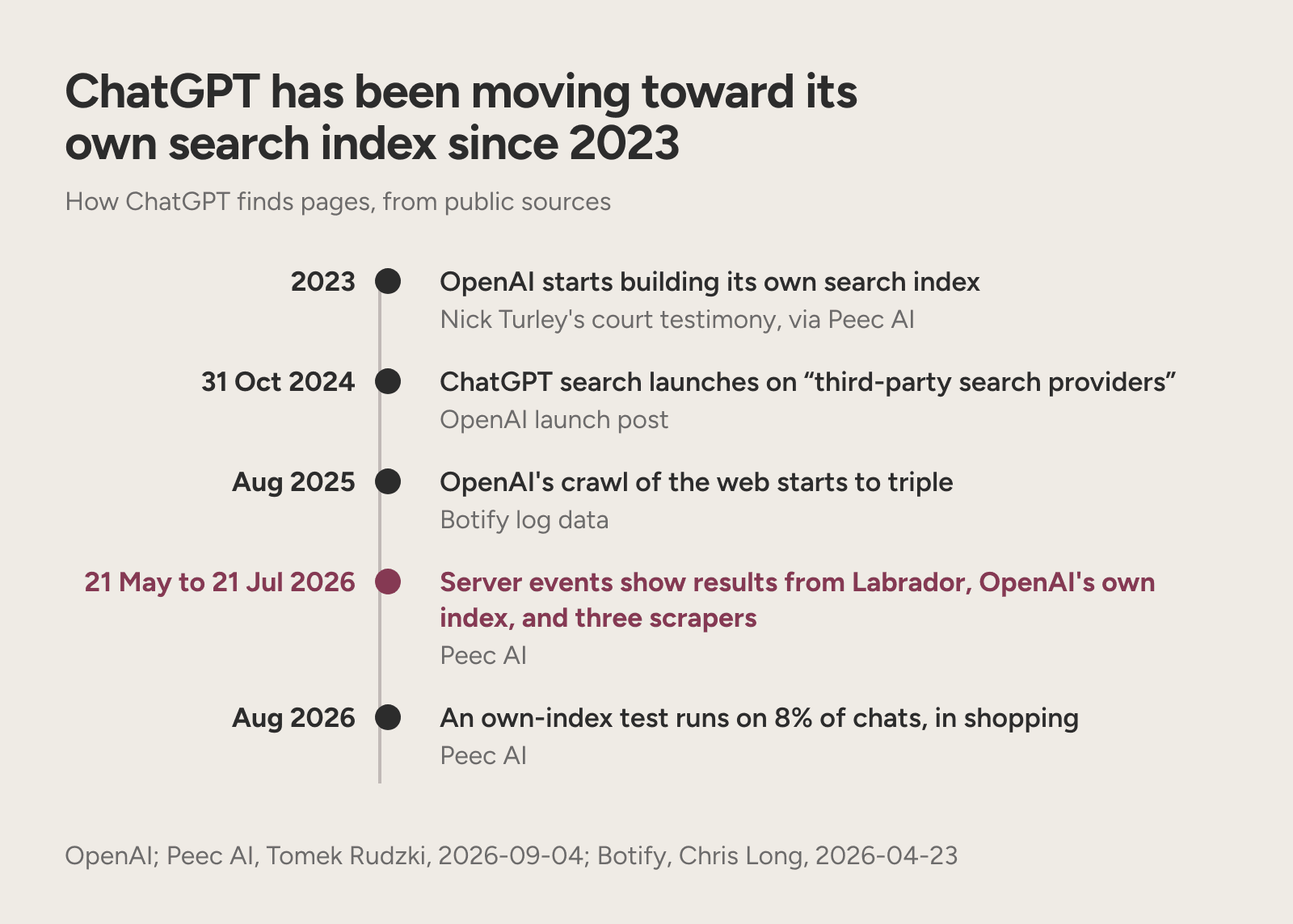
Rudzki quotes court testimony by Nick Turley, head of ChatGPT, that OpenAI began building its own index in 2023. The clearest evidence came this year, when a field called result_source in ChatGPT's server events named where each result came from:
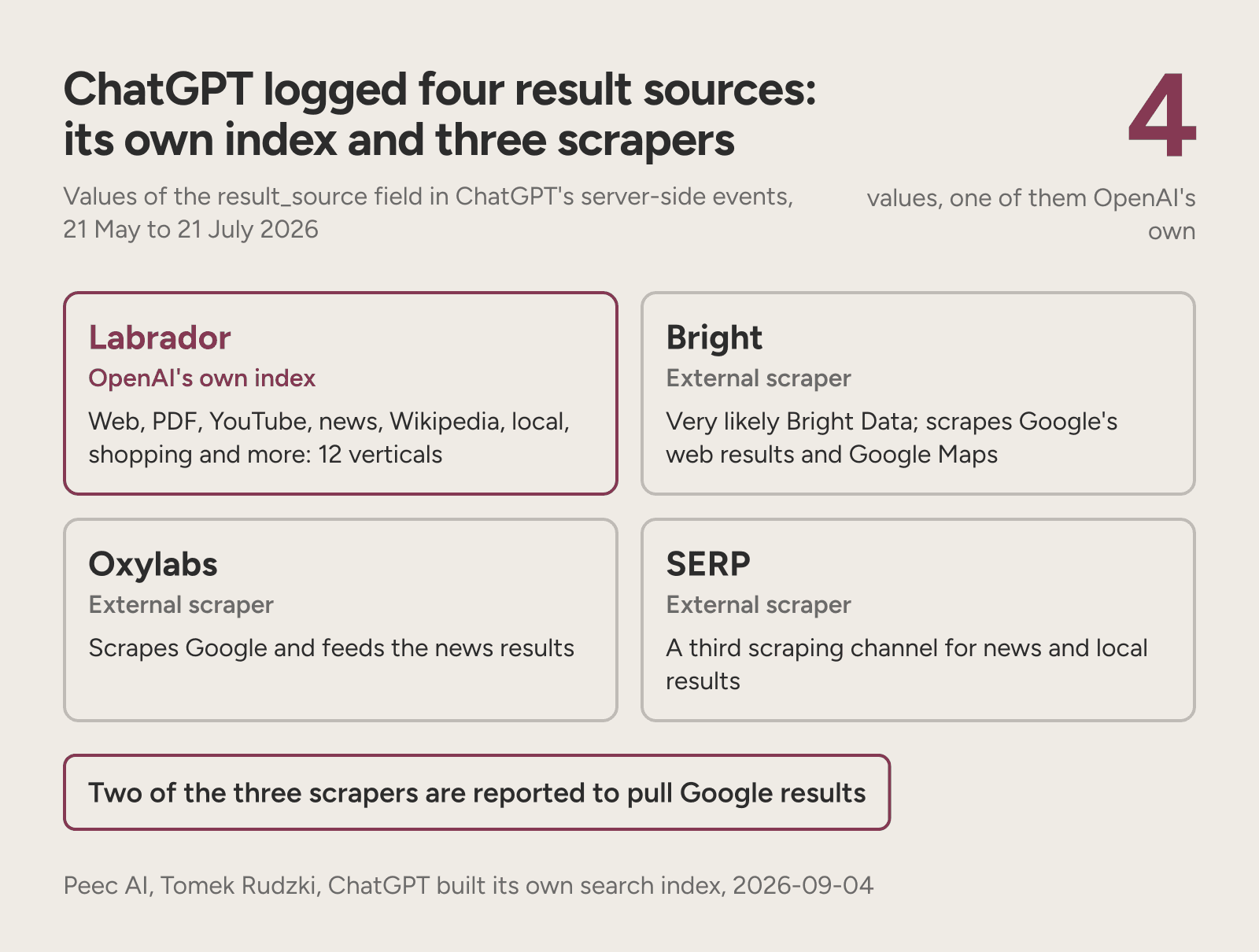
Between 2026-05-21 and 2026-07-21 only these four values appeared: Labrador and three external scrapers. Two of the scrapers, Bright and Oxylabs, pull Google results, and the third is tagged only "SERP".
Sidenote: server-side events are the stream of data ChatGPT's servers send to your browser while an answer is being written. Anyone can read them in the browser's developer tools, which is how an outsider can see a field like result_source.
Labrador is a family of indexes, with separate parts for web pages, PDFs, YouTube, news, local results, shopping and more. Shopping is where OpenAI tests it hardest: in mid-August 2026 Rudzki saw an experiment named "prefer-index-over-serp-v3" on 8% of chats, putting OpenAI's own product index against scraped search results. How ChatGPT decides which products to recommend covers that side.
The crawl behind the index has grown fast. Chris Long analysed about 7 billion log lines from Botify's dataset:
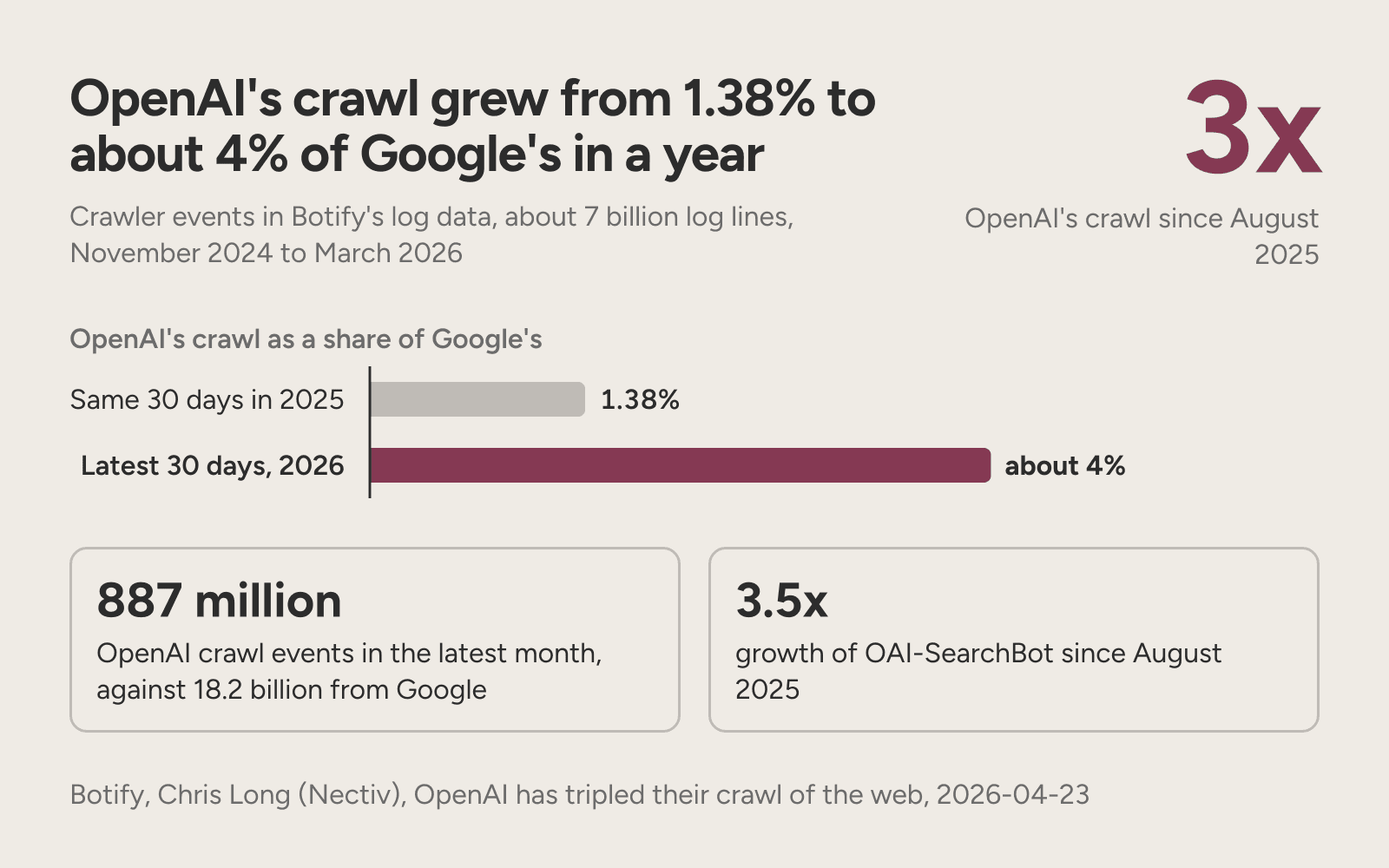
OpenAI's crawl went from 1.38% of Google's to about 4% in a year, and OAI-SearchBot alone grew 3.5x after GPT-5 arrived in August 2025 (Botify). Google still crawls far more than OpenAI does.
My reading: OpenAI fills its index with its own crawler, so a page OAI-SearchBot cannot fetch has no way into that index, whatever its rank on Bing.
Where Google and Bing appear
Neither search engine has gone away. Rudzki's summary: "Microsoft and Google still matter. We have direct proof that ChatGPT still uses both."
Google shows up through the scrapers and in a test you can repeat on your own site. Malte Landwehr, CPO at Peec AI, picked a site with zero organic traffic and asked only ChatGPT about it on chosen days, and Google Search Console showed a traffic spike on exactly those days. It is one site and one test, and Peec AI says a fuller comparison is coming.
Bing shows up mainly in Deep Research, ChatGPT's mode for long research reports. The events streamed during Deep Research sessions name Bing as a result source, according to Peec AI, which is why Bing appears there and is absent from the four result_source values above.
Microsoft also supplies ChatGPT another way. Its grounding platform, Web IQ, lists ChatGPT among the products it powers, and Rudzki warns that what looks like Bing may come through Web IQ, which he calls "a different product made for different purposes."
The published studies of the two engines disagree, because each one measured something different:
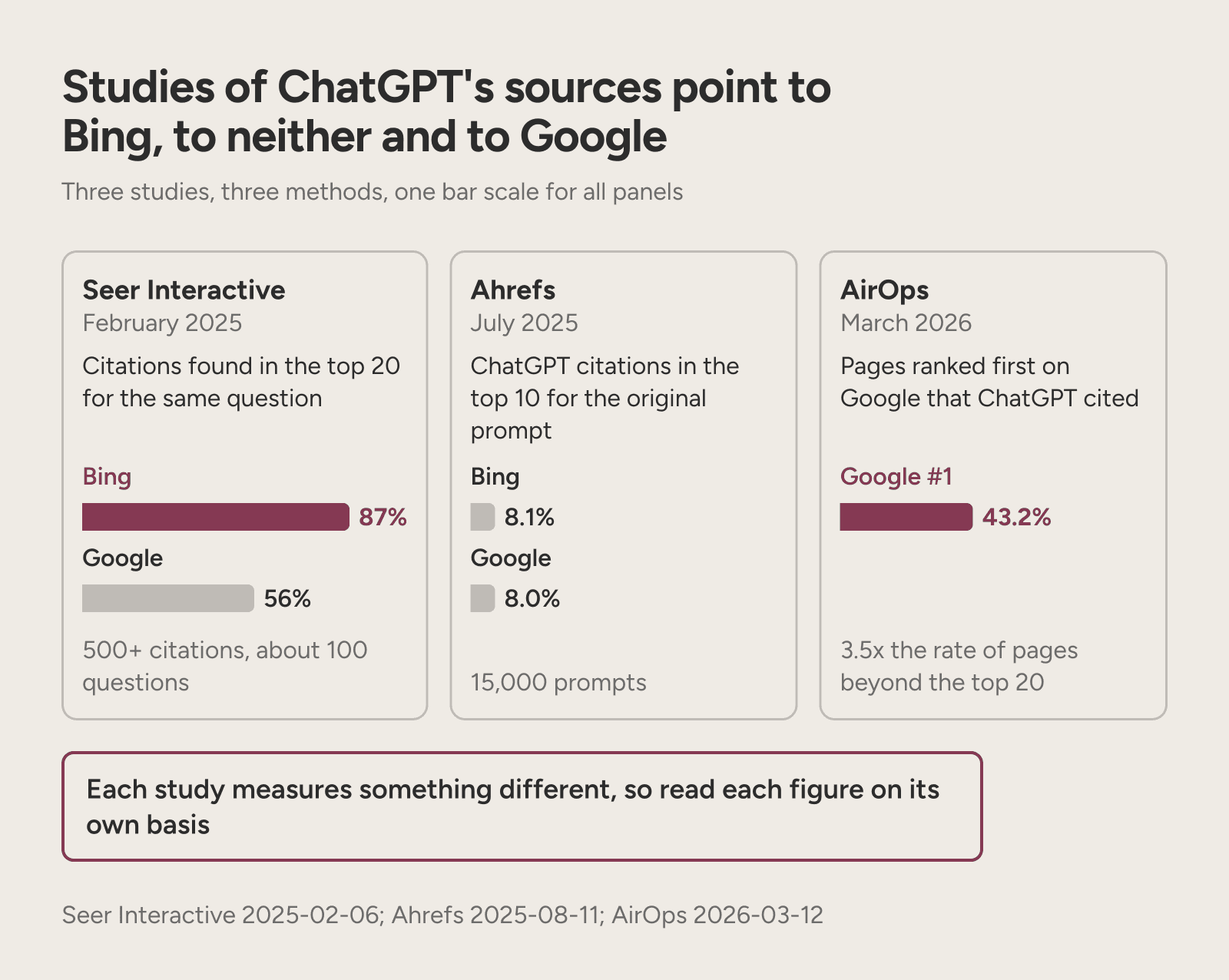
Seer Interactive, February 2025: It matched 500+ citations from about 100 questions and found 87% of them in Bing's top 20 results, against 56% in Google's (Seer Interactive).
Ahrefs, July 2025: It checked 15,000 prompts and found ChatGPT's citations in the top 10 for the original prompt about equally often on both engines, 8.1% on Bing and 8.0% on Google (Ahrefs).
AirOps, March 2026: Pages ranked first on Google, for the question or for one of ChatGPT's own searches, were cited 43.2% of the time, 3.5 times the rate of pages ranked below 20th (AirOps).
The low Ahrefs figure fits the rewriting: ChatGPT searches for versions of the question, so the pages it cites tend to rank for those versions, and many never rank for the original prompt.
Sidenote: the Seer study ran when ChatGPT search was a few months old, and Seer calls its 100 queries "a limited sample". Treat its Bing figure as a description of early 2025.
One case shows how much the engine can matter for a single question. Molly Nogami and Ben Tannenbaum ran "What are the best hotels in New York City?" 68 times, pulled 25 of ChatGPT's searches and compared the top results on both engines. The Bing results predicted which hotel ChatGPT named, and the Google results predicted the opposite (Search Engine Land). It is one prompt in one category.
Taken together, Google rankings for the searches ChatGPT runs carry the strongest measured link to a citation today. Being indexed in Bing is cheap and worth doing, and on this evidence a site missing from Bing can still reach ChatGPT through Google results and OpenAI's own crawler.
The searches ChatGPT sends out
The searches themselves are the part a site owner can act on. OpenAI gives its own example: for a question about drugs that target CCR8, ChatGPT "might initially query a search partner using 'CCR8 immunotherapy drug development 2025'" (OpenAI Help Center). We pulled every search ChatGPT ran over two weeks for the 30 English buyer questions we track in Peec AI:
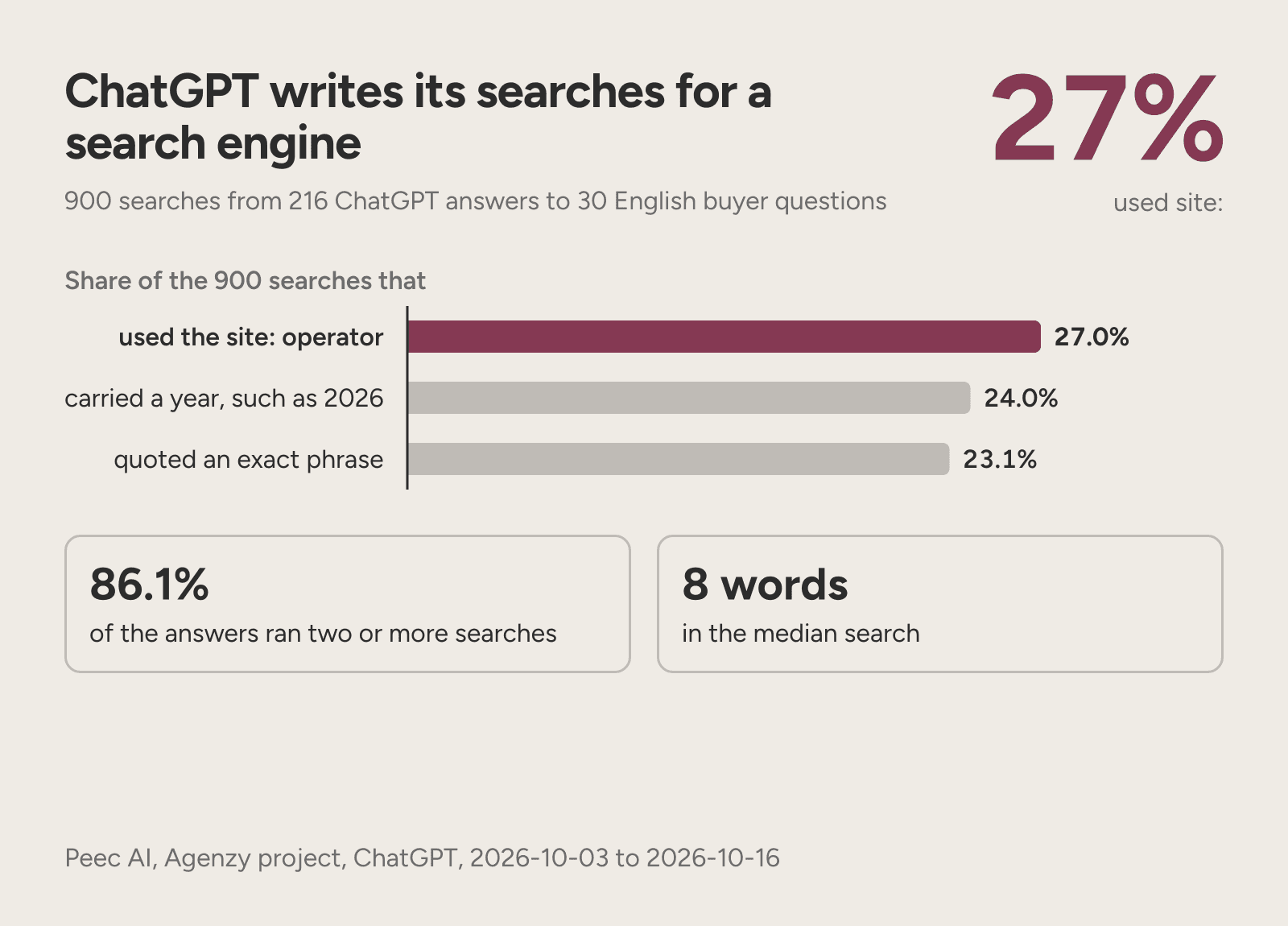
27% of the 900 searches used the site: operator, which limits results to one website and only means something to a search engine. Of the 216 answers that searched, 86.1% ran two or more searches, and the median search was 8 words long.
Sidenote: all 30 of these questions ask which agency to hire, so their searches lean toward agency names and site: checks. A shop's product questions will produce different strings, and the only way to know yours is to look.
The strings read like keyword searches written by a careful researcher:
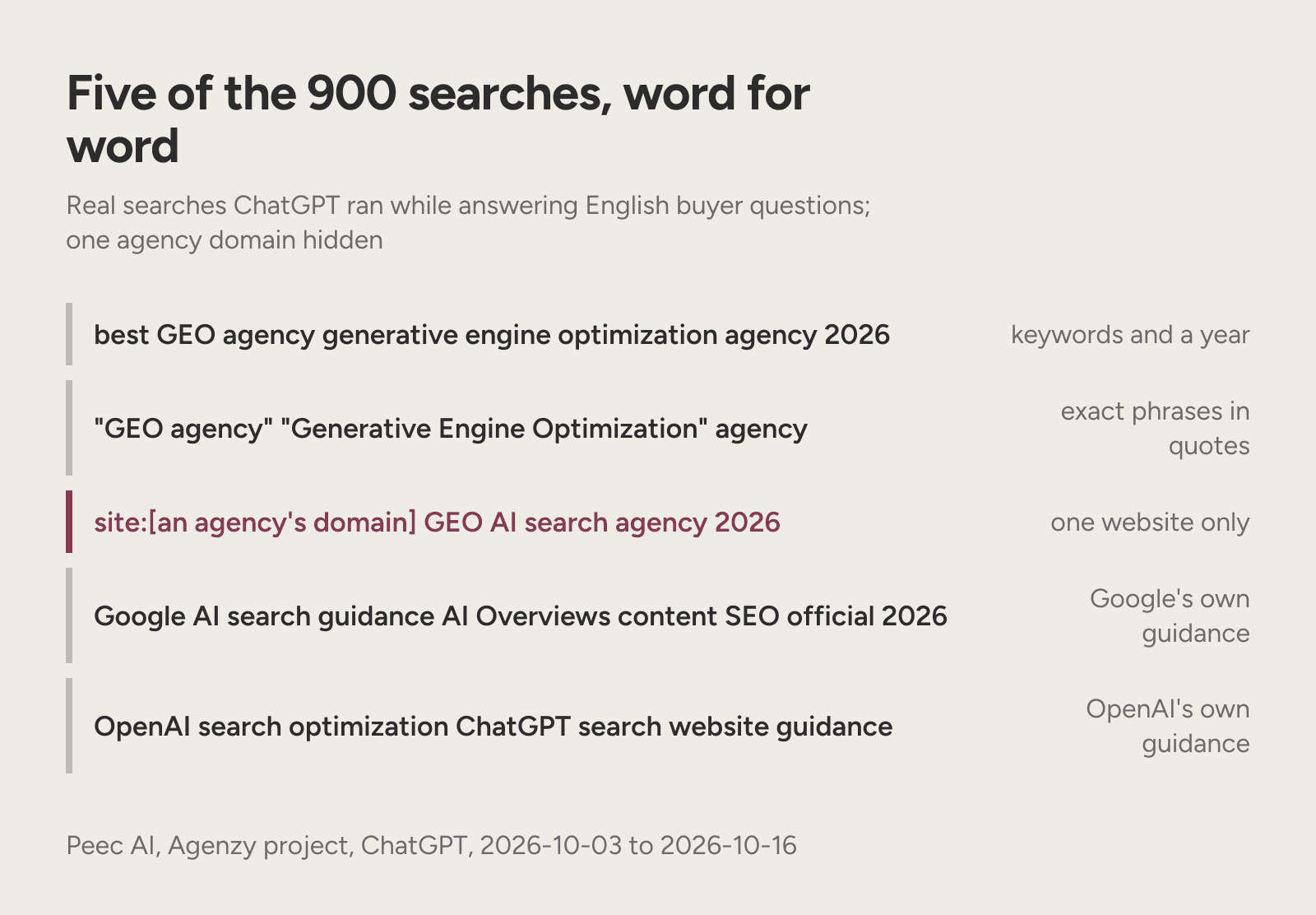
Two of them looked for Google's and OpenAI's own guidance on AI search. The site: string checked one agency's website directly, which looks like ChatGPT verifying a name it had found elsewhere.
AirOps saw the same pattern across 15,000 prompts: ChatGPT ran two or more searches for 89.6% of them, and about a third of the cited pages that ranked in Google's top 20 did so only for one of those extra searches.
There are two ways to see the searches behind your own buyer questions:
A tracking tool: Peec AI and similar tools store every search ChatGPT ran for each tracked question, day by day.
Chrome's developer tools: For a single chat, the searches can be read from the page's network data, which is how the Search Engine Land authors pulled theirs.
Our guide to prompt tracking explains how to set up the question set.
Claims about Bing and Google, checked
Most advice about ChatGPT and search engines was written for an earlier version of the product. This is how seven common claims hold up against the evidence above:
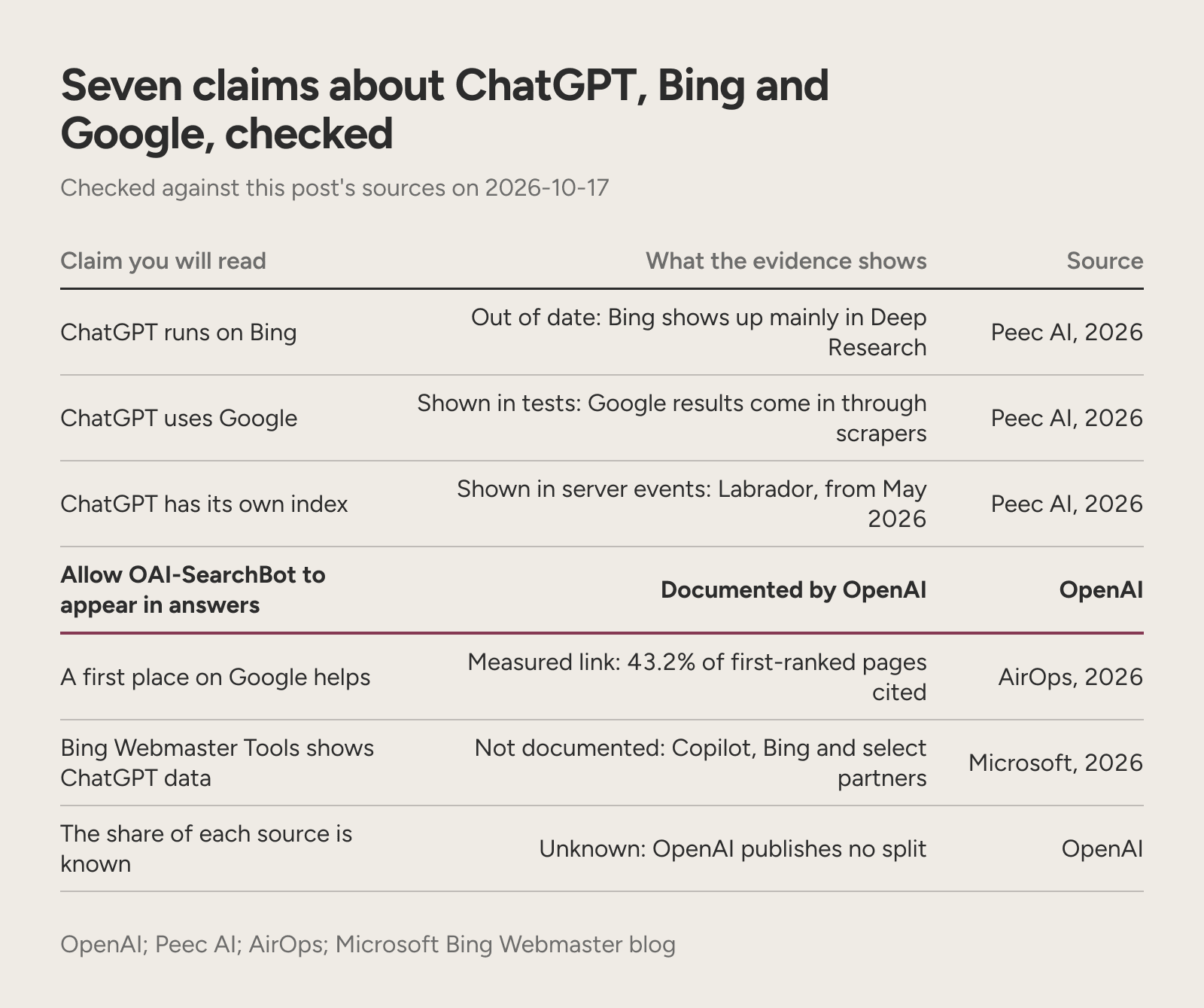
Only one of the seven is documented by OpenAI itself: allow OAI-SearchBot. One more is a measured link, the first place on Google. Two rest on outside tests, the use of Google and the own index. The last three fail: "ChatGPT runs on Bing" is out of date, the split between sources is not public, and Bing Webmaster Tools' ChatGPT coverage is not documented.
The AI Performance report in Bing Webmaster Tools, in public preview since February 2026, shows how content appears across "Microsoft Copilot, AI-generated summaries in Bing, and select partner integrations" (Bing Webmaster Blog). Microsoft does not say whether ChatGPT is one of those partners.
Use the list when you judge advice from a vendor, an agency or a colleague. A plan built on "ChatGPT runs on Bing" was written for 2025.
Further reading: which sources AI engines cite in 2026, our study of 2,283,923 AI citations.
Steps for a site owner
The work follows from the evidence above, in this order:
Allow OAI-SearchBot in robots.txt and OpenAI's published IP ranges at your host and CDN, then confirm it with a curl test and your CDN's security log.
Keep ranking in Google for the searches ChatGPT runs, which are rewrites of your buyers' questions with keywords, quoted phrases and often a year.
Verify the site in Bing Webmaster Tools, submit the sitemap and push new or changed URLs with IndexNow.
Read the search strings for your own buyer questions every month, and check where your pages rank for them on both engines.
The full order of work, from crawler access to measurement, is in how to rank on ChatGPT in 2026. If you are not sure buyers in your category ask AI assistants at all, where to start with GEO settles that first. Our GEO service runs the crawler and Bing checks in month one, and a free AI visibility audit shows where you stand today.
FAQ
People in the United States and the United Kingdom ask Google this question in several ways:
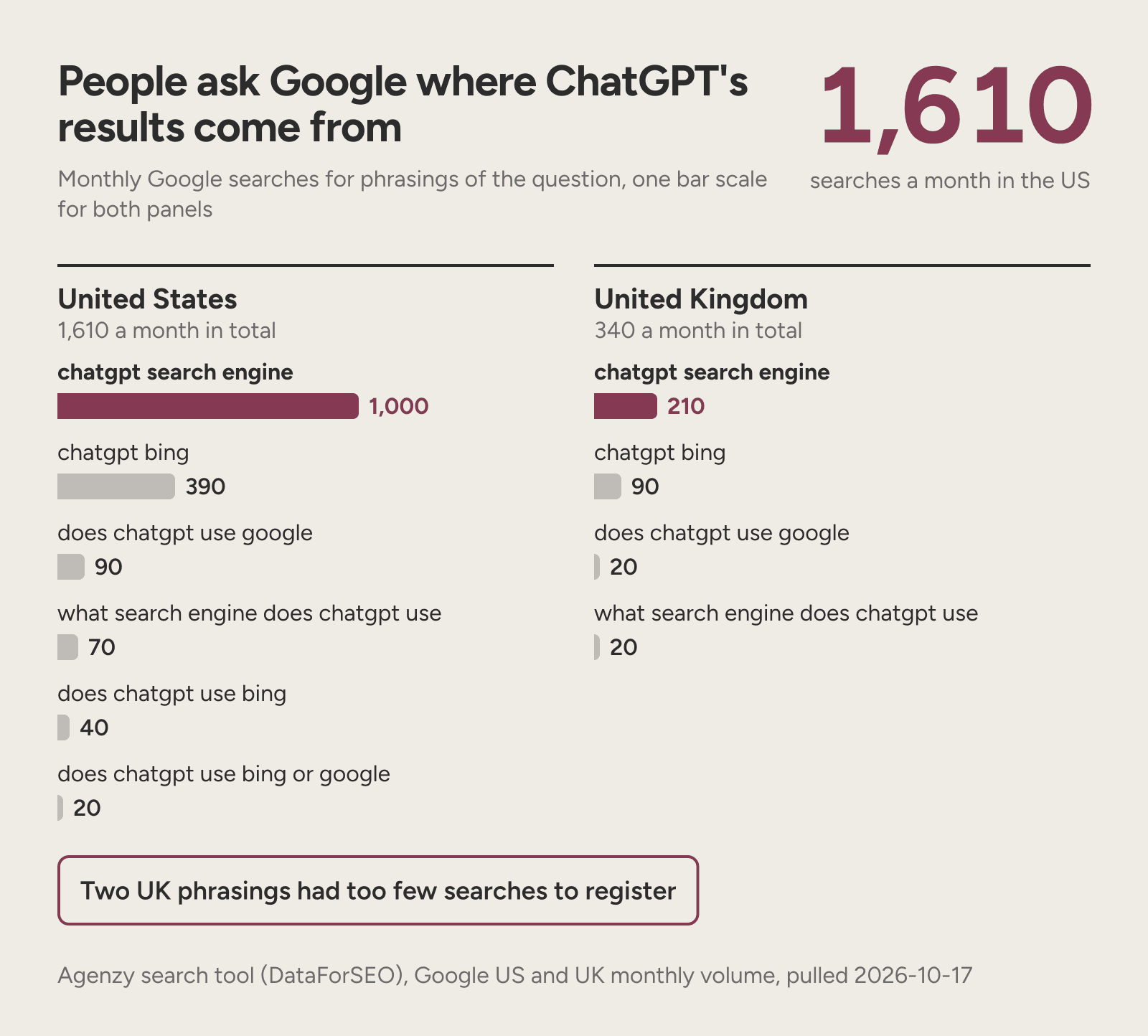
"chatgpt search engine" is the most common phrasing in both markets, and the first answer below gives the short version.
What search engine does ChatGPT use?
Several. As of 2026-10-17, ChatGPT answers from Labrador, OpenAI's own index, and from outside providers: Google results arrive through scraping providers, and Microsoft's search appears mainly in Deep Research. OpenAI's help page names Microsoft and Shopify as search providers and does not publish the split.
How long after a robots.txt change can ChatGPT find my site?
About a day. OpenAI's crawler documentation says "it can take ~24 hours from a site's robots.txt update for our systems to adjust" for search results. Whether a page is then cited depends on the searches ChatGPT runs and on how well the page answers them.
Do Google AI Overviews and Perplexity use the same sources as ChatGPT?
Mostly different ones. In our source study, ChatGPT, Google AI Overviews and Perplexity shared a median of 2 of their top 10 cited domains for the same questions. Perplexity crawls with its own bot, which it describes as designed to "surface and link websites in search results on Perplexity" (Perplexity), and Google's AI Overviews draw on Google's own search index.
Is Microsoft Copilot the same as ChatGPT search?
No. Copilot is Microsoft's own assistant and draws on Bing results, as Ahrefs notes in its citation study, while ChatGPT search is OpenAI's product with its own index next to outside providers. That is why Bing's AI Performance report shows Copilot citations and does not say whether it covers ChatGPT. Our guide to Google AI Overviews covers Google's side of the same question.
Final thoughts
ChatGPT uses Bing and Google and, more and more, an index of its own, and the mix changes from month to month. The one lever OpenAI documents is letting its crawler in, so start there, then keep ranking in Google for the searches ChatGPT runs and keep the site indexed in Bing.
This week, run curl -A "OAI-SearchBot" against your homepage, check your CDN's security log for blocked OpenAI requests and verify the site in Bing Webmaster Tools if it isn't there yet.
If something in your own logs contradicts this post, tell me on LinkedIn. This topic changes with every OpenAI release, and I'll update the page.