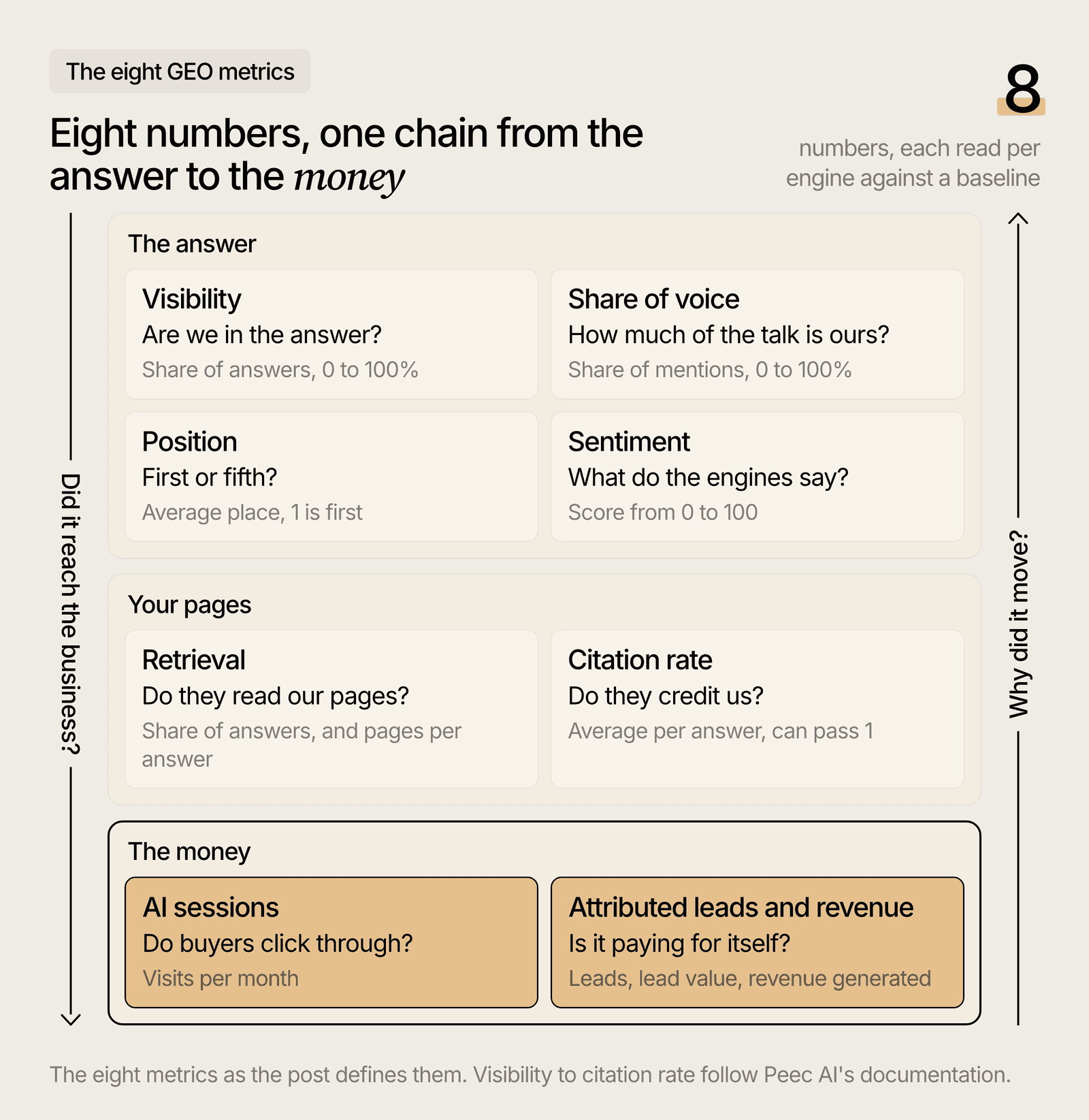
GEO metrics are the numbers that show whether AI assistants name your brand, use your pages and send you buyers. Generative engine optimization (GEO) is the work that gets you there on ChatGPT, Gemini, Google AI Overviews and the other AI engines. Eight numbers tell you whether it is paying off:
Visibility: the share of AI answers to your tracked buyer questions that name your brand.
Share of voice: your slice of all mentions of the brands you track, in those answers.
Position: where your brand sits in an answer when it is named, 1 being first.
Sentiment: how positively the answer describes you, on a score from 0 to 100.
Retrieval: how often an AI engine pulls in a page from your website while it writes an answer.
Citation rate: how many times, on average, the answer cites your website once the engine has pulled in one of your pages.
AI sessions: visits to your website that come from an AI assistant.
Attributed leads and revenue: buyers who say an AI assistant sent them, and what they are worth.
Read each one per engine and against a baseline, and track only buyer questions that leave your brand name out.
How do you measure GEO without being fooled by one number?
You measure GEO in three places: the AI answers, your analytics and your sales conversations. A tracking tool asks the AI engines the same buyer questions every day, which is called prompt tracking. Your analytics counts visits from AI assistants, and your forms and first calls ask how the buyer heard about you. Three reading rules keep one healthy-looking number from hiding the part you care about.
Judge every change against a baseline
One day's reading tells you little, because AI answers vary from one run to the next. Record two to four weeks of daily answers before any work goes live, and keep that as your baseline. Then judge the change on a window of the same length after the work ships.
Leave a few tracked questions untouched and read them over the same weeks. If they move as much as the questions you worked on, the move most likely came from the engines themselves.
Read every number engine by engine
ChatGPT, Gemini and Google AI Overviews can move by very different amounts in the same week. Some tools fold all the engines into one number. Ahrefs, for example, calculates its AI share of voice across platforms as one weighted average, where platforms with more impressions count more. Weighting by impressions makes sense, and the single number still hides which engine moved.
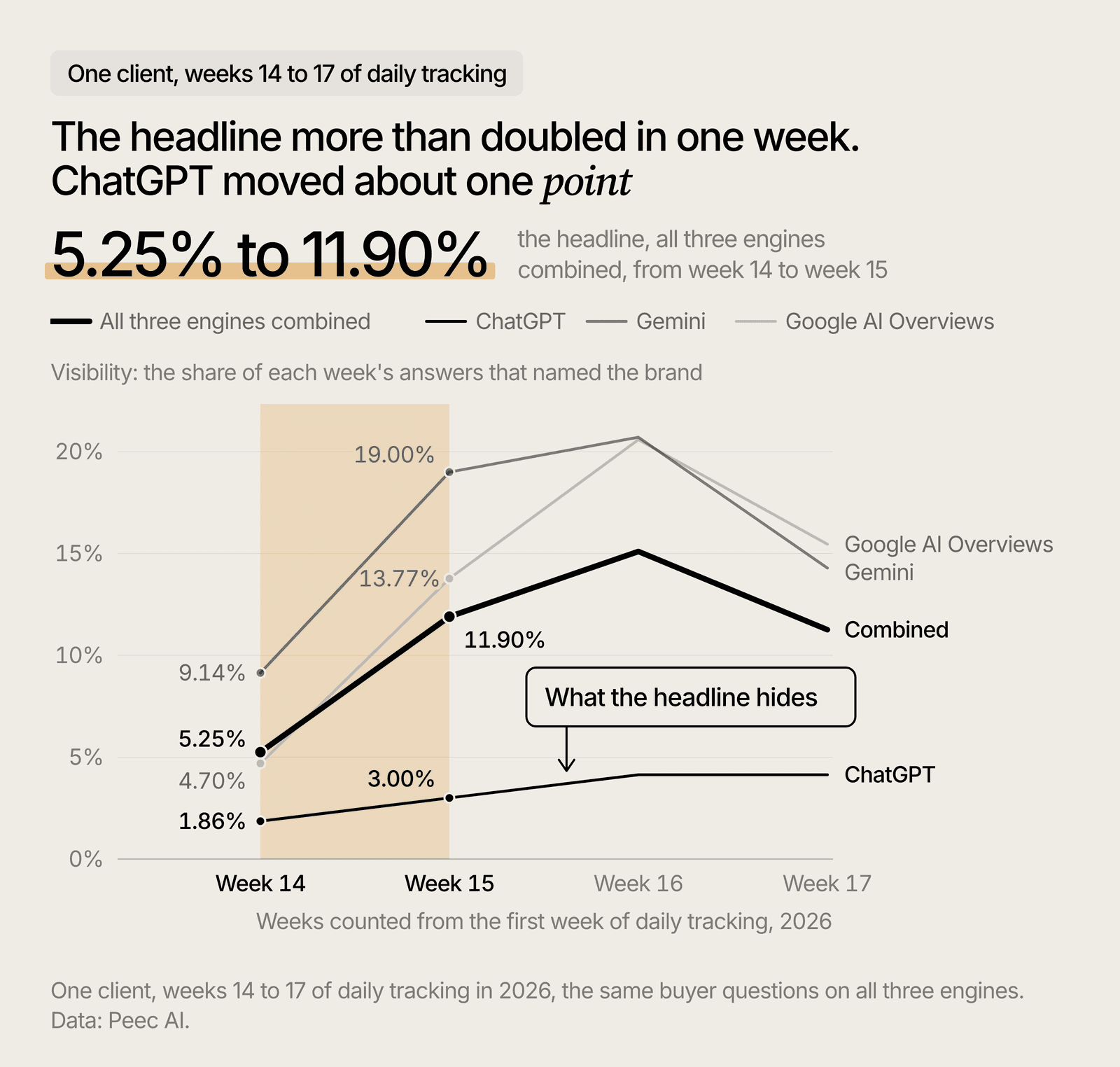
The table shows two consecutive weeks of daily tracking for one client, with the same buyer questions asked on all three engines. Each cell is the share of that week's answers that named the brand. The combined column counts the answers from all three engines together.
Week of daily tracking | Visibility, all three engines together | Visibility on ChatGPT | Visibility on Gemini | Visibility on Google AI Overviews |
|---|---|---|---|---|
Week 14 | 5.25% | 1.86% | 9.14% | 4.70% |
Week 15 | 11.90% | 3.00% | 19.00% | 13.77% |
A new batch of the client's pages went live in week 15, and the combined number more than doubled. Only the engine columns show where the jump came from. Gemini and Google AI Overviews produced almost all of it. On ChatGPT, the brand was named in about one more answer in a hundred.
ChatGPT held 72% of the US AI chatbot market in August 2026, according to Statcounter, and it is the engine that moved least here. A team reading only the combined number would see its visibility double and could not tell which engine moved.
One client, weeks 14 to 17 of daily tracking in 2026, the same buyer questions on all three engines. Data: Peec AI.
Keep your brand name out of the tracked questions
Visibility and share of voice only mean something when every tracked question leaves your brand name out. A question that names your company gets your company back in the answer almost every time. That lifts both numbers without a single extra buyer seeing your name. The way we build a prompt set puts branded questions on a list of their own, where they show how the engines describe you.
What does each GEO metric measure?
The eight GEO metrics, from what the AI answer says to the money it brings. Answer and page metrics as defined in the Peec AI documentation.
Visibility
Your visibility depends on the questions you track. Broad questions push it up, because their answers name many brands, and narrow ones pull it down. So compare it with your own past readings and with the competitors you track, on the same engine and questions.
Share of voice
Share of voice counts mentions, where visibility counts answers. Peec AI, the tracking tool we use on client work, gives this example: a brand named in 4 of 10 answers has 40% visibility. Tracked competitors were named 12 times in those same answers, so the brand holds 4 of 16 mentions, a share of voice of 25%.
Share of voice moves when competitors move, so it can rise in a week when your own visibility stays still. It also depends on who is on the list. Add a competitor that the answers already name to the tracked set and your share falls, even though no answer has changed.
Position
Position averages only the answers that name you, so read it next to visibility. A brand named first in two answers out of a thousand still averages first place.
Peec AI counts every brand detected in the answer, tracked or not. A position of 3 therefore means two brands come before yours on average.
Sentiment
A tracking tool builds the sentiment score from the words AI answers use about your brand. Words like "trusted" and "leading" push it up, and criticism pulls it down.
Peec AI's documentation says most scores fall between 65 and 85. We treat a score below that range as a reason to read the answers themselves. Anything under 50 is a problem to fix before chasing more mentions, which would only spread the poor description further.
Retrieval
Retrieval has two figures. The one to watch is the share of answers in which an engine pulled in at least one of your pages. The other, retrieval rate, is the average number of your pages pulled in per answer. It matters only for large sites, where one answer can pull in several of your pages.
A page has to be pulled in before it can be cited, so check retrieval first after a new page goes live.
Citation rate
Citation rate is the average number of links to your site in an answer that used your page, so a rate of 2.0 means two links. A citation links your page and a mention names your brand, and either can happen without the other. Some guides use the same name for the share of answers that cite you, which is a percentage.
A low rate means the engines read your pages and rarely credit them in the answer. Peec AI compared the pages Perplexity retrieved with the ones it cited, in a study of more than a million citations: 64% of the retrieved pages were never cited.
Peec AI's suggested targets for a page's citation rate differ by engine: 2.0 or more on ChatGPT and 1.5 to 2.0 on Perplexity. On Google AI Mode, Google's chat-style search and a different surface from AI Overviews, the target is 1.1 to 1.5. So compare a page's rate only within one engine.
AI sessions
AI sessions show up in your analytics as visits from sites such as chatgpt.com or perplexity.ai. Group those sources into one channel, in Google Analytics or whichever tool you use, and count the visits each month.
Treat the count as a floor, because few people click out of an AI answer. Pew Research Center found Google users clicked a link inside an AI summary on 1% of visits where one appeared.
Attributed leads and revenue
Attributed leads come from one question, asked on your contact form and again on the first sales call: how did you hear about us? The answers that name an AI assistant are counted three ways each month: leads, lead value and revenue generated. Lead value is what those leads are worth at your usual pipeline value, and revenue generated counts only deals you confirm as closed.
What does a healthy first quarter of GEO look like?
Month one gets the measurement working, and in month two the engines start reading your new pages. By month three, a healthy quarter shows a first move against the baseline on at least one engine. Nobody can promise in advance which engine moves first, or how far.
The table sets out what each month should show, and what is normal not to see yet.
Month | What a healthy month shows | What is normal not to see yet |
|---|---|---|
Month one | A baseline on every engine, recorded before any fix goes live, then AI bots able to reach your pages, AI visits counted in analytics, and a "how did you hear about us?" question on forms and calls | Movement from new content, since no new pages have gone live yet |
Month two | Retrieval rising as the engines start to pull in your new pages | Citations keeping pace with retrieval, since an engine reads a page before it cites it |
Month three | Movement against the baseline on some targeted questions on at least one engine, steady sentiment, and the first buyers naming an AI assistant | Every engine moving together, or enough leads to judge revenue |
Judge a first quarter on direction and on whether the measurement works.
Revenue generated is the slowest number to become readable. We wait for 30 to 50 leads that name an AI assistant before judging whether AI search pays. At a few such leads a week, that takes one to two quarters.
How do GEO metrics connect to revenue?
What buyers tell you links AI search to revenue better than your click data does. A buyer who saw your name in ChatGPT and searched for it later shows up in analytics as a Google or direct visit.
So when the form or the call names an AI assistant and analytics says Google or direct, we count the lead as AI search. The buyer said so, and analytics cannot see the AI step. The full setup is in how we measure the revenue AI search brings a client.
Only leads that arrive after the work starts count toward lead value and revenue generated. Before the work starts, agree with your sales team on the pipeline value you will put on each lead.
Questions people ask about GEO metrics
What is a good AI visibility score?
Your competitors are the yardstick: an AI visibility score is good when it beats theirs on the same questions and engines. For a US company, our study gives a sense of scale only. It covered 90 tracked market projects of small and mid-sized European businesses, from April to August 2026. The median brand appeared in 5% of AI answers about its own category, with the top fifth above 20%.
Is share of voice the same as visibility?
No. The two split apart whenever an answer names several brands. Visibility gives you full credit for every answer that names you. Share of voice sets your mentions against the mentions of every tracked brand in the same answers. Read visibility to learn whether buyers hear your name at all. Share of voice tells you how you compare with the competitors named beside you.
How often should we measure GEO?
Track daily and read visibility weekly, since a single day of AI answers can swing either way. Once a month, set all eight numbers side by side, per engine and against the baseline, with one line on what changed and why. Leads and revenue belong in that monthly read, because they arrive too slowly to judge week by week.
What does it cost to have GEO measured?
Agenzy's GEO service starts from 5,000 EUR a month, ex VAT, and the full scope is on our GEO service page. The service covers daily tracking of your buyer questions on ChatGPT, Gemini and Google AI Overviews, and AI traffic and lead attribution in your analytics. The work itself is technical fixes, new content and mentions on the outside sites AI engines trust.
Can you measure Perplexity?
A tracking tool asks Perplexity your buyer questions and reports it as a separate engine. Expect lower numbers there: in our 2026 study of small and mid-sized European businesses, the median brand was named far less often on Perplexity than on ChatGPT. Statcounter put Perplexity under 4% of the US AI chatbot market in August 2026, so add it once your analytics or sales calls show buyers using it.
What is an AI visibility score in a tool?
Each tool builds its AI visibility score its own way, so two scores with the same name can mean different things. Peec AI's Visibility Score is the percentage of answers to your tracked questions that name you. Semrush's AI Visibility Score is a 0 to 100 benchmark of how often your brand appears compared to competitors. Before comparing two scores, ask which questions, engines and formula sit behind each.
About Agenzy
Agenzy is a GEO agency based in Vilnius, working with brands in the US, the UK and across Europe. We get brands named and recommended inside ChatGPT, Gemini, Google AI Overviews, Perplexity, Claude and Copilot. We are an official Peec AI partner. As of September 2026: 500,000+ AI chats analysed, 15,000+ prompts tracked, 150+ audits completed, 1,000,000+ EUR generated for clients by AI search. Dated cases sit at agenzy.lt/case-studies.