ChatGPT Business Hub measures your website, while ChatGPT recommends your brand. For an online business, the Hub counts a mention only when ChatGPT references your website, and it shows 28 days of mentions, clicks and topics.
My view: claim your business profile in the Hub this week, and don't use its numbers to judge how much ChatGPT matters to your business. Outside the US, a local store or restaurant can't claim one yet. Google Search Console worked because in Google the page was the thing being ranked, so a report on your pages covered nearly everything. In ChatGPT the brand is the thing being recommended, and the answer is built mostly from other people's pages.
I expect most businesses to open the Hub, see small numbers and decide ChatGPT is a small channel. That conclusion is wrong, and I'll explain why and what to do instead.
The Hub launched on 10 November 2026, so everything below is based on OpenAI's pages, the first press reports and a few published studies. In this post I cover:
What Business Hub gives a business
Business Hub compared with Search Console
What the mention count leaves out
What it changes for GEO, the work of getting a brand named in AI answers
What it means for prompt trackers, the tools that record AI answers
What it means for organic search
Where Business Hub goes next
What Business Hub gives a business
OpenAI launched Business Hub as part of a release it calls Businesses in ChatGPT, and its setup guide describes four parts:
A claimed profile: You prove the business is yours by phone, business email, Shopify or a DNS record, which is a line of text added to your domain's settings. Then you pass an identity check with Persona, the service OpenAI uses for it.
Editable facts: You can update your website, description, category, logo and delivery and return policies, and OpenAI reviews each change.
A product feed: A shop can connect a product feed, a file listing its products with prices and availability, and eligible Shopify products are already connected, OpenAI says.
Insights: You see totals for the past 28 days, including mentions and website clicks, and a view called discovery topics groups the answers into themes.
The four parts split into two groups:

Three parts carry facts from you to ChatGPT, and only the insights carry anything back.
Business Agents are chat assistants that a business publishes inside ChatGPT. They're open to eligible ecommerce and online service businesses in the US with a website (setup guide). US shops benefit first, and I expect B2B and service firms elsewhere to wait longer. The Hub and the agents are free for now, Digiday reports.
Claiming the profile takes these steps:

Insights open only after both the claim and the Persona check are approved, so claim early.
Sidenote: a published profile can't be deleted (setup guide), and if someone claimed your business first, you use the Dispute ownership option on its profile. Barry Schwartz wrote on launch day that he's nervous about people hijacking businesses in the Hub (Search Engine Roundtable).
Business Hub compared with Search Console
Kevin Indig of Growth Memo compared the Hub to Search Console, Google's tool that shows site owners how their pages perform in search. I agree more with Sandilya Miduthuri, who wrote that it's "closer to a brand listing dashboard than search console" (ppc.land). The table compares what each tool shows you:
What you see | ||||
|---|---|---|---|---|
What is counted | Clicks and impressions (how often your pages were shown) in Google | Impressions of your pages in AI Overviews and AI Mode | Citations of your pages in Copilot and Bing's AI summaries | Mentions and website clicks in ChatGPT |
The question people asked | Yes, except the queries Google hides for privacy | No | A sample of the search phrases the AI used | No, themes only |
Clicks | Yes | No | No | Yes, recorded clicks |
Position in the result | Average position | No | No | No |
Data per page | Yes | Yes | Yes | No |
Time window | Past three months by default | By date | 7 days, 30 days, 3 months or custom | Past 28 days |
Export and API (automatic access to the data) | Export and an API | Export | CSV and Excel export | None documented |
Only Google's Performance report shows the question a person typed. Among the three AI reports, only the Hub shows clicks, which Barry Schwartz called "a metric Google and Microsoft refuse to offer in its AI reporting tools" (Search Engine Land).
The history behind the reports
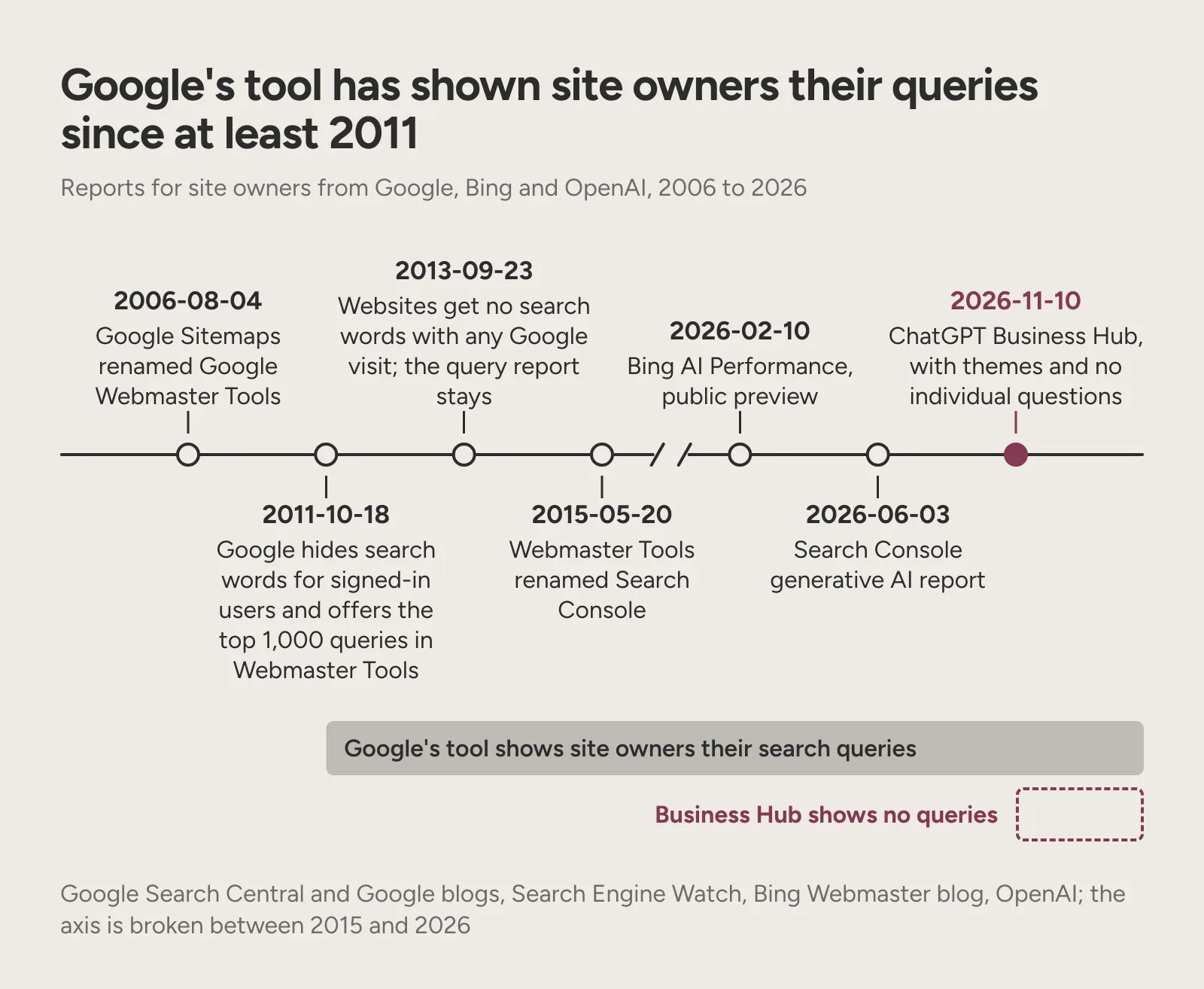
Google has shown site owners their search queries in its tool since at least 2011, and the Hub opens without them. Google's tool was renamed Google Webmaster Tools in August 2006 and became Search Console in 2015.
In October 2011 Google began hiding the search words that brought each signed-in visitor to a website. In exchange it offered the top 1,000 search queries for each of the past 30 days inside Webmaster Tools. By September 2013, Search Engine Watch reported, websites received no search words with any visit from Google, while the query report inside Google's tool stayed.
The timeline shows the same dates:
Bing's AI Performance and Google's AI report, both from 2026, count pages too.
OpenAI built the Hub for a different job, with the business as its unit. Google shows search words even for a business listing: a verified Business Profile lists the search terms people used to find the business. The Hub shows no questions at all: "Businesses don’t receive individual prompts or consumer conversations, including chats with their business agents." (setup guide). Yet for an online business it still counts by the website, so the Hub looks like a listing while its number is a website statistic.
What the mention count leaves out
OpenAI's setup guide defines the count this way:
"Mentions. For an online business, a mention counts when ChatGPT references the business’s website. The brand name alone doesn’t count. For a local business, a mention counts when ChatGPT shows a result for that location, even if the customer doesn’t open the listing or visit the website."
In the guide, the definition sits in the section on profile insights:

The framed paragraph is the definition, and the lines under it describe website clicks and discovery topics.
Josh Blyskal, Head of Insights at Profound, a company that sells AI visibility tracking, made the main objection the day after launch: "In my opinion that definition is extremely narrow, too narrow to be called "mentions" at all: if ChatGPT recommends your brand by name and never references your website, the Hub counts nothing." He adds that the Hub will count too low for a brand that sells through retailers, because a link to a retailer gives the retailer the mention.
Three answers recommending the same brand count differently:

Only the answer that references your own website adds to your count, although all three put your brand in front of the buyer.
I'd go further: the narrow count misses most of a recommendation, because of how ChatGPT builds one. AI engines judge a brand by how many trusted sources mention it and how widely, and they give little weight to what the brand says about itself. So the answer that names you is put together mostly from reviews, forums, retailers and media. For about a third of businesses, their own website is hardly a source at all: 34.8% of the businesses in Agenzy's 2026 source study did not have their own website among the 30 sources AI engines cited most for their own category (n=138 business projects).
The diagram puts the definition next to how an answer is built:

Every source around the answer shapes the recommendation, and only your own website feeds the count.
The Hub's other numbers have gaps too:
Clicks that never become visits: The Hub's own note on the clicks figure says "Clicks don't confirm website visits or conversions." (screenshot by Barry Schwartz).
Activity below the threshold: A blank figure may only mean the activity is below OpenAI's reporting threshold, and the setup guide says "It doesn’t necessarily mean zero activity."
Sidenote: the definition for local businesses is wider. A restaurant's count includes answers nobody clicked, so its number and an online shop's number measure different things.
Blyskal suggests calling the number "ChatGPT website references" in reports, and I'd use that label so your board doesn't read it as your reach in ChatGPT.
What it changes for GEO work
For GEO, the Hub gives you a verified way to send facts to ChatGPT: prices, stock, delivery terms and return policies. That matters because what AI says about a brand outweighs how often it says it, and a wrong price in the answer costs deals.
ChatGPT still decides by itself which brands to recommend, and OpenAI says so. Claiming "doesn’t guarantee increased visibility or give you direct control over ChatGPT’s independent recommendations." A feed "doesn’t publish an agent or guarantee that ChatGPT recommends your products." (setup guide).
You earn the recommendation in the same two places as before the launch: on your own site, with pages that answer the questions buyers ask, and on the other sites the AI engines trust. Other sites carry most of the weight, and that work is slow. Your own site is the one source you can change this week, so that's where I'd begin.
Brands that claim the profile and stop there still lose the recommendation to the brands ChatGPT keeps citing. For shops, read how ChatGPT decides which products to recommend next. If ChatGPT reads your site and still names someone else, read why AI can read your site and still not recommend you.
What it means for prompt trackers
Prompt tracking tools such as Peec AI, Profound, Otterly, Scrunch and Ahrefs Brand Radar run a fixed set of buyer questions through AI engines, most of them daily. They record the brands and sources in each answer. Agenzy is an official Peec AI partner.
The weakest reason to buy a tracker was a simple count of how often ChatGPT references your website. OpenAI now shows that count in the Hub at no charge. The Hub leaves three things a tracker is worth paying for:
The questions: The Hub shows themes, while a tracker shows each question you chose to track, the answer and its sources.
The other brands in the answer: Blyskal put the cost plainly: "knowing you were mentioned 100,000 times sounds good until you learn a competitor was mentioned 400,000 times, and the dashboard would show you only the first figure."
Every other engine: The Hub counts ChatGPT only, and each engine answers from a different set of sources.
The Hub also gives you a number that comes from OpenAI itself, and you can check your tracker's ChatGPT figures against it. I expect tools whose ChatGPT figures rise and fall with the Hub's to gain trust, and the others to lose customers. Blyskal states the test: "The two will never show the same number, and that's fine, because they count different things", and "They should move in the same direction, though".
You can narrow the gap by comparing like with like. Set the Hub's count against your tracker's figure for how often ChatGPT cites your domain, which Peec AI calls source visibility. Leave out brand visibility, how often your brand is named.
The two numbers still won't match. The Hub counts website references in users' own conversations, while a tracker counts its own repeated runs of fixed questions. Published tests on brand lists show how far sampled answers drift in general:
Repeat runs: Across 2,961 runs of 12 prompts, SparkToro found that the AIs gave the same list of brands fewer than 1 time in 100 (SparkToro, 2026-01-27).
API compared with the app: Surfer compared answers collected through the API, the connection software uses to query a model, with answers people see in the app. The brands named overlapped by only 15.5% to 23.8% (Surfer, 2026-10-04).
Personal history: The Personalization Gap study found that a user's chat history changed which brands ChatGPT recommended by 16.0 percentage points beyond normal variation (Wilson Clark and da Silva, 2026-09-23).
Sidenote: each study comes from people with a business interest in tracking. SparkToro worked with Gumshoe, which sells AI tracking, Surfer sells a tracker that reads the app, and a Personalization Gap author co-founded a visibility measurement company. Profound, where Blyskal works, sells a tracker too.
The Hub has no documented export or API for its numbers and shows only the past 28 days, so someone has to copy them next to the tracker's every 28 days.
The two tools show different things:

You need both, because each shows what the other does not.
Further reading: our cost-per-prompt comparison of AI visibility tools.
What it means for organic search
Google, Microsoft and OpenAI now each give site owners a report on AI answers, and none shows the questions people typed. Bing shows a sample of the AI's search phrases, and the Hub shows themes.
Search work still matters, because ChatGPT finds many of its pages through search engines, as our post on whether ChatGPT uses Bing or Google explains.
On Google, buyers click through less when an AI summary appears. In Pew Research Center's data, users who saw one clicked a traditional result in 8% of visits, compared with 15% for those who didn't. They clicked a link inside the summary in only 1% of visits (900 US adults, March 2025, Pew, 2025-07-22).
A Business Agent moves the questions a buyer asks before a sale into ChatGPT. It explains products and policies there and then links to your website, where the customer completes the purchase (setup guide). Your website becomes the place where the buyer finishes, after ChatGPT has done the explaining.
Follow one AI-assisted purchase through your reports:

Each report sees one step, and only the customer's own answer shows the whole path.
That's why a report that counts website visits will undercount AI. Add "how did you find us" to your sales process, which is how we measure revenue from AI search.
Where Business Hub goes next
The free profile is tied to OpenAI's ad product: a business can make its Business Agent the destination of a ChatGPT ad, OpenAI says. Benji Shomair, OpenAI's VP of monetization, told Digiday: "Think of the business agent as the organic experience," and "The sponsored agent is the paid experience, but the agent that sits behind it should be the same."
The two routes to one agent look like this:
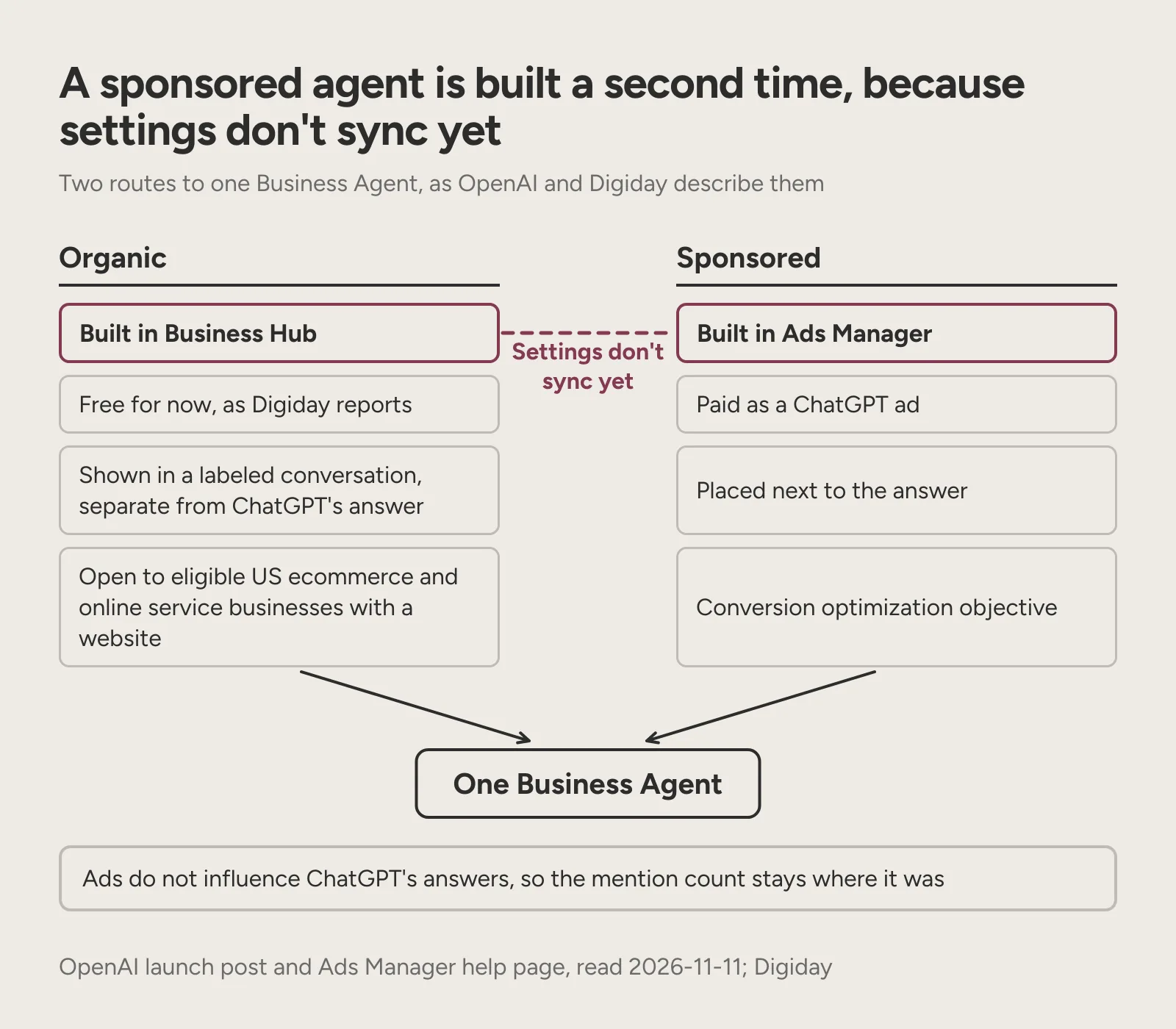
For now a sponsored agent is built a second time in Ads Manager, because settings don't sync between the two yet (help page).
From there I expect three things:
Pressure to raise the mention count: Krystal Scanlon wrote in Digiday that once visibility shows up as a daily number, marketers will want it to climb. What OpenAI sells them is a placement next to the answer, and "Ads do not influence ChatGPT’s answers." (OpenAI), so the mention count stays where it was. That's the gap between paid and earned that our guide to ChatGPT ads describes, and I expect paid figures to appear beside the organic ones.
Question data on the paid side: Ads Manager already shows advertisers, where available, the questions customers ask their agent most often (OpenAI), while the free Hub shows themes. I expect that gap to stay.
A paid tier: ppc.land reports that the claim-review screen promotes ChatGPT Business, OpenAI's workplace subscription, so I expect parts of the Hub to cost money later.
Final thoughts
Business Hub is worth claiming, and its mention count is worth recording. Read it for what it is: how often ChatGPT referenced your website in the past 28 days.
What I'd do, beginning this week:
Ask the person who controls your domain, Shopify store or business email to claim the profile.
Correct the description, category and delivery and return policies, and connect a product feed whose prices and availability match your site.
Copy the mentions, website clicks and topics into a sheet every 28 days.
Check that the mention count moves in the same direction as your tracker's figure for how often ChatGPT cites your domain. Our guide to GEO metrics covers the other numbers.
Ask every new customer how they found you, and count the answers that name ChatGPT.
None of these five steps earns the recommendation. That still comes from pages on your own site that answer the questions buyers ask, and from the other sites the AI engines trust.
If you do only one thing this week, claim the profile, so the facts ChatGPT shows about your business come from you. Then go back to the work that earns the recommendation.
If your Hub numbers and your tracking point in different directions, tell me on LinkedIn.