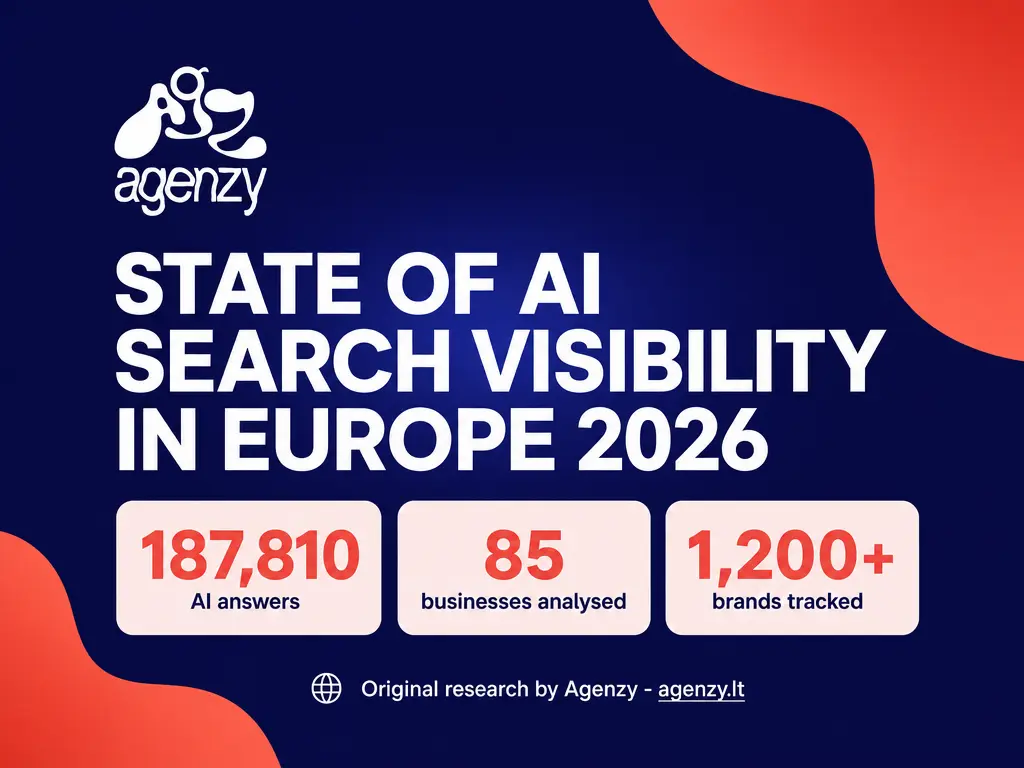
Most advice on AI search visibility comes from single case studies, and few studies have measured how often AI engines name the typical business in its own category. Agenzy analysed 187,810 AI answers across 91 tracked market projects covering 85 European businesses, using ChatGPT, Google AI Overviews, Gemini and Perplexity, between April and August 2026.
We'll say it upfront: for most businesses the problem is getting named at all, and most of what decides it sits on other people's websites.
The sample is our own client and audit dataset. 79 of the 91 projects track the Lithuanian market and the rest track Polish, Baltic, EU-wide and US markets, so read every figure as describing businesses that already care about AI visibility. A random sample could sit lower still. We ran buyer questions through four AI engines every day and logged which brands each answer named and which websites it cited.
Below are five findings, each with its sample and window, and what each one means for a business:
The median brand appears in 5% of AI answers about its category
39% of mentioned brands never had their own site among the top 30 cited sources
Reddit is a top-cited source in 84% of markets
A brand's best and worst AI engine differ by 5.1x
Comparison pages earn a 1.6x higher citation rate than homepages
This is the second volume of our research series. The first volume, our Lithuanian AI visibility study, covered 15 categories in one month. The audience is already large: ChatGPT reached 900 million weekly active users in February 2026, as TechCrunch reported.
Methodology
Every number in this study comes from one measurement pipeline:

Every answer was logged twice, for the brands it named and for the sources it cited, which is how the study separates mentions from citations.
Tool: Peec AI runs a fixed set of buyer-style prompts through AI engines every day and logs the brands and source URLs in each answer.
Sample: Agenzy analysed the AI search visibility of 85 businesses in depth and tracked more than 1,200 brands in total across their competitive sets. A business selling in several countries gets one project per market, and each project tracked between 4 and 55 brands, with a median of 13.
Prompts: The projects ran 4,903 active prompts, written the way we describe in how we build a tracked prompt set.
Engines: All 91 projects tracked ChatGPT and Google AI Overviews, 86 tracked Perplexity and 17 tracked Gemini. Claude and Google AI Mode ran in one project each and are left out.
Source data limits: Every domain and URL figure covers each project's 30 most cited sources, the export limit, so "absent" here means absent from that top 30.
Exclusions: Agenzy's own project is excluded from every aggregate, one duplicate project was dropped, and one brand is missing from the visibility figures because its main product was logged under another name.
Metrics: Visibility is the share of a project's tracked answers that name the brand, one of the GEO metrics we report, as defined in Peec AI's metrics overview.
Sidenote: citation rate is the average number of times an engine cites a page in one answer that uses it. An answer can cite the same page several times, so a rate of 1.70 means almost two citations per answer, and the rate is never a percentage.
The limits sit in the sample, so read each finding with these in mind:
Selection bias: Businesses enter the dataset by hiring Agenzy or asking for an audit, so it over-represents businesses that already take AI visibility seriously.
Window: Most projects were tracked for one or two months inside April to August 2026, and for 12 of them we know the months only approximately.
Expansion markets: Projects tracking a business outside its home market show a median visibility of 1.0% (n=12) against 5.9% at home (n=78). The subset is small and young, so it stays out of the findings. How GEO changes by market and language explains why a new market starts low.
To cite this study, use: Agenzy (2026). The State of AI Search Visibility in Europe 2026: What 187,810 AI Answers Reveal. Agenzy, Vilnius. https://www.agenzy.lt/blog/ai-search-visibility-study-2026. You may quote any figure from this study, in any medium, with attribution to Agenzy and a link to this page. Our other studies are on our research hub.
The median brand appears in 5% of AI answers about its category
Agenzy's 2026 study of 187,810 AI answers found the median European SMB brand appears in just 5% of AI answers about its own product category (n=90 tracked market projects, 2026-04 to 2026-08).
Here is how own-brand visibility spreads across the 90 projects, decile by decile:
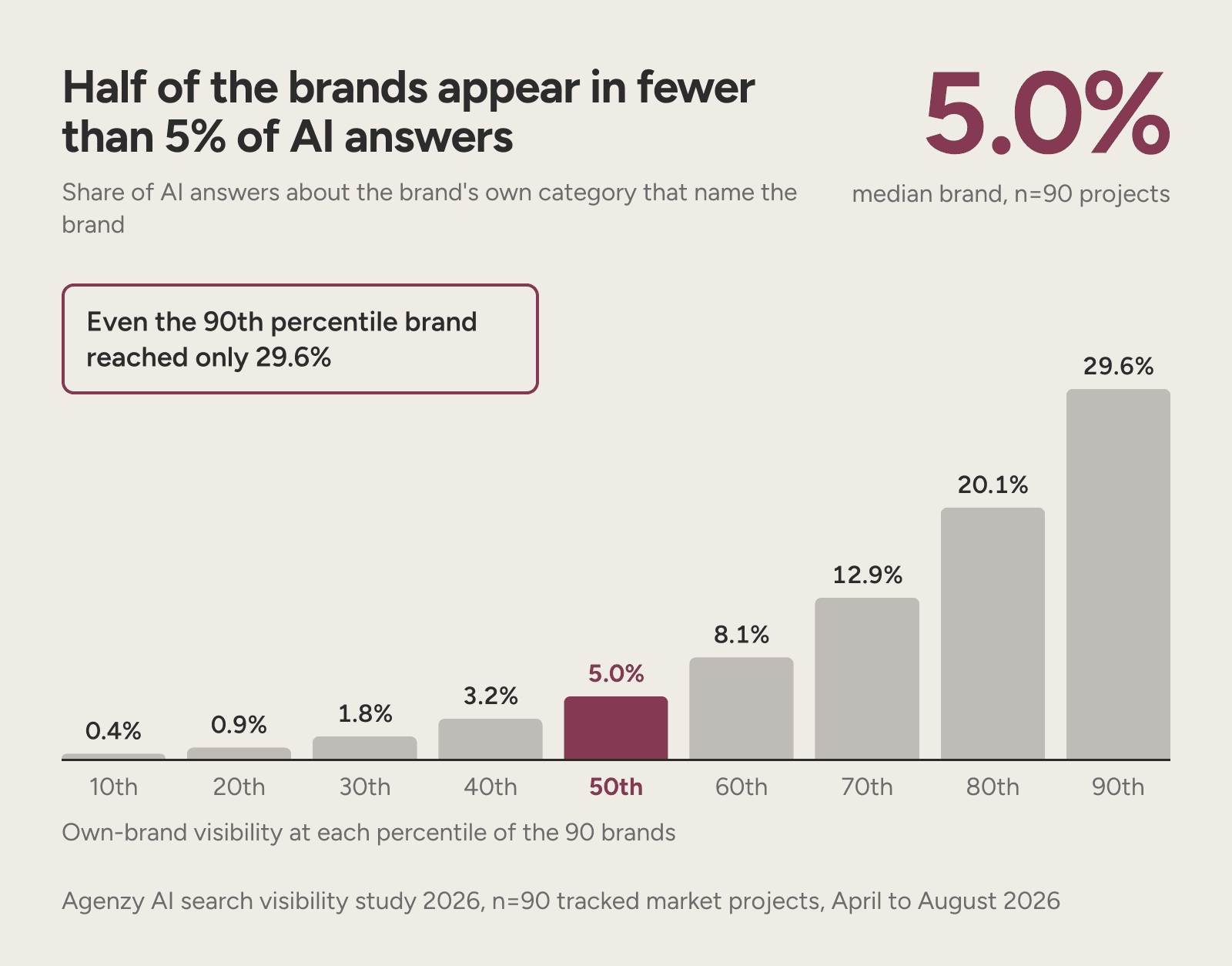
Even the 90th percentile brand reached only 29.6%. At the bottom, 20 of 90 brands appeared in fewer than 1% of answers, and 4 were never named during their tracking window.
Set the median next to the mean and you see why we quote the median:
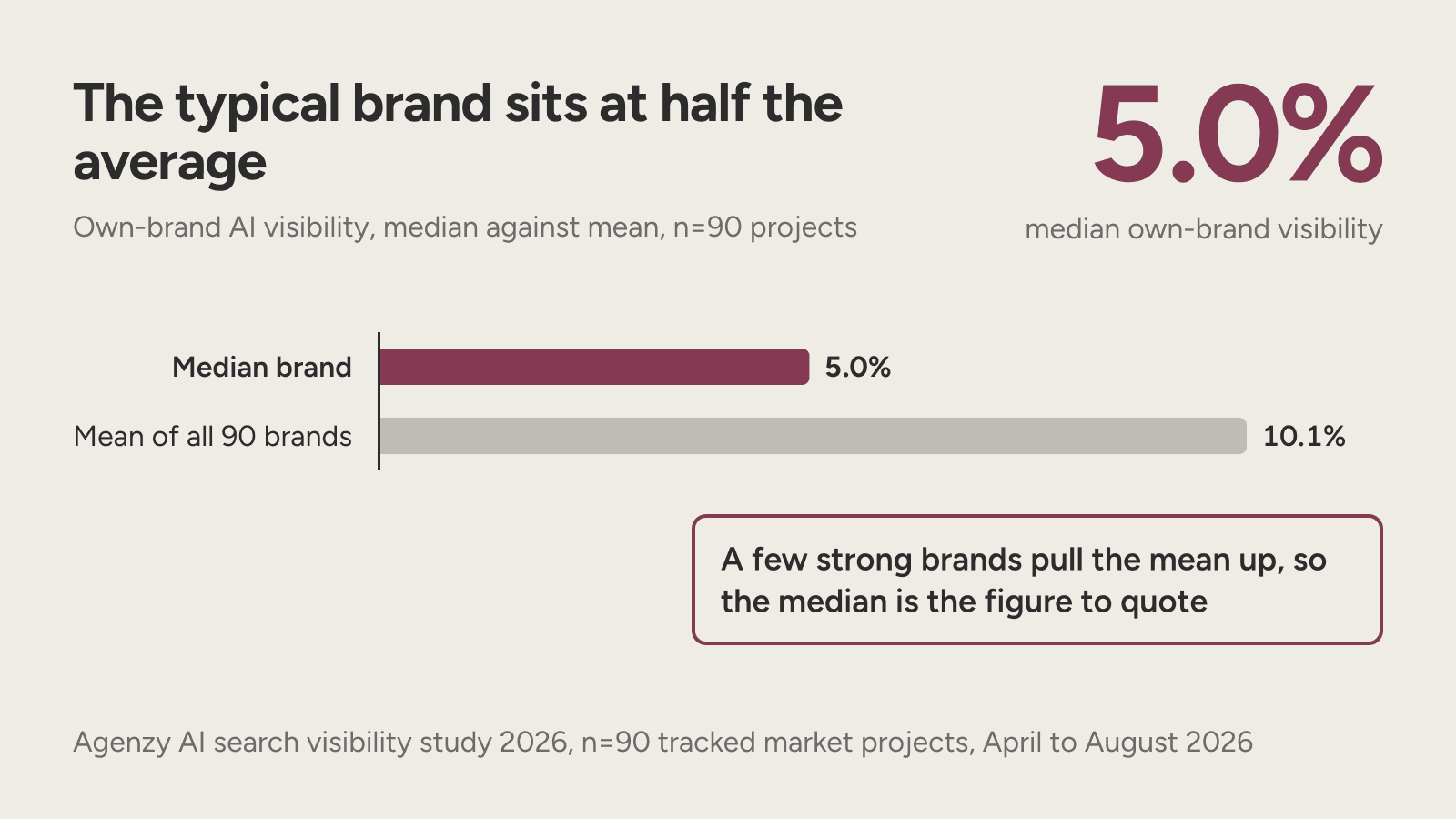
A few strong brands pull the mean up to 10.1%, about twice the median.
In Agenzy's 2026 dataset of 90 tracked market projects, 72% of brands appeared in fewer than 15% of AI answers in their category, and only 1 of 90 exceeded 40%. Split into bands, the 90 brands look like this:
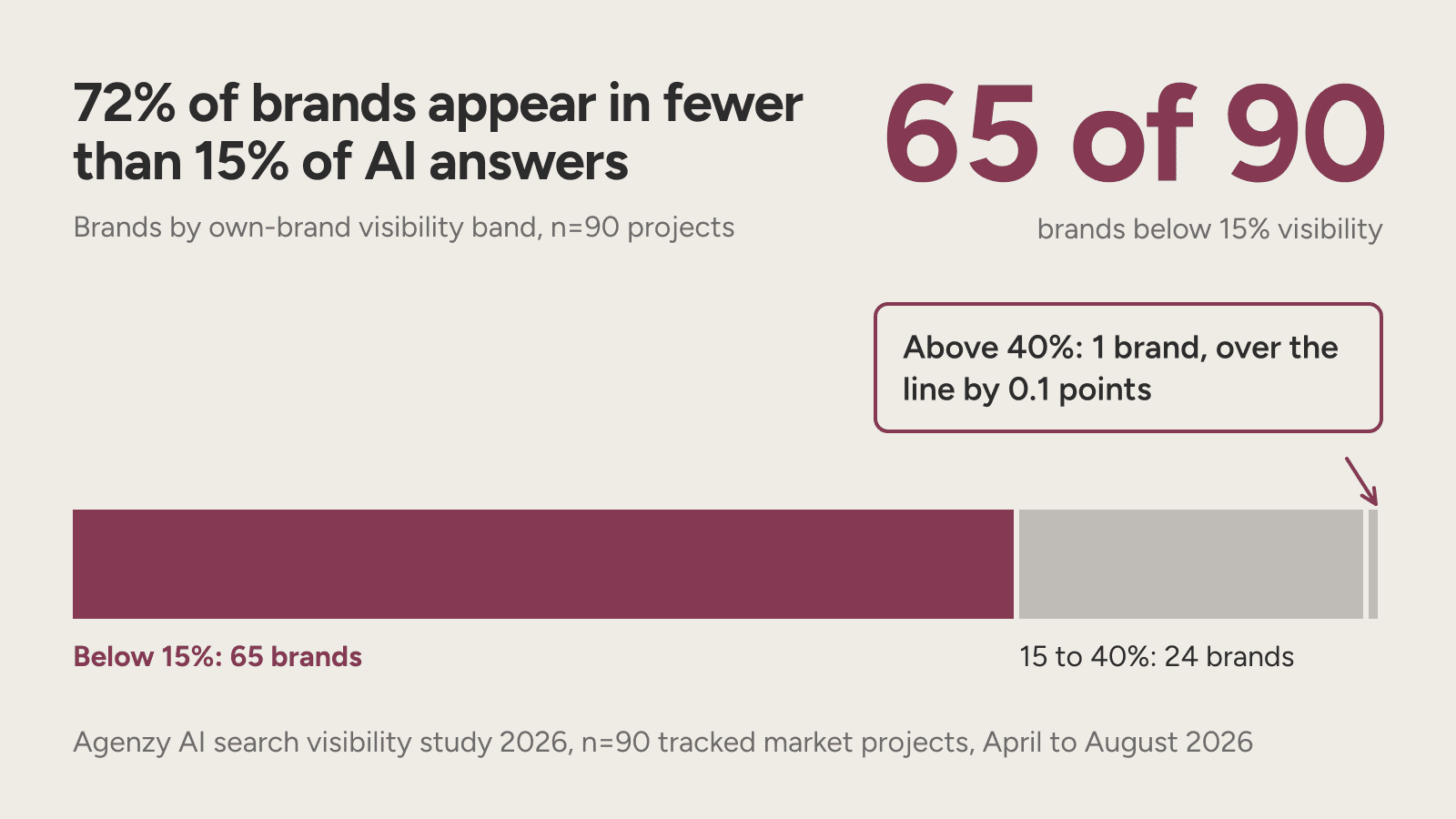
65 of 90 brands sit below 15%, 24 sit between 15 and 40%, and the single case above 40% clears the line by 0.1 points.
Inside their own competitor sets, few brands lead:
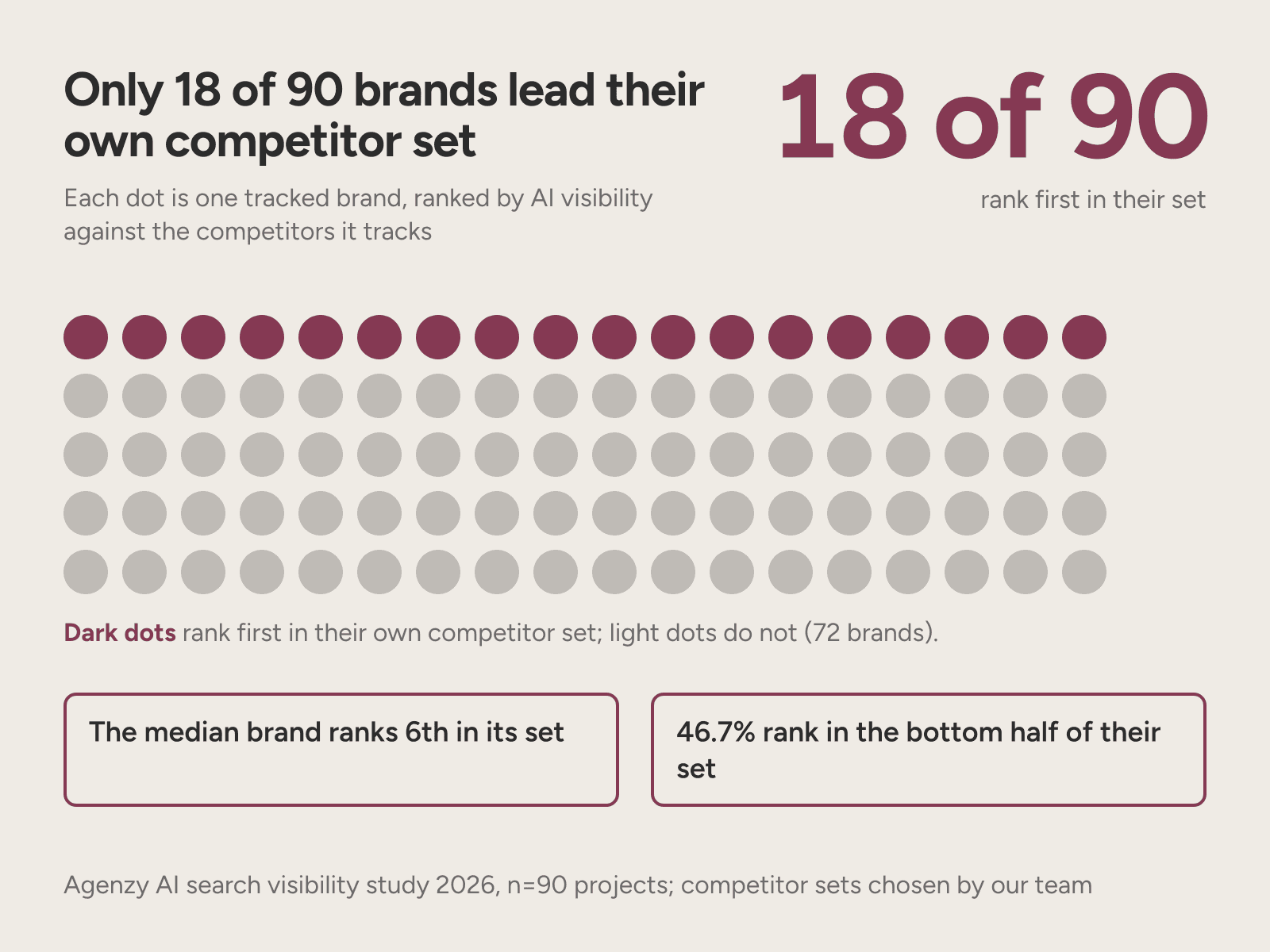
Only 18 of 90 brands were the most visible in their own set, and the median brand ranked 6th. Our team chose these sets and usually included the strongest local players, so 6th is measured against a strong field.
When engines do name a brand, they list it at a median position of 3 (n=83), and only 4.8% of brands average worse than position 5. Getting into the answer is the hard part, and once a brand is in, it usually sits near the top.
Part of the reason is that engines answer from a short list of sources. Our larger source study, published in September 2026, covered 138 projects from January 2025 to September 2026 and found that inside a single project a median of 23 domains covers half of the citations.
Outside data shows the same uneven spread among brands. Louise Linehan, Content Marketer at Ahrefs, studied 75,000 brands in Google AI Overviews: brands in the top quarter for web mentions averaged 169 AI Overview mentions, over 10 times the 14 of the quarter below them.
Set your first target as being named at all. For a median brand, reaching the 70th percentile means moving from 5.0% to 12.9% of answers.
39% of mentioned brands never had their own site among the top 30 cited sources
Agenzy's 2026 study found that 39% of brands mentioned by AI engines never had their own website among the top 30 sources those engines cited (n=87 mentioned brands, 2026-04 to 2026-08).
A mention means the engine names the brand in its answer, and a citation means it lists a URL as a source for that answer. A mention without a citation looks like this:
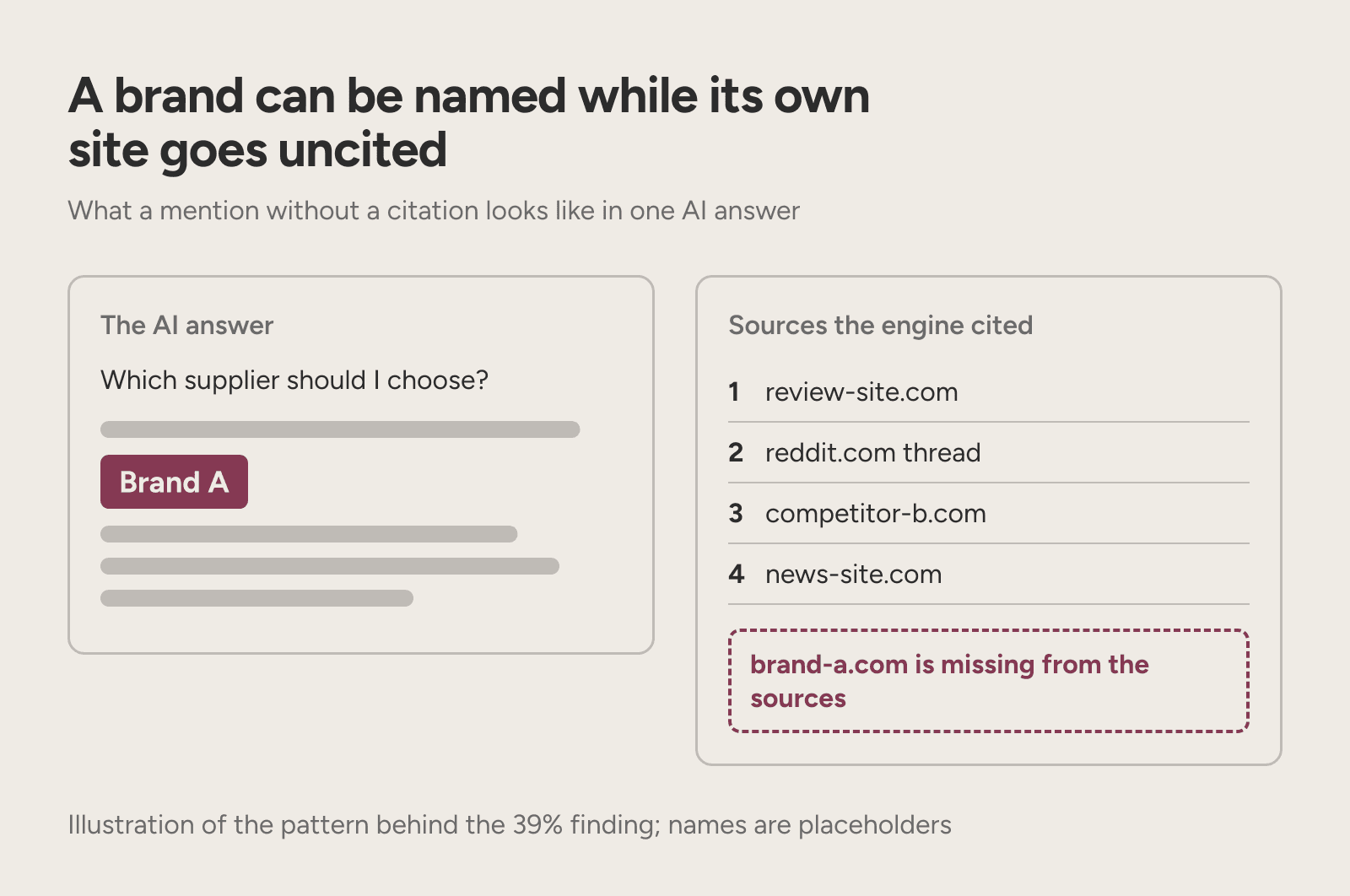
The engine names the brand and builds the answer entirely from other websites, so the brand has no say in how it is described.
How often does a mentioned brand's own site make the cited sources? The bar answers it:
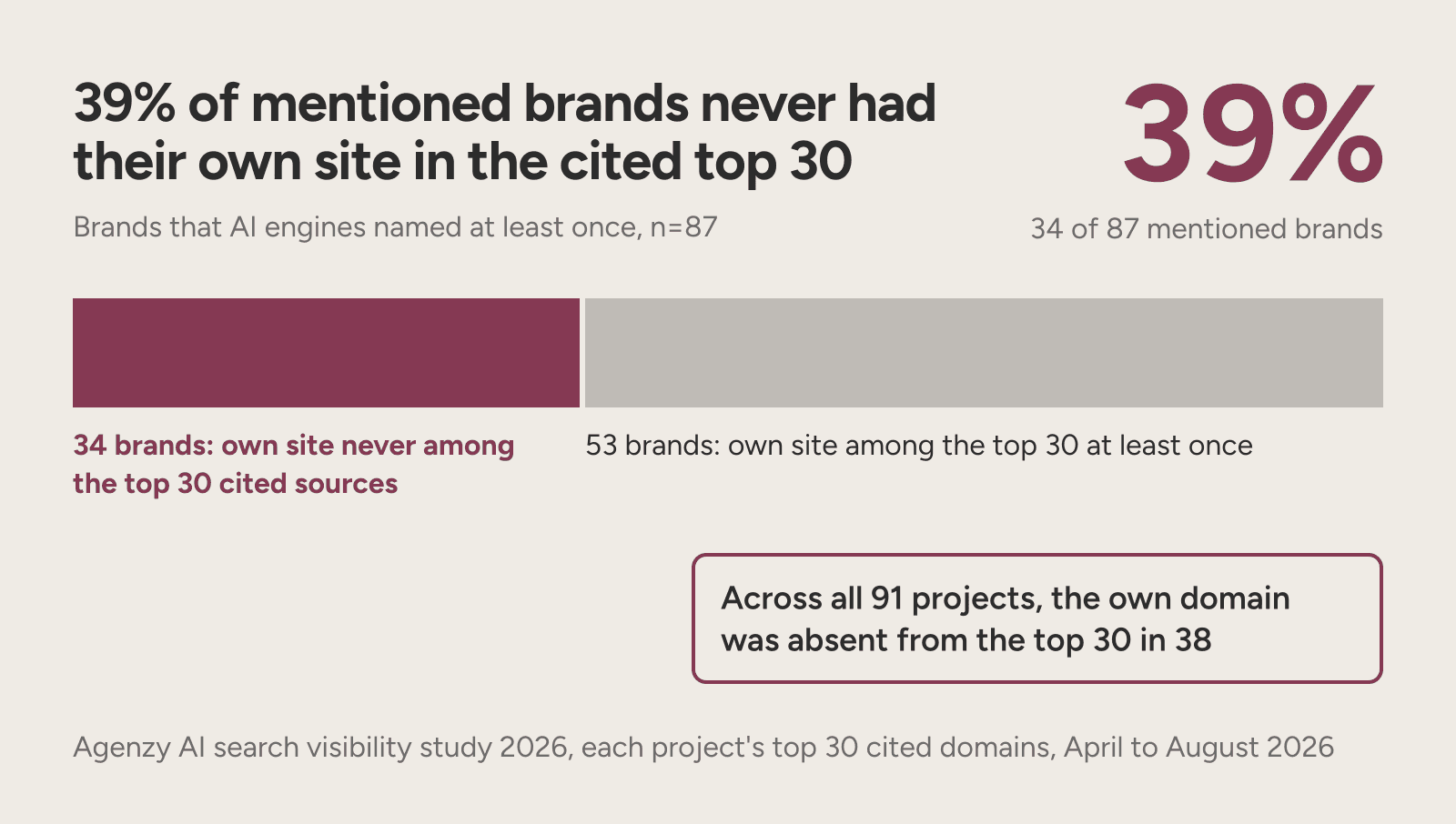
34 of 87 mentioned brands never had their own website in the top 30. Counting all 91 projects, mentioned or not, the brand's own site was missing from the top 30 in 38. When it did appear, its median rank was 6, and only 11 of 91 projects had their own site as the most cited source in their market.
Across 497,883 AI citations analysed by Agenzy in 2026, brands' own websites earned just 4.6% of citations, while competitor and third-party corporate sites took over 60%. Here "competitor" means the rivals each project chose to track, so the split changes if the tracked rivals change. The citations break down by type of source like this:
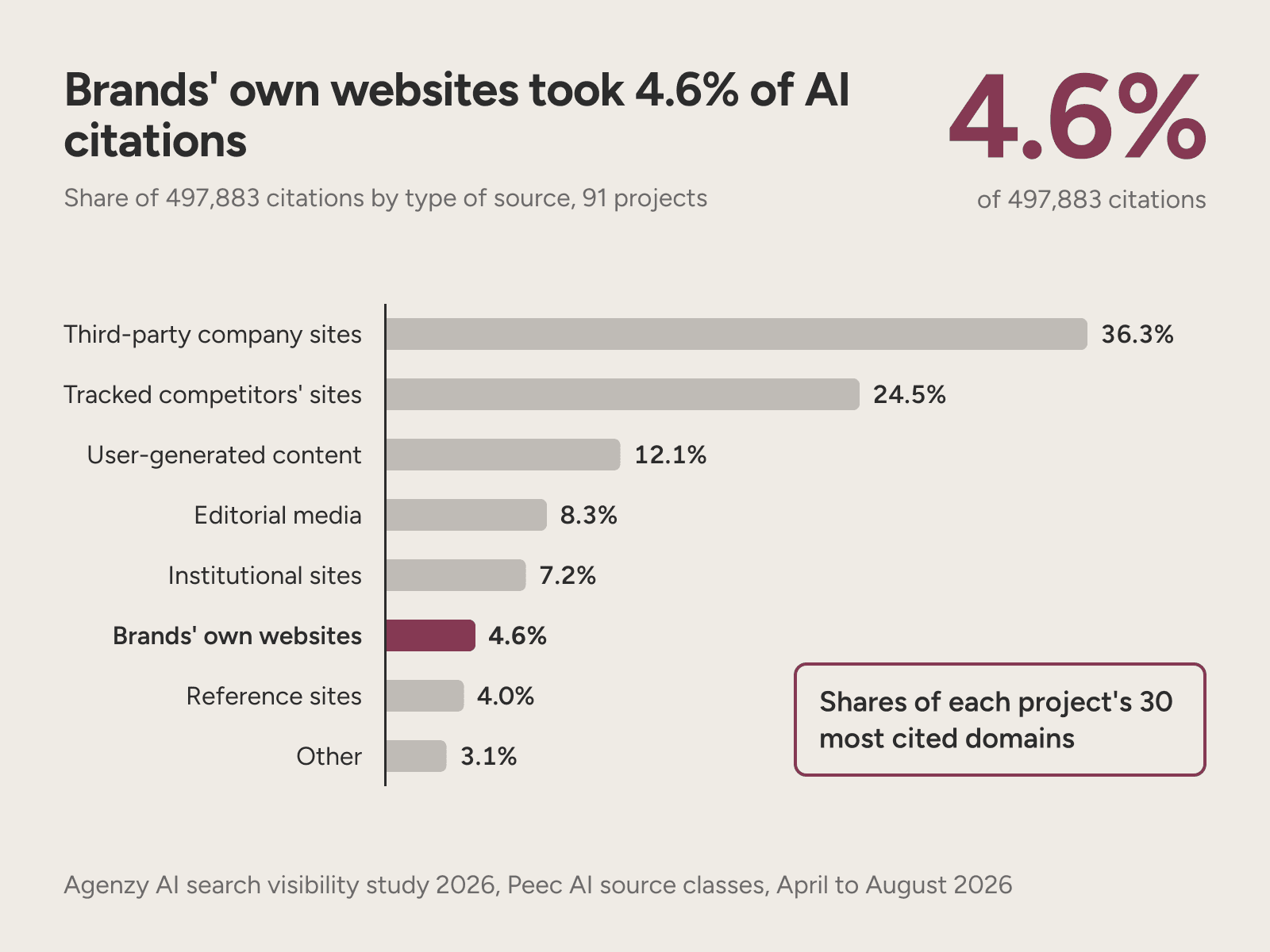
Third-party company sites took the largest share, at 36.3%.
Sidenote: the 4.6% is a share of each project's top 30 cited domains. Own-site citations further down the list go uncounted, so the true share is slightly higher.
The same Ahrefs study by Louise Linehan points the same way: across its 75,000 brands, branded web mentions correlated with AI Overview visibility at 0.664, against 0.218 for backlinks. What other websites say about a brand predicts its AI visibility better than its own links do. We saw this inside one company in why AI reads your site and recommends a competitor.
Give engines a page of your own they can cite for the questions where they already name you. Start with the prompts where you are mentioned and your site is missing from the sources, and publish a page that answers that exact question.
That work sits at the core of what GEO is. We measure first, then fix crawler access, then build content and third-party sources, which is how we structure a GEO engagement. In our B2B SaaS case study, the client's site was closed to AI crawlers when we started in May 2026. Ninety days after we opened it and published pages for its buyers' questions, the client held 98% share of voice on its core category prompt.
Reddit is a top-cited source in 84% of markets
Reddit appeared among the top-cited sources for 84% of the 91 business projects in Agenzy's 2026 AI search study - more than any other domain on the internet.
That is a share of projects, measured in each project's 30 most cited sources, so Reddit is a top source in nearly every tracked market. The open platforms compare like this:

Reddit's bar is more than twice as long as Facebook's, while business directories barely register. The numbers behind each platform:
Reddit: It was a top-cited source in 84% of projects and the largest single domain by volume, with 34,266 citations.
Facebook: It was a top-cited source in 37% of projects.
YouTube: It was a top-cited source in 24% of projects.
Business directories: The two counted, imones.lt and visalietuva.lt, collected 137 citations out of 497,883, a share that rounds to zero.
Here is one answer from our own tracking where a Reddit thread leads the sources:

Google's AI Overview put a Reddit discussion first among the 11 sources it used and cited it 4 times, so the answer a buyer read was built first from a forum thread.
Sidenote: the larger source study counted Reddit in 60.9% of its 138 projects when it looked only at each project's 30 most cited sources, as this study does, and in 92.8% when it counted all sources. Each figure holds for its own sample and window, and we have not merged them.
Si Quan Ong, SEO and Marketing Educator at Ahrefs, found Reddit at the top of ChatGPT's cited domains too, with 16.8% of citations on US queries in September 2026 (Ahrefs).
Take part in the threads that engines already cite for your category. Ethan Smith, CEO of Graphite, names "landing pages, YouTube videos, and Reddit comments" as the three tactics that work in his guide to answer engine optimization on Lenny's Newsletter, and he warns against spam. In practice, answer the question in the thread with something useful, under your own name.
Further reading: our study of 2,283,923 AI citations.
A brand's best and worst AI engine differ by 5.1x
Agenzy's 2026 study measured a median 5.1x visibility gap between a brand's best and worst AI engine, and 30% of visible brands were completely invisible on at least one engine (n=86 brands visible somewhere, 2026-04 to 2026-08).
The same brand looks different on each engine:
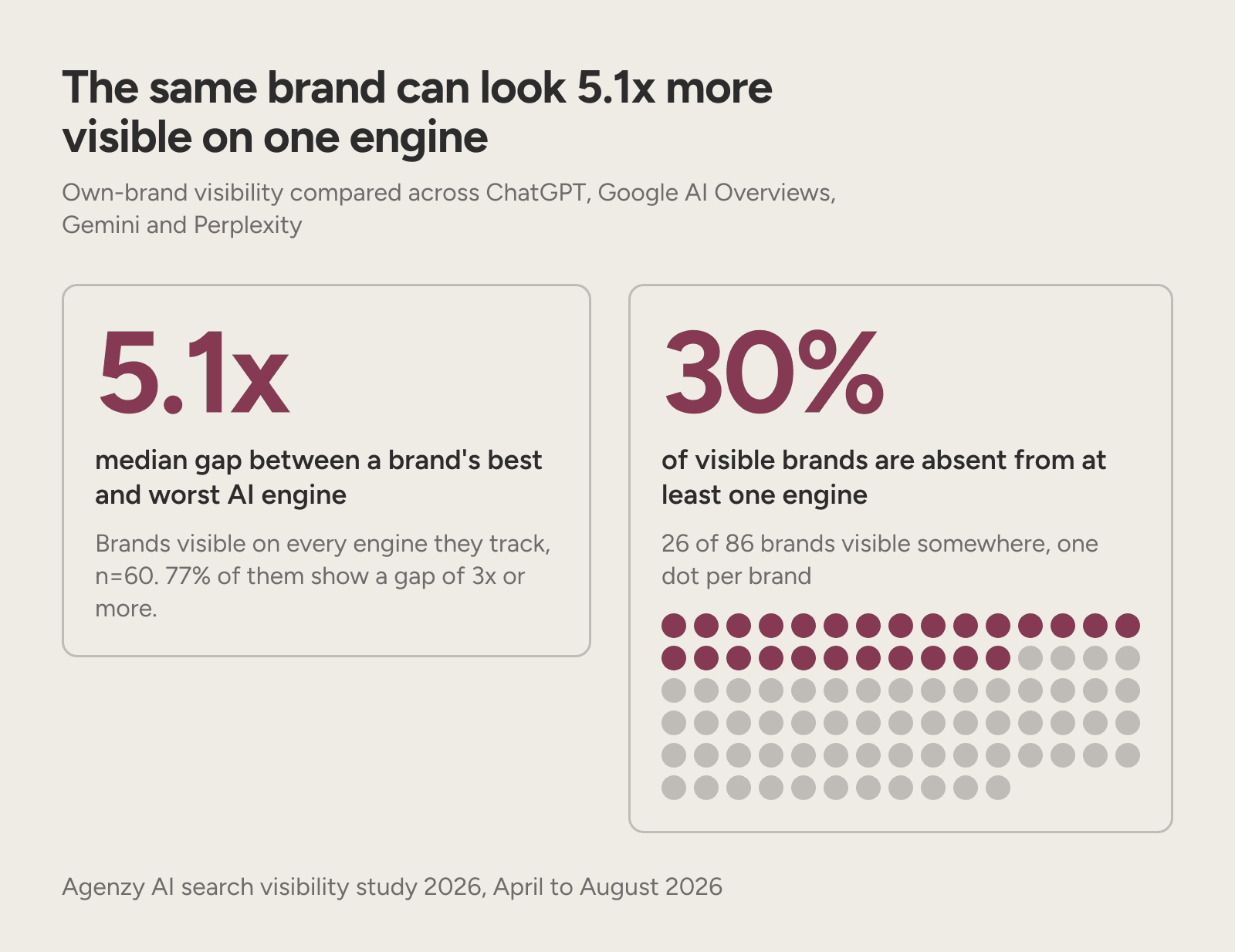
The 5.1x is the median over the 60 brands that were visible on every engine they track, and 77% of those 60 show a gap of 3x or more. The other 26 of the 86 visible brands were missing from at least one engine entirely.
Each engine's median, with the number of projects behind it:
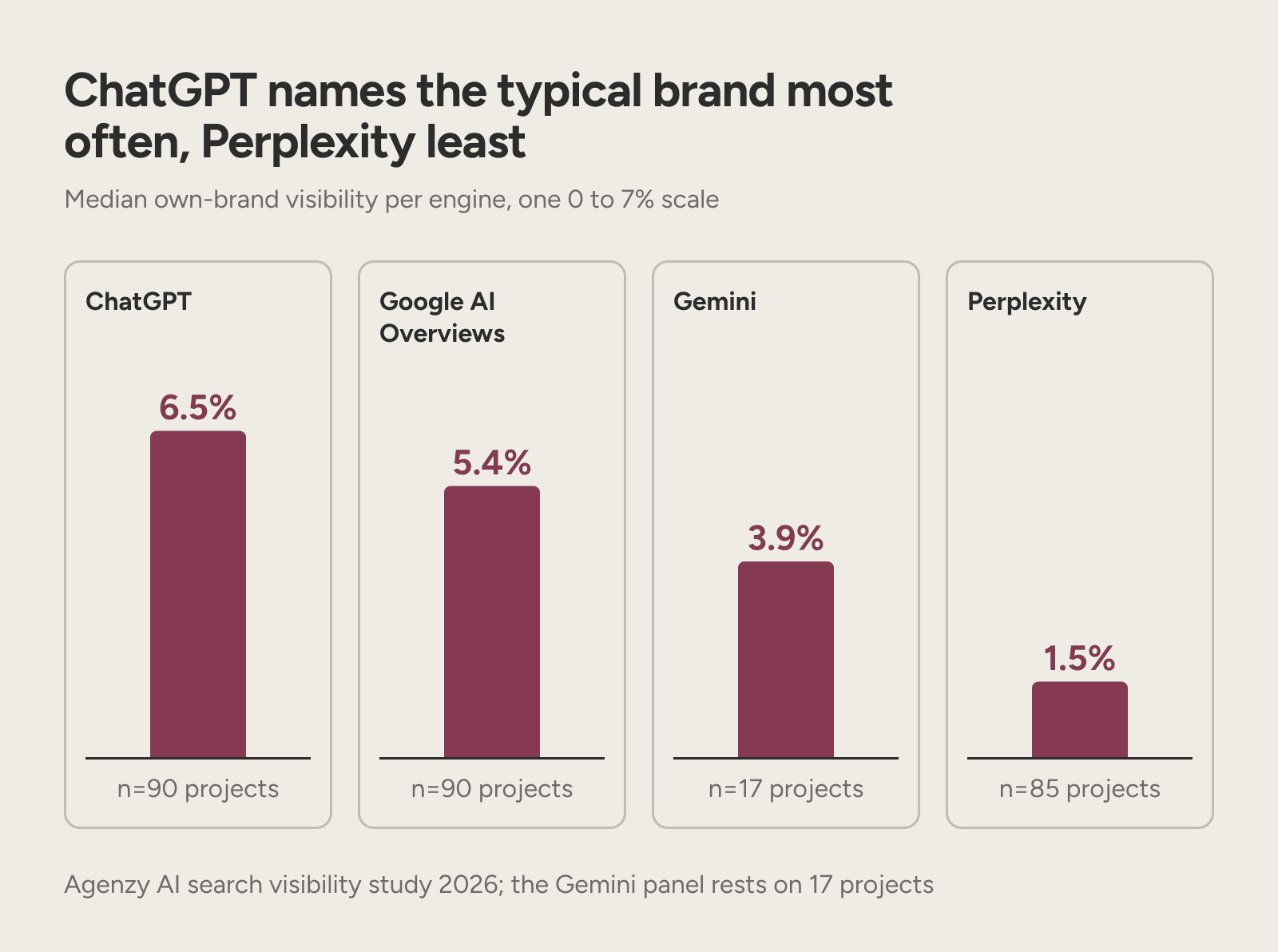
ChatGPT names the typical brand most often at 6.5%, Google AI Overviews follows at 5.4%, and Perplexity names it least at 1.5%.
Sidenote: the Gemini median of 3.9% rests on 17 projects, so read it as indicative. The Perplexity median covers 85 projects because 86 tracked it and the one brand left out of every visibility figure is not counted.
The engines differ because each reads from its own index. Christina Blake, Director of Product, and Alisa Scharf, Chief AI Officer, at Seer Interactive found that 87% of SearchGPT citations matched Bing's top organic results, against 56% for Google (Seer Interactive). AI Overviews draw on Google's own search index instead, and Google states that "There are no additional requirements to appear in AI Overviews or AI Mode, nor other special optimizations necessary" (Google Search Central). So a brand that is strong in Bing can show up in ChatGPT and be missing from AI Overviews, and the other way round. We explain the logic per engine in how AI engines decide which brands to recommend.
Measure every engine separately before you decide anything. Track the same buyer questions daily on all four engines and read each one on its own. Our guide to prompt tracking covers the setup, and AI share of voice, explained covers the number to report. The free route is to ask ten buyer questions in a logged-out ChatGPT window and in Google and note who gets named. For all four engines over several weeks, a free AI visibility audit runs it for you.
Comparison pages earn a 1.6x higher citation rate than homepages
In Agenzy's 2026 study, comparison-style pages earned a 1.6x higher median citation rate from AI engines than homepages, yet homepages still absorbed 29% of all citations (n=2,730 top-cited URLs across 91 projects).
The two page types side by side:

When an answer uses a comparison page, the engine cites it a median of 1.70 times, against 1.06 times for a homepage.
Rate measures how hard engines cite a page type, volume measures its share of all citations, and the two disagree:
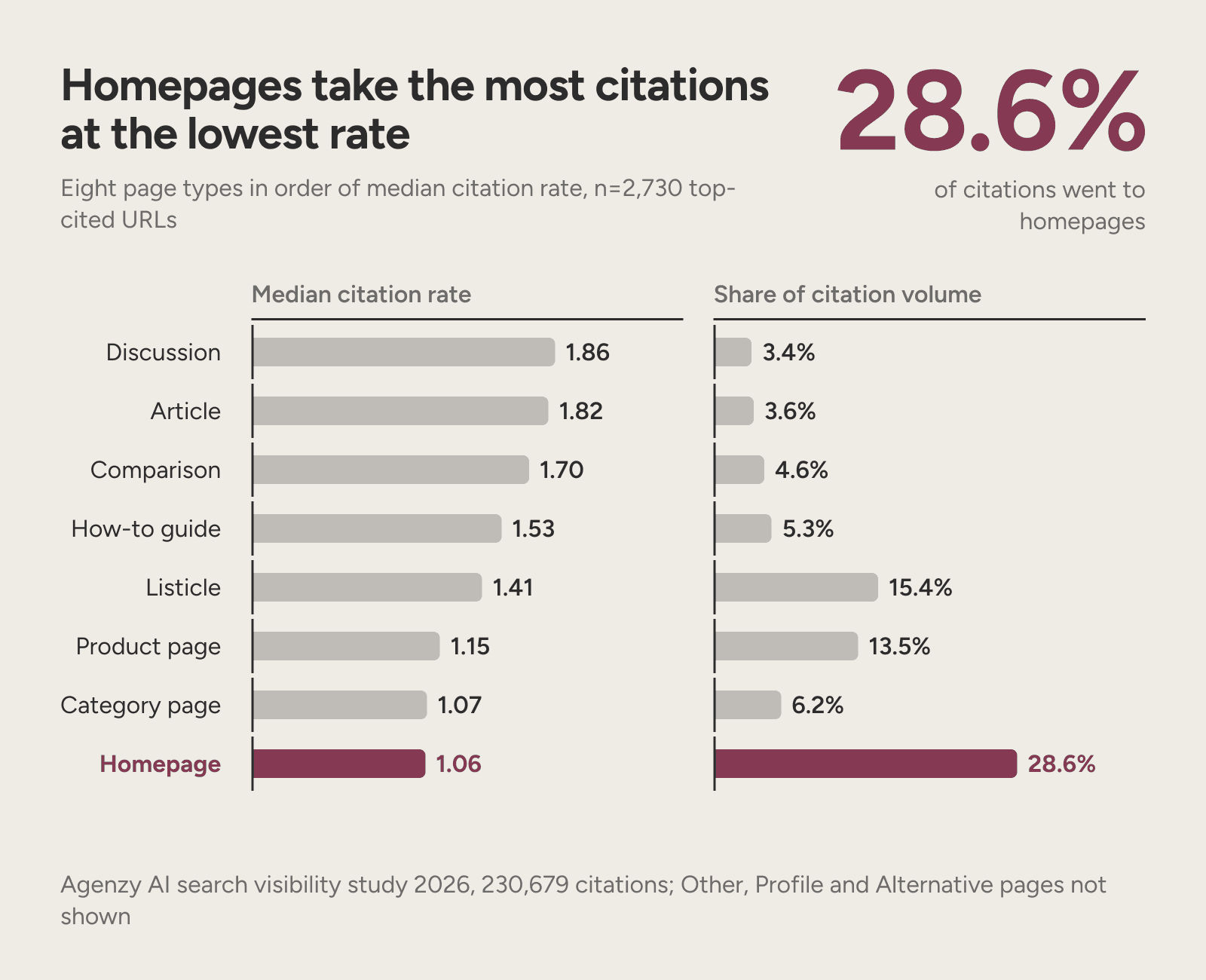
Homepages absorb 28.6% of citations because they are what most businesses publish, even though engines cite every other page type in the list harder. The full league, by median citation rate, with each type's share of volume:
Discussion pages: 1.86, with 3.4% of volume.
Articles: 1.82, with 3.6% of volume.
Comparison pages: 1.70, with 4.6% of volume.
How-to guides: 1.53, with 5.3% of volume.
Listicles: 1.41, with 15.4% of volume.
Product pages: 1.15, with 13.5% of volume.
Category pages: 1.07, with 6.2% of volume.
Homepages: 1.06, with 28.6% of volume.
Comparison pages matter most to a business because it can publish one about its own offer, which it cannot do with a forum thread.
Tom Wells of Peec AI found that ChatGPT also cites list-style pages hard, in a study of more than a million citations: "Listicles are just under one-fifth of all URLs and 52% of them are cited more than twice per answer." In our data, listicles also sit above homepages, at 1.41.
Publish comparison and how-to pages for the questions your buyers ask. A page that sets your offer next to the alternatives, with prices, use cases and limits, gives engines a passage worth citing, and our content service writes these pages for the prompts a client tracks.
How this compares with other studies
Other studies measure different engines, markets and units, so the exact numbers differ, and the direction mostly holds:
Reddit's share moves fast: Luke Harsel at Semrush tracked more than 230,000 prompts over 13 weeks in 2025 and found ChatGPT citing Reddit in close to 60% of responses in early August and around 10% by mid-September (Semrush). Our 84% is a share of projects, so it says nothing about how much of each answer Reddit takes.
Comparison pages are rare: AirOps, using Wix AI Search Lab data, reports that "Product alternative and comparison pages pull less than 3% of citations" (AirOps). That matches our volume figure of 4.6%, and our rate figure adds that engines cite these pages harder whenever they exist.
Our larger study only partly repeats the 1.6x: Counting each project's 30 most cited pages, our September study of 138 projects measured a 1.47x gap (n=4,140 URLs). Counting all pages, the two medians fall to 0.641 for comparison pages and 0.667 for homepages, because the long tail holds many pages cited once or never.
Zero visibility is rarer here: In Louise Linehan's Ahrefs study, 26% of brands had no AI Overview mentions at all. In our dataset 4 of 90 brands were never named, which fits a sample of businesses already investing in being found.
Our read: the direction of each finding is solid, and the exact figures belong to this sample and window. Treat the 1.6x as a result about top-cited pages.
FAQ
We track our own site in Peec AI too. These are the questions, asked of AI engines in the last 30 days, that led them to cite this study:
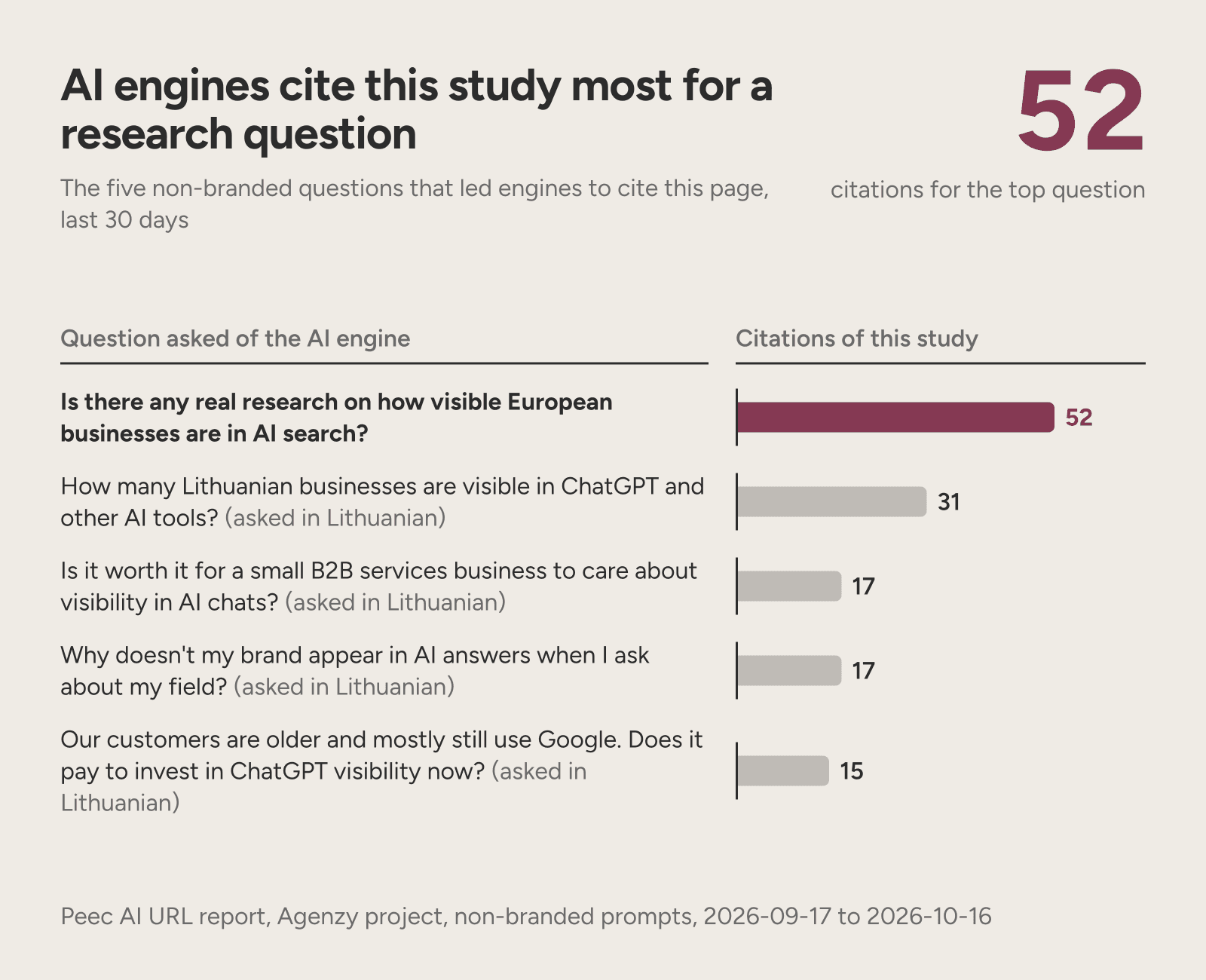
The most cited is an English request for "actual 2026 data on how often ChatGPT mentions brands", which the first answer below covers.
How visible are European businesses in ChatGPT and other AI engines?
Barely. Agenzy's 2026 study of 187,810 AI answers found the median European SMB brand appears in just 5% of AI answers about its own product category (n=90 tracked market projects, 2026-04 to 2026-08). Only 1 of 90 brands exceeded 40%.
Does ChatGPT cite brand websites as sources?
Less often than it names the brands. Agenzy's 2026 study found that 39% of brands mentioned by AI engines never had their own website among the top 30 sources those engines cited (n=87 mentioned brands, 2026-04 to 2026-08).
Which websites do AI tools cite most often?
Reddit appeared among the top-cited sources for 84% of the 91 business projects in Agenzy's 2026 AI search study - more than any other domain on the internet. Facebook followed in 37% of projects and YouTube in 24%.
Do different AI engines recommend the same brands?
Often they do not. Agenzy's 2026 study measured a median 5.1x visibility gap between a brand's best and worst AI engine, and 30% of visible brands were completely invisible on at least one engine (n=86 brands visible somewhere, 2026-04 to 2026-08).
What is the difference between an AI mention and an AI citation?
A mention means the engine names a brand in its answer text, and a citation means it lists a URL as a source for that answer. Peec AI's documentation describes citations as "the sources explicitly referenced in the final answer".
Final thoughts
The typical European business appears in 5% of AI answers about its own category, and AI engines describe many brands entirely from other people's websites. Getting named is the hard part, and most of what decides it sits off your own site.
This week, run ten questions your buyers ask through ChatGPT and Google AI Overviews, and write down who gets named and which sites get cited. That list is your starting point.
If your own numbers look different from ours, write to Emilis Zabilius, Agenzy's co-founder, on LinkedIn. We'd like to hear what you found.