AI visibility does not travel with a brand from one country to the next. Each market has its own prompts, its own cited sources and its own engine mix, so a brand that ChatGPT names at home usually starts near zero abroad. This page measures six European markets with one method: Lithuania, Latvia and Estonia for our own brand, Greece, Poland and Spain for clients.
We hold no German client data. The mechanism is the same in every market, and the Germany section further down runs the same four checks on Germany from public data. The checks run the same way on any other market.
Our own agency is the first example. Agenzy appears in 35.2% of AI answers about GEO agencies in Lithuania, 5.5% in Latvia and 3.1% in Estonia. Each figure comes from 75 buyer prompts per market with no brand name in them, run on ChatGPT, Google AI Overview and Perplexity. Lithuania was measured on 2026-08-05 against 15 tracked brands, Latvia and Estonia on 2026-08-25 against 50 and 36 tracked brands.
In Agenzy's 2026 study of 187,810 AI answers (2026-04 to 2026-08), the projects tracking a brand in a second country sit at a median visibility of 1.0% (n=12).
Does AI search visibility carry over from one country to another?
No. AI visibility by country is earned market by market, and the numbers a brand holds at home say almost nothing about the next country. The cleanest evidence we hold is our own brand, measured with one method in three markets.
Ask an AI engine which GEO agency to hire and the shortlist changes at each border. In Lithuania the most-named agencies are Agenzy, Insite, Digital Star, AISEO.lt and EASYSEO. In Estonia they are Nobel Digital, Maison Mint, SECRO Solutions and, in fourth place, Agenzy. In Latvia they are Marketing Hackers, Moza Agency, Agenzy, JKonsult and Omnius.
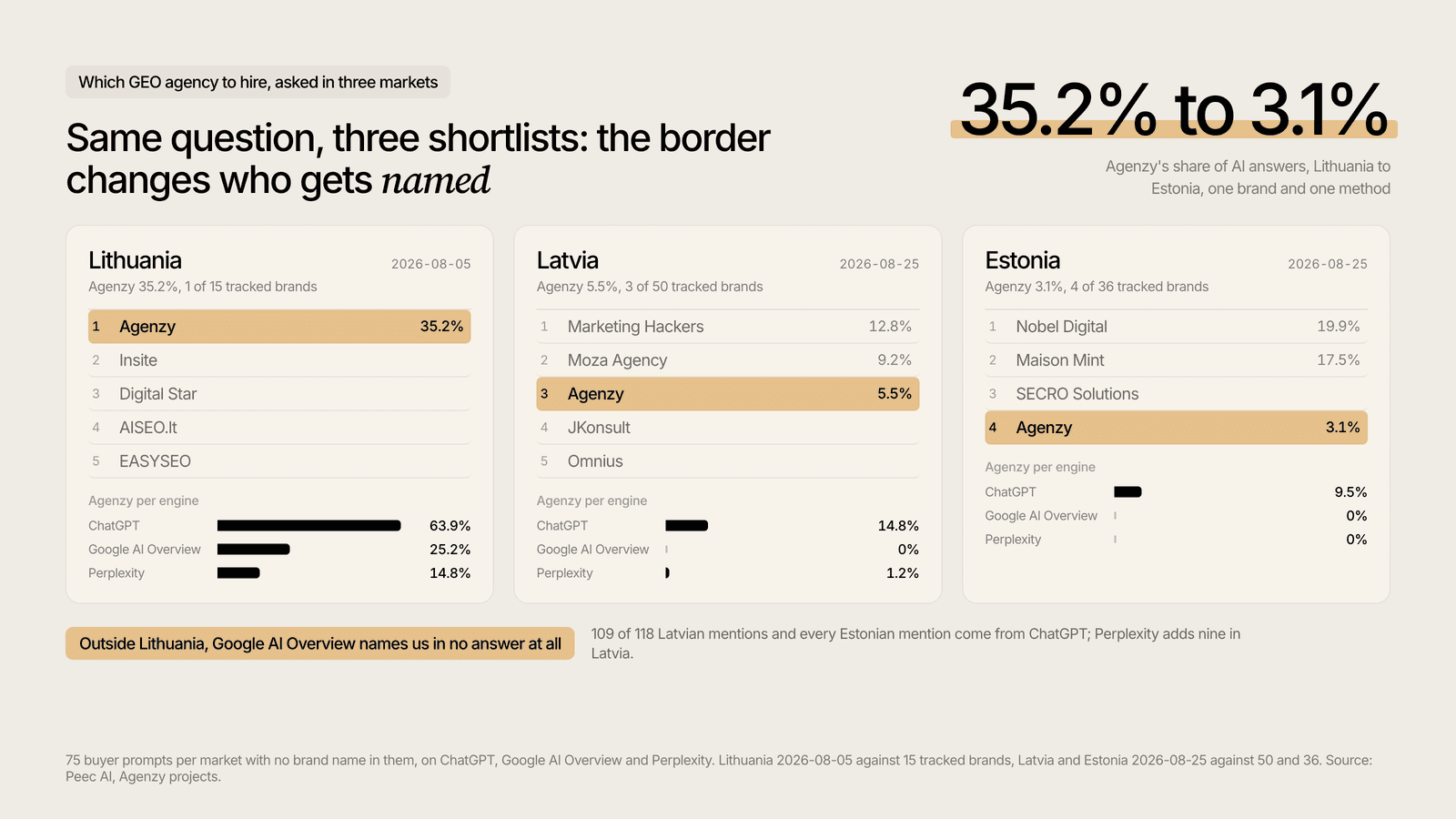
75 buyer prompts per market with no brand name in them, on ChatGPT, Google AI Overview and Perplexity; Lithuania 2026-08-05, Latvia and Estonia 2026-08-25. Source: Peec AI, Agenzy projects.
Market | Agencies named most often, in order (all three engines) | Agenzy, all engines (rank) | Agenzy in ChatGPT answers | Measured |
|---|---|---|---|---|
Lithuania | Agenzy, Insite, Digital Star, AISEO.lt, EASYSEO | 35.2% (1 of 15) | 63.9% | 2026-08-05 |
Latvia | Marketing Hackers, Moza Agency, Agenzy, JKonsult, Omnius | 5.5% (3 of 50) | 14.8% | 2026-08-25 |
Estonia | Nobel Digital, Maison Mint, SECRO Solutions, Agenzy | 3.1% (4 of 36) | 9.5% | 2026-08-25 |
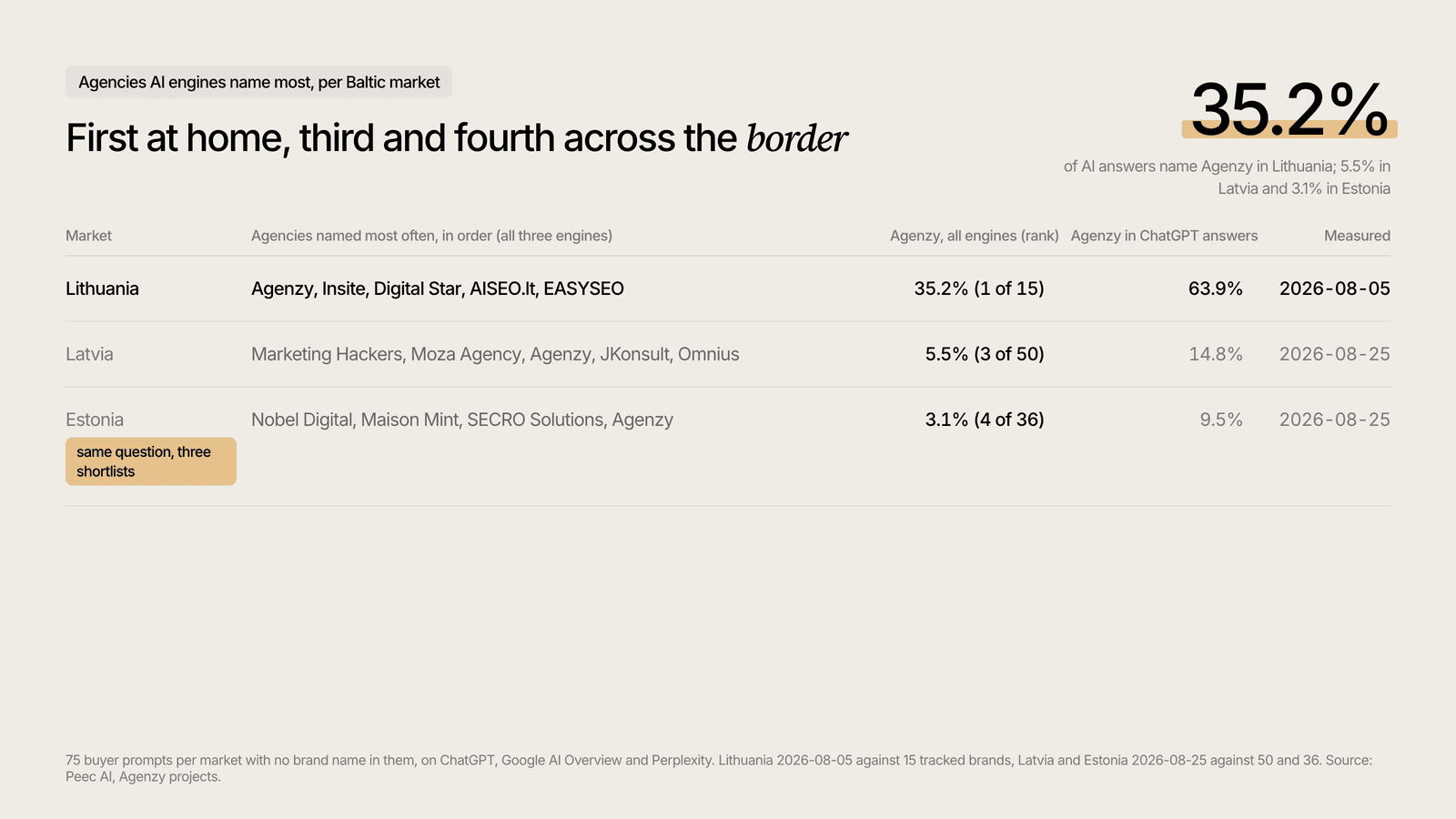
Same source as the chart above: 75 prompts per market, Lithuania against 15 tracked brands, Latvia and Estonia against 50 and 36, Peec AI.
Per engine in Lithuania, Agenzy holds 63.9% on ChatGPT, 25.2% on Google AI Overview and 14.8% on Perplexity. In Latvia, ChatGPT names us in 14.8% of answers, Google AI Overview in 0% and Perplexity in 1.2%; the Latvian ChatGPT share matches the Lithuanian Perplexity share by coincidence only. In Estonia, ChatGPT names us in 9.5%, Google AI Overview in 0% and Perplexity in 0%.
Google AI Overview names us zero times in both new markets and Perplexity nine times in Latvia, so 109 of 118 Latvian mentions and every Estonian mention come from ChatGPT. Each Baltic set is 75 prompts on the first full day of tracking, 2,120 responses in Estonia and 2,141 in Latvia. The Lithuanian figure comes from a one-day run of the same 75-prompt format three weeks earlier. The full method sits in the Agenzy case study.
The sources behind the answers change with the question as well. Asked in Lithuanian which agencies in Lithuania do GEO best, ChatGPT reads apgmedia.lt, agenzy.lt, aiseo.lt, insite.lt, ainora.lt, digitalstar.lt, verslosavaite.lt and paslaugos.lt. Asked in Lithuanian which GEO agency suits a B2B SaaS company selling across Europe, it reads apgmedia.lt's service page, Agenzy's English study, a growpad.pro listicle of European agencies, team4.agency in London, derivatex.agency, Profound's index report, Semrush's topic study, the aeovision.ai directory, topstuttgart.com and a beomniscient.com listicle.
The Lithuanian agencies vanish from the source set the moment the question says Europe. The answer is assembled from listicles and agency pages that carry the words B2B SaaS and Europe, and Agenzy is named in 2.4% of answers to that prompt.
Both source lists are Peec AI pulls from our Lithuanian tracking project over the 14 days to 2026-09-07, one for the Lithuanian agency prompt set and one for the European B2B SaaS prompt. The Estonian and Latvian source lists were not captured before those two projects closed, so the Baltic comparison rests on brands and visibility.
The brands that do hold Estonia and Latvia are full-service digital agencies the engines have known for years from SEO work: Nobel Digital at 19.9% and Maison Mint at 17.5% in Estonia, Marketing Hackers at 12.8% and Moza Agency at 9.2% in Latvia (same baselines, 2026-08-25). Three of the four list GEO among their services as of 2026-09-07.
What decides which market's brands an AI engine names?
The language of the question selects the market, and the exit IP, meaning the country the request is sent from, moves which brands inside that market are named. The two act separately, and the research below measured each on its own.
The clearest test is a paper by Dmitrij Żatuchin, "The Language of the Question Selects the Market" (arXiv 2608.30052, submitted 2026-08-30). Its subtitle is "Query Language and Exit IP as Separable Factors in Commercial Recommendations from a Generative Search Interface". The study ran 234 runs against the logged-out ChatGPT web interface and the OpenAI API, across four exit countries and six query languages.
The finding, in the paper's own words: "query language, and not location, decides whether local suppliers appear at all". Where the query language matched the country, "a global brand won 1 of 24 runs", so local suppliers won the other 23. Asked in English on the same connections, "local brands took 0 of 6 runs in Estonia and Turkiye". Estonian asked from Estonia "names a local supplier in every run and English names none".
A companion paper by the same author, "The Language Blind Spot" (arXiv 2606.23165, submitted 2026-06-22), measured the size of the effect on 66 brands from eleven Northern, Baltic and Central European markets, in twelve languages, over 35,640 responses. Moving from an English query to the brand's home language raised the recommendation share of local champions far more than it raised the share of global multinationals. The paper's conclusion is that an English-only audit understates a local champion's AI visibility.
Location works on the other axis. Żatuchin varies the exit country, so the same prompt answered from Germany, the United Kingdom and Belgium gives three separate measurements. Since the paper shows the exit country changes which brands inside a market get named, an answer pulled from head office describes head office only, and the unit worth measuring is one prompt set per country, each answered from inside that country. Peec AI, the tracking platform we run, works this way: one project per country, prompts run from the market's own location.
How does query fan-out change by language?
Query fan-out is the set of background web searches ChatGPT runs before it writes an answer, and for a non-English prompt a large share of those searches run in English. Peec AI's analysis of over 10 million prompts and 20 million fan-outs found that 43% of query fan-outs for non-English prompts are performed in English ("ChatGPT searches in English, even when you don't", Tomek Rudzki, 2026-02-12). The share varies by language: "Turkish queries switch to English most often at 94%, while Spanish is lowest at 66%."
Our own count for Lithuanian points the same way. Of the background searches ChatGPT ran behind our 94 tracked Lithuanian agency prompts between 2026-07-06 and 2026-08-05, 76% were in English, while the prompts themselves were all Lithuanian. ChatGPT kept Lithuanian mainly where the local entity mattered, such as "geo agentūra vilnius", and translated the rest before it touched the web. Our figure is one language on one prompt set; Peec's is many languages on 10 million prompts.
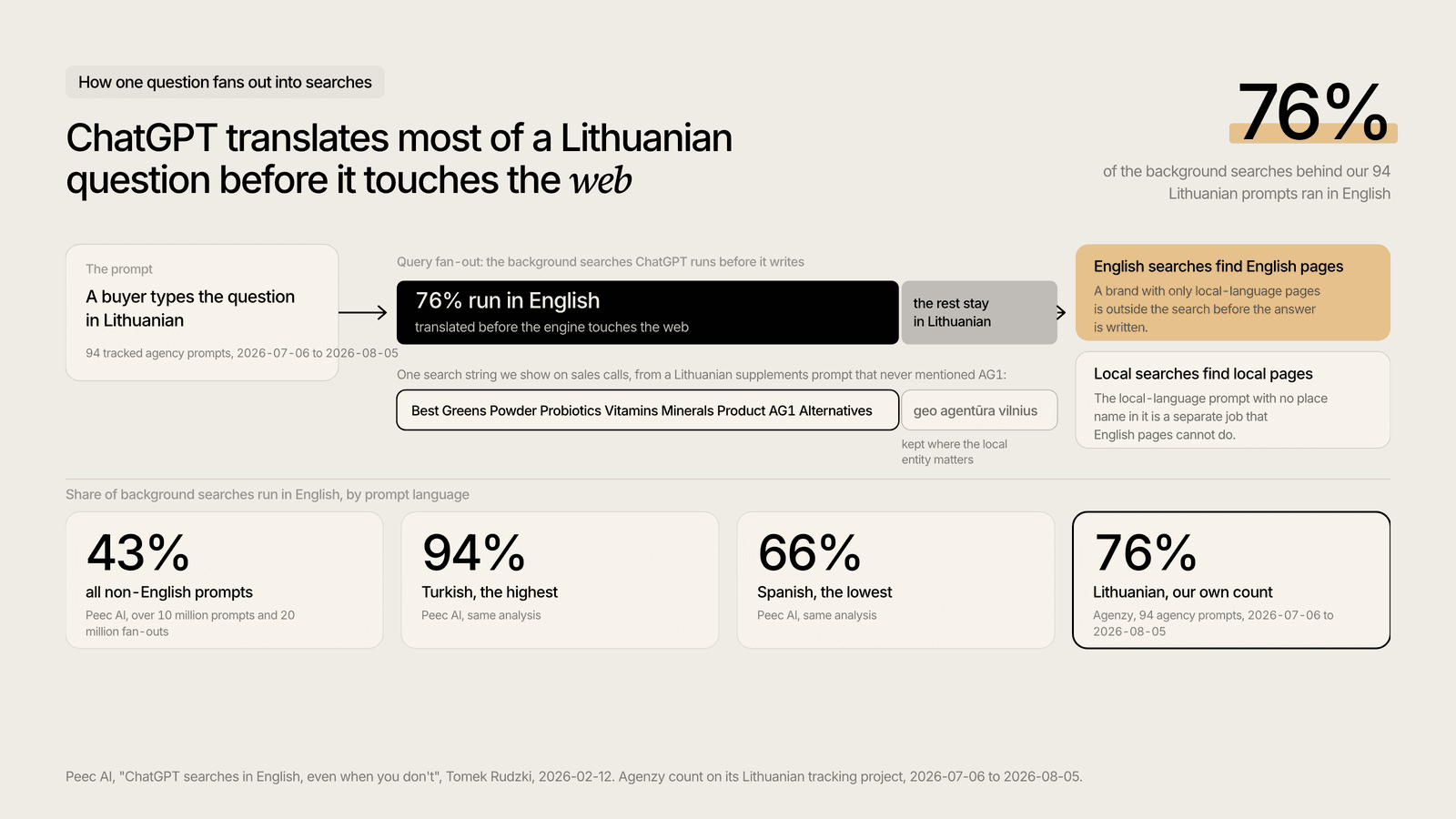
Peec AI, "ChatGPT searches in English, even when you don't", 2026-02-12; Agenzy count on 94 Lithuanian prompts, 2026-07-06 to 2026-08-05.
What the engine does with those English searches is the part that matters for a brand. On sales calls we show one search string. For a Lithuanian prompt about supplements that did not mention AG1, ChatGPT ran the search "Best Greens Powder Probiotics Vitamins Minerals Product AG1 Alternatives". The engine reached for the global category leader in English, and a Lithuanian brand with only Lithuanian pages was outside that search before the answer was written.
Radyant, a Berlin GEO agency, built its guide "Translate content to English to capture ChatGPT's hidden queries" (Niklas Buschner, 2026-03-06, updated 2026-08-15) on the same 43% figure. The guide is often read as "translate everything to English" and it says something narrower: "your local content dominates Google AI Overviews. Your English content captures ChatGPT's English fan-outs. Both versions can be cited in the same response." It carries no per-market measurement of one brand and no Baltic or Central European data.
How far does visibility fall in a second market?
Projects tracking a brand in a second country sit at a median of 1.0% (n=12) in Agenzy's 2026 AI search visibility study, against a median of 5% across all 90 tracked market projects and 5.9% across the 78 that track a brand in its home market. The study keeps the expansion figure out of its headline findings because the subset is small and skews to young expansion projects, so part of the gap is age and part is market.
Three client markets from our live tracking show the gap against a category leader. Each figure is a 30-day window ending 2026-09-07, measured on that market's own tracked prompts.
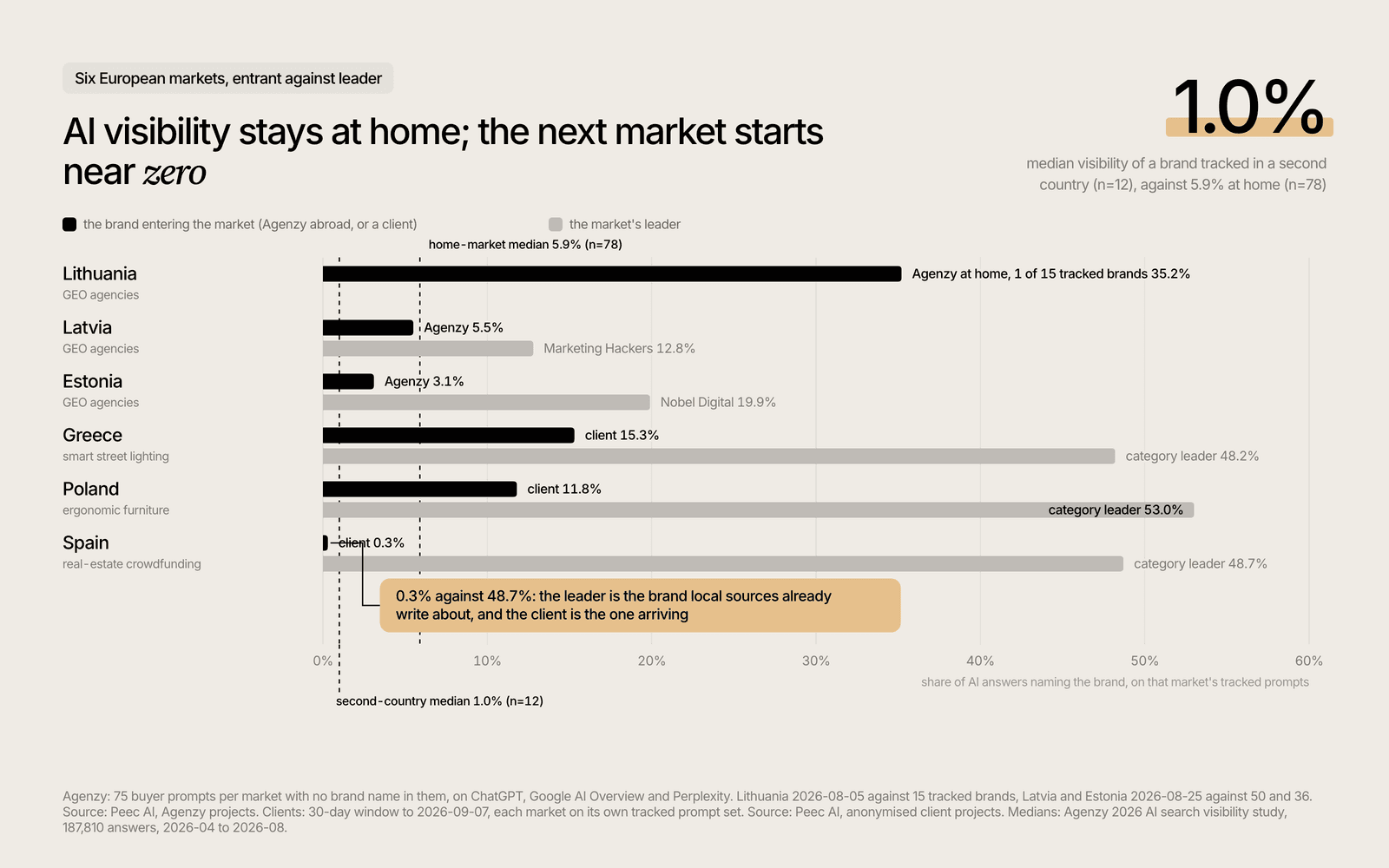
Agenzy's Baltic baselines (2026-08-05, 2026-08-25) and three anonymised client markets (30 days to 2026-09-07), Peec AI; medians from Agenzy's 2026 study of 187,810 answers.
Market and category | Client visibility | Category leader | Gap |
|---|---|---|---|
Greece, smart street lighting | 15.3% | 48.2% | 32.9 points |
Poland, ergonomic furniture | 11.8% | 53.0% | 41.2 points |
Spain, real-estate crowdfunding | 0.3% | 48.7% | 48.4 points |

30-day window to 2026-09-07, each market on its own tracked prompt set. Source: Peec AI, anonymised client projects.
In each market the leader is a brand the local sources already write about, and the client is the one arriving. A brand entering a market has no local sources naming it yet, and those sources weigh more than its own site: Agenzy's 2026 study found that 39% of brands mentioned by AI engines never had their own website among the top 30 sources those engines cited (n=87 mentioned brands, 2026-04 to 2026-08).
Which AI engine matters in which country?
The engine mix differs by country, and the engines that name a brand at home are often the ones that ignore it abroad. Statcounter's AI chatbot share for August 2026, counted on browser visits, puts ChatGPT at 77.83% in Germany, 83.99% in Poland and 79.4% worldwide. Google Gemini is second at 9.85%, 9.99% and 10.9%, and Perplexity third at 5.44%, 3.08% and 4.31%.
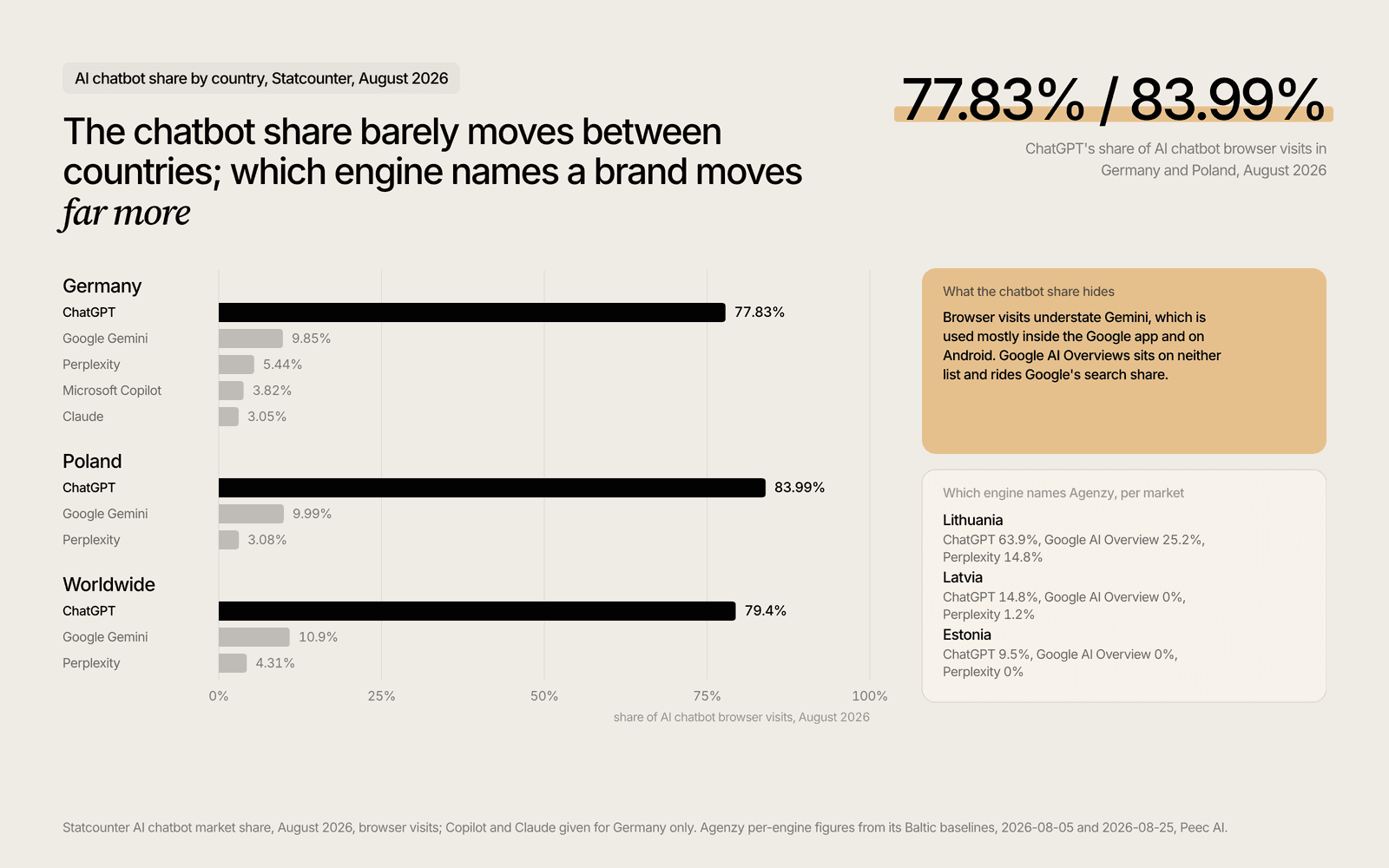
Statcounter AI chatbot market share, August 2026, browser visits; Copilot and Claude given for Germany only. Agenzy per-engine figures from its Baltic baselines, Peec AI.
Two limits apply. Browser visits understate Gemini, which is used mostly inside the Google app and on Android. Sensor Tower's State of AI 2026 report (2026-06-16) says ChatGPT's True Audience share, counting unique users across mobile app and web, fell below 50% for the first time in March 2026. Google AI Overviews sits on neither list and rides Google's search share, so a programme that tracks only ChatGPT measures the largest chatbot and misses the largest answer surface.
What we can measure is which engine names a brand in each country, and that changes more than the chatbot share does. In Lithuania all three engines we track name us, and Google AI Overview alone gives us 25.2%. In Estonia and Latvia, Google AI Overview names us in 0% of answers and Perplexity in 0% and 1.2%. Almost every mention we hold in a new market comes from ChatGPT, which is also the engine that searches in English.
Agenzy's 2026 study measured a median 5.1x visibility gap between a brand's best and worst AI engine, and 30% of visible brands were completely invisible on at least one engine (n=86 brands visible somewhere, 2026-04 to 2026-08). Across the same projects the median brand sat at 6.5% on ChatGPT, 5.4% on Google AI Overview and 1.5% on Perplexity (n=85 for Perplexity).
A second market usually starts on ChatGPT alone, and Google AI Overview follows once local-language pages and local sources exist. How share of voice and visibility are counted is explained in what AI share of voice means.
Do we need local-language content or English content?
A brand entering a market needs English pages for the English fan-outs ChatGPT runs and local-language content for the prompts buyers type in their own language, since each covers a job the other cannot. Our Baltic baselines show the two halves side by side, because the same brand is measured on both kinds of prompt in the same project.
In Estonia our best prompts are English or say "Baltics". We are named in 37% of answers to "How much do GEO services cost in the Baltics and which agencies offer transparent monthly reporting on AI visibility". We are named in 30% of answers to "I run a B2B company in the Baltics and we're invisible in ChatGPT and Perplexity answers about our category", and in 32% on an Estonian-language prompt that asks for the top three agencies in the Baltics.
The native-language prompts with no location in them, "parim GEO agentuur" and every Estonian vertical prompt, return 0% for us. Latvia repeats the pattern: 39% on the English Baltics prompt, 43% on a Latvian prompt that names the Baltics, 0% on "labākā GEO aģentūra".
We have English pages and no Estonian or Latvian pages, so ChatGPT finds us when it searches in English or when the prompt widens to the Baltics. It has nothing of ours to retrieve when an Estonian asks in Estonian about Estonia. English pages and Baltic-scope prompts put us third in Latvia at the first measurement. They cannot earn the Estonian-language prompts, and those are the prompts an Estonian buyer types.
The research reads the same way. The Language Blind Spot paper found the home-language query lifts local champions far more than multinationals, so the local language is where a local brand wins and English is where a global one does. Radyant's guide reaches the same split from the engine side: local content for Google AI Overviews, English content for ChatGPT's English fan-outs.
How does AI search visibility differ between the US and Europe?
Different brands lead in the US and in Europe, and the citations behind them come from different domains, so a brand's US AI search visibility says little about its standing in any European market. Profound's Summer 2026 Index Report (2026-08-19), built on "1.9+ billion real user conversations across 50+ industries", states that "In 24 of 30 multi-region industries, at least one European market crowned a #1 brand that never cracked the US top five." In the markets where a net-new regional brand led, "46-59% of citations went to country-specific domains".
The source set is national even inside Europe. Żatuchin's citation study, "How Large Language Models Source Brand Reputation Across Languages and Markets" (arXiv 2606.25787, 2026-06-24), covered 128 brands across 12 home markets and 13 languages, 167,551 citations. It found that 85.7% of citations point to sites the brand does not own. Wikipedia is the most-cited domain in 11 of 12 languages, with Lithuanian the exception, where the business daily vz.lt edges it.
For 46 Polish national brands the most-cited domain is YouTube, and four HR and careers portals supply about twice as many citations as Polish Wikipedia. A brand entering Poland needs to be on the pages Polish answers are built from, and those are different pages from the German or the British ones.
Semrush's study of 50,000 brands across 1,094 US categories, tracked in ChatGPT from January to June 2026 ("AI visibility is a topic-level game", Margarita Loktionova, 2026-07-20), found that "Only 15.2% of the 1,094 categories we analyzed had a clear owner". The same study found that "Clear category owners we analyzed stayed on top in 90.4% of month-over-month comparisons".
Which market should we start GEO in?
Start in the market where the four conditions below are met first, in this order, and treat any market that fails one of them as a later phase. For a brand expanding to Germany and Poland, run the four conditions on each country and start where all four hold.
Buyers ask the question in that language. Pull the prompts people type in the market, in the market's language, and look at the fan-out. If ChatGPT translates most of the searches to English, English pages will carry part of the load. If it keeps the local language, as it does for local-entity questions, local pages are the whole job.
A citable source set exists and can be entered. List the 30 domains the engines cite for the category in that country. The pattern differs by country: Wikipedia in most languages, YouTube and careers portals for Polish brands, a business daily in Lithuania. If those domains are open to a new entrant, the market is workable; if they are closed lists of incumbents, budget for the time it takes to get on them.
The engine mix can be measured from inside the country. Prompts run from the market's own exit IP on ChatGPT, Google AI Overview and Gemini in a retainer, with Perplexity in the audit format we used for the Baltic sets. A market where the client can only check answers from head office is a market with no baseline.
The category has no locked owner. Semrush's 15.2% of categories with a clear owner, retained 90.4% month on month, is the number to fear; it is measured on US categories and is the closest published figure we have. A market where the leader is at 48.7% and the client at 0.3%, the Spanish real-estate crowdfunding case in the table earlier on this page, is a longer programme than a market where the leader is at 20%.
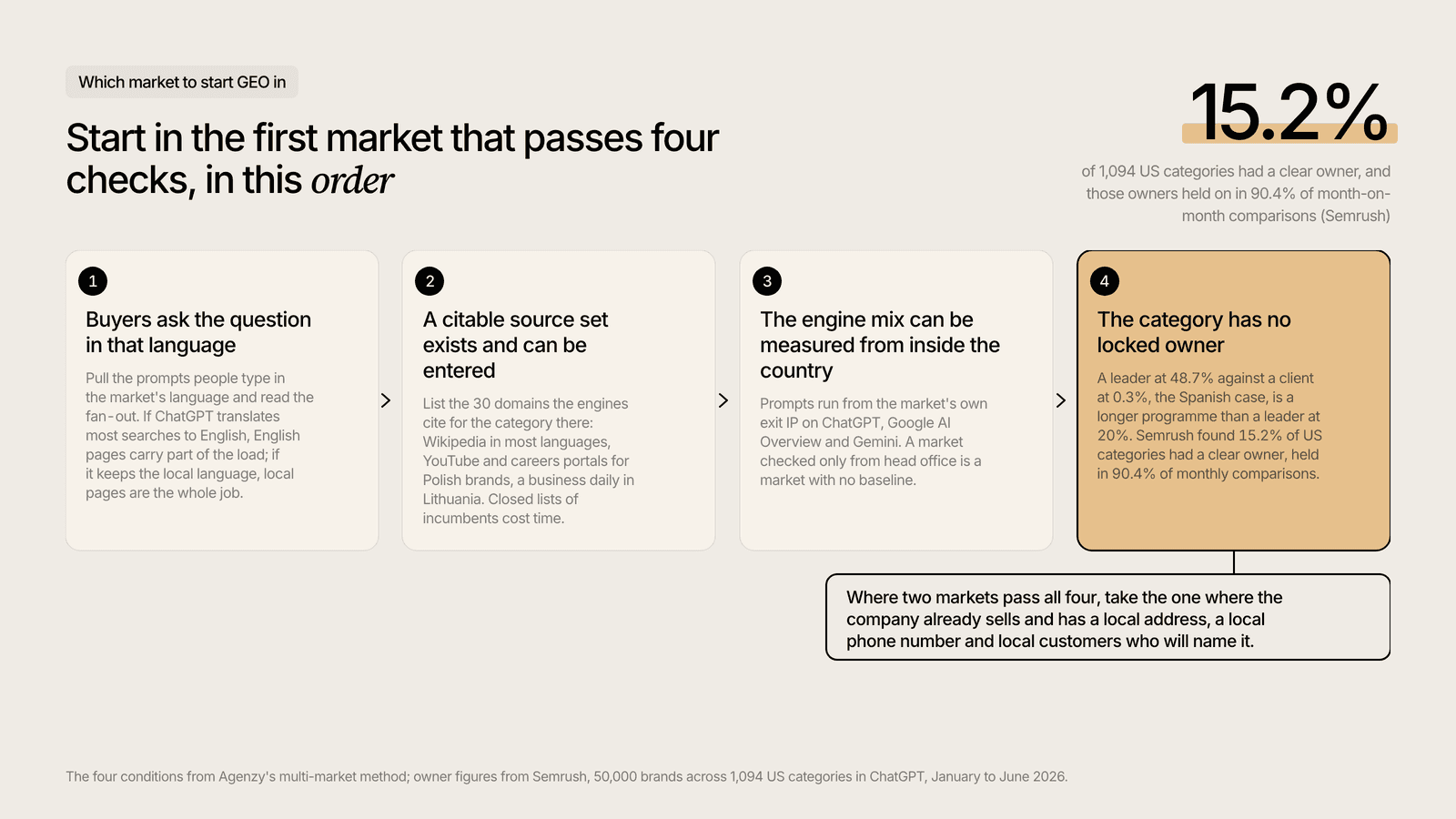
The four conditions from Agenzy's multi-market method; owner figures from Semrush, 50,000 brands across 1,094 US categories, January to June 2026.
Where two markets pass all four, take the one where the company already sells and has a local address, a local phone number and local customers who will name it, because those are the entities the engines resolve first.
For Poland, two of the four can be checked from public data today: ChatGPT holds 83.99% of chatbot browser visits (Statcounter, August 2026), and for Polish brands the most-cited domains are YouTube and careers portals (Żatuchin, arXiv 2606.25787), so the Polish source-set list starts there. Germany, the market we have no client in, gets its own section below.
What we know about Germany without a client there
We hold no German client data, so what follows is public data plus the four conditions applied to Germany. Three of the four can be started from a desk this week. The fourth needs a German prompt set run for two to four weeks.
German buyers use the German term for the service. In Semrush's German database (pulled 2026-08-07), "geo agentur" is searched 1,600 times a month at keyword difficulty 18, "geo optimierung" 1,300 times at difficulty 17, "ki seo" 1,300 at difficulty 49 and "chatgpt seo" 1,000 at difficulty 20. The English phrase "generative engine optimization" gets 1,900 German searches a month at difficulty 68. A German prompt set written in English would miss most of that demand.
The German source set starts at Wikipedia, like most languages'. In Żatuchin's citation study (arXiv 2606.25787, 128 brands, 12 home markets, 13 languages), Germany is one of the 12 markets and Wikipedia is the most-cited domain for German-language queries, at 4.41% of citations. Across the Germanic-language group in that study (Swedish, Norwegian, Danish, German and English, 54,956 citations), 14.8% of citations pointed to a site the brand owns. The paper gives Poland a market-level breakdown and gives Germany none, so the category-level German list has to be pulled per brand.
The engine mix is ChatGPT first by a wide margin: 77.83% of German AI chatbot browser visits in August 2026, then Google Gemini 9.85%, Perplexity 5.44%, Microsoft Copilot 3.82% and Claude 3.05% (Statcounter). A German baseline starts on ChatGPT and Google AI Overview, with Gemini tracked from day one.
To run the four conditions on Germany:
Write 50 German-language prompts the way a German buyer types them, built around the terms they search for ("geo agentur" and "ki seo" in our category, the German trade term in yours), and run them from Germany on ChatGPT, Google AI Overview and Gemini for two to four weeks. Read the share of background searches that run in English on those prompts.
Pull the 30 domains the engines cite on those prompts and sort them into the ones a new entrant can appear on (trade press, comparison portals, directories, YouTube) and the closed ones (Wikipedia, incumbents' own sites).
Check the .de host or the German folder in this order: AI-crawler access in robots.txt, then server-side and CDN bot blocking, then schema, then page structure. A German folder behind a different Cloudflare rule has its own robots.txt and its own bot behaviour.
Read the leader's share on the German prompt set against yours. No public source gives this figure for a German category; it comes out of the prompt set in step one, after the first two to four weeks.
How is a multi-market GEO programme run?
A multi-market GEO programme is run as one programme per market, with a separate prompt set, source set, engine mix, content language and technical check for each country, and one experiment per market per window.
Per market | What is separate |
|---|---|
Prompt set | 50 buyer prompts per market in a retainer (75 in the pre-sale audit), written in the market's language, run from that country, frozen at signature |
Source set | The domains the engines cite for the category in that country, with the ones a new entrant can appear on |
Engine mix | The engines tracked, and the one the brand currently depends on |
Content | Pages in the market's language for local prompts, English pages for the English fan-outs, each read before publishing by someone who lives in the language |
Technical check | AI-crawler access in robots.txt, server-side and CDN bot blocking, schema, page structure, for each host the market uses |
Measurement | A baseline of two to four weeks before anything ships, then one intervention per market per window |
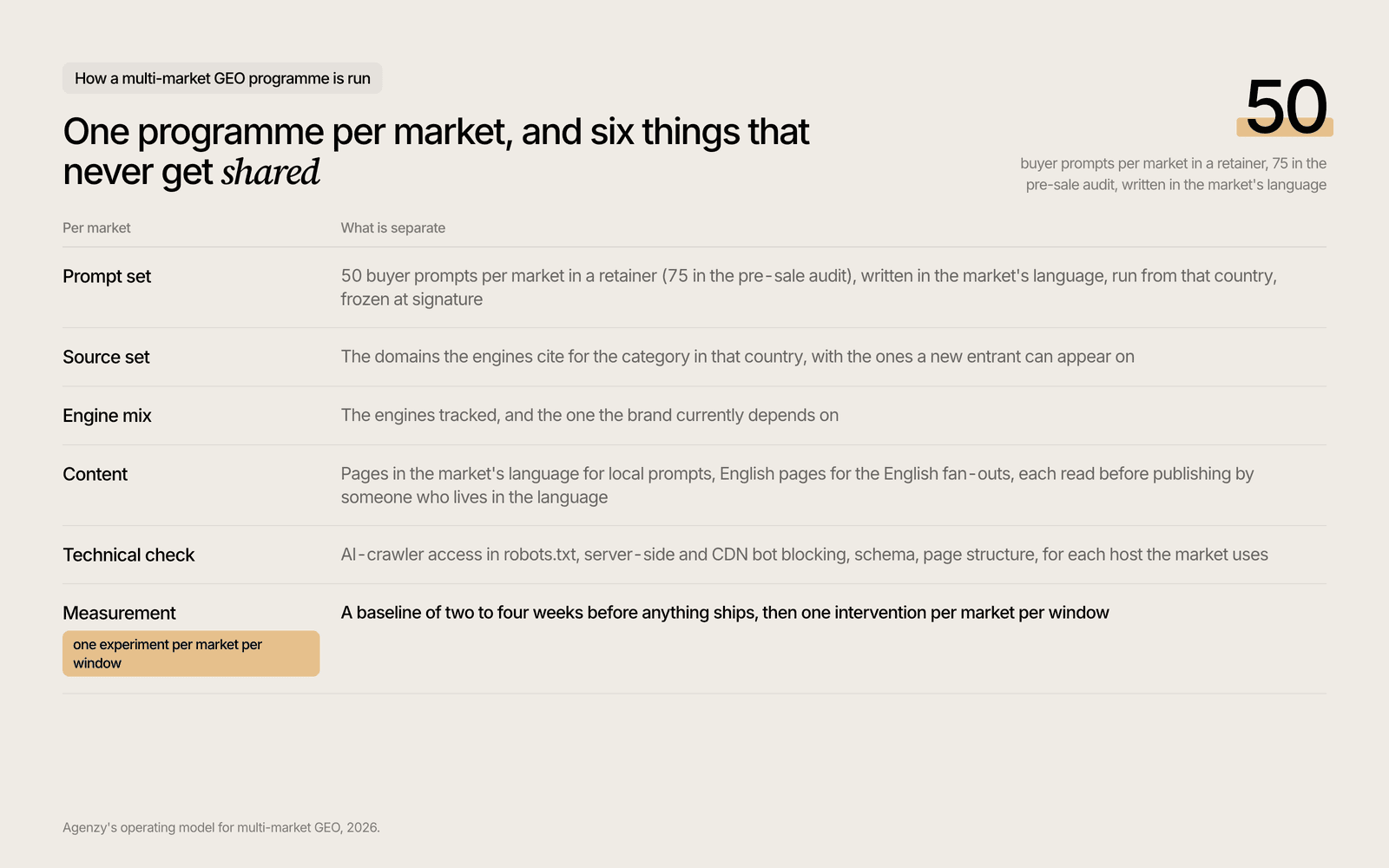
Agenzy's operating model for multi-market GEO, 2026.
The prompt set is written in the market's language by people who talk to that market's buyers, run from that country's exit IP, and frozen once the client signs, so the trend line means something. The source set is the list of domains the engines cite for the category in that country; the work is getting the brand onto the open ones. The engine mix is measured per country, because a brand can hold 25% on Google AI Overview at home and 0% next door, as we do.
Content is written in two layers. Local-language pages answer the local-language prompts and are reviewed by a reader who lives in the language, because a translated page that reads as translated is retrieved and then ignored. English pages answer the English fan-outs and serve every market at once.
Market-specific material, such as prices, sellers and the local buyer's question, sits in a named block on the page, so the same page can be localised by swapping the block instead of rewriting the text.
The technical check runs per host, in this order: AI-crawler access in robots.txt, then server-side and CDN bot blocking (Cloudflare rules, a WAF, hosting-level blocks), then schema, then page structure. A .de subdomain or a country folder behind a different CDN rule has its own robots.txt and its own bot behaviour, so the check is repeated for each.
Our GEO service opens month one with this technical work; a second market runs as its own project. We also ship an llms.txt file, because it costs nothing. Ahrefs found that of about 38,000 domains with a valid file, 97% received zero requests for it in May 2026 (137,000 domains studied), so it is a courtesy and never a priority.
Measurement is per market too. Every market gets a baseline of two to four weeks before any page ships, one intervention per window so the cause can be read, and a holdout group of prompts inside the same market. Every client gets every intervention; only the timing differs between markets.
What does the retrieval data show in Greece and Poland?
In Greece the engines retrieved two of six published topics and ignored four. In Poland the gap to the category leader sits in the source set. Both markets appear in the client table earlier on this page.
Greece, smart street lighting
A street-lighting company selling across Europe tracks 15 buyer prompts in Greece, 11 of them in Greek. At the baseline the brand was named in 3.23% of answers (30 days to 2026-05-12, 526 responses, 11 brands tracked). In the 30 days to 2026-09-07 it is named in 15.3%, against the category leader at 48.2%.
The rise from 3.23% to 15.3% spans the whole engagement. What the retrieval data shows is which content the engines took. Six topics were published in three languages, English, Lithuanian and Greek, on 2026-08-05. Between 2026-08-05 and 2026-08-27 exactly two of the six were retrieved at all.
The guide to choosing a municipal lighting platform was retrieved 128 times in English and 127 times in Greek, appears on all 15 tracked prompts, and became the most-retrieved page on the domain, ahead of the homepage. The four posts that explained a mechanism (connectivity, edge against cloud, zone control, predictive maintenance) were retrieved zero times in every language. All 15 prompts ask a sourcing question, and the four dead posts answered a question no prompt asks.
The Greek layer still has a gap. The client's Greek pages exist only as blog posts, with no Greek homepage and no Greek product tree, while the category leader has a Greek homepage that the engines retrieve on the same prompts. The next step in Greece is the product tree in Greek, because the engine is retrieving homepages in the language of the question and has none of the client's to retrieve.
Poland, ergonomic furniture
In a Polish market we still track for a client, an ergonomic-furniture brand is named in 11.8% of answers on its Polish prompt set against a category leader at 53.0% (30 days to 2026-09-07). The gap is 41.2 points, and the leader is a brand Polish sources have written about for years.
The Polish source set is the reason a translated storefront closes little of that gap on its own. Żatuchin's citation study found that for 46 Polish national brands the most-cited domain is YouTube, with HR and careers portals supplying about twice the citations of Polish Wikipedia. A furniture brand reviewed on Polish YouTube channels and named in Polish workplace press sits inside the source set the engines read.
A programme for Poland therefore has two parts: Polish-language category pages that answer the Polish prompts, and mentions on the Polish domains the engines already cite. It runs as its own project with its own baseline, separate from any home-market project.
Which agency handles several European markets?
A GEO agency for a B2B SaaS company selling across Europe is one that measures each market separately, in that market's language, from inside that country, and shows the per-market numbers before it names a price. The questions to ask, in order:
Does the agency track one prompt set per market, written in the market's language, run from that country's exit IP? Ask to see one brand measured in two markets side by side, the way this page shows ours.
Does it report visibility per engine per market, so you can see where the brand is at zero? A single blended number hides the engine that matters in that country.
Does it publish its own multi-market numbers, including the markets where it is losing? Ours are on this page: first in Lithuania, third in Latvia, fourth in Estonia, zero on Google AI Overview abroad.
Does it plan local-language content for local prompts and English content for the fan-outs, or does it sell one of the two as the whole job?
Does it publish its prices, and can it say what a second market adds? The corridor for a GEO retainer in Europe, the UK and the US, and what a second market changes, is in how much a GEO agency costs in 2026.
The agencies we measured across 100 English buyer prompts, with their visibility on those prompts and their own robots.txt and bot-access state, are in the best GEO agencies in Europe in 2026, which has separate sections for the UK, Germany and DACH, and the Nordics and Baltics.
FAQ
Does AI visibility carry over to another country?
It does not. An identical audit format that puts Agenzy in 35.2% of answers at home in Lithuania puts it in 3.1% in Estonia, a drop of more than tenfold across one border.
Why does ChatGPT recommend different brands in different countries?
The language a question is written in picks the country whose suppliers are eligible, and the place the request comes from adjusts which of them get named. In Żatuchin's controlled test, suppliers from the country whose language was used won 23 of 24 runs.
Do we need local-language content for ChatGPT?
Yes, together with English pages, because ChatGPT translates much of its background searching into English before it reads the web. Behind our Lithuanian prompts, 76% of those searches ran in English, while our local-language prompts in Estonia and Latvia, where we have no local pages, give us nothing.
How does AI search visibility differ between the US and Europe?
A brand that leads a US category rarely leads the same category in Europe, and the pages the engines quote are national ones. Profound counted 24 of 30 multi-region industries where a European market's top brand was absent from the US top five.
Which market should we start GEO in?
The market that first clears four checks: the question is asked in its language, the cited domains admit newcomers, answers can be measured from inside the country, and no single brand owns the category. The last check carries the most weight, since Semrush found category owners keep their lead in 90.4% of monthly comparisons.
Is there GEO data for Germany?
Only public data; Agenzy runs no German client project. The strongest signal in it is that German buyers search in German, with "geo agentur" typed 1,600 times a month (Semrush, German database, 2026-08-07).
Is there real research on how visible European businesses are in AI search?
Yes. Agenzy's 2026 study read 187,810 AI answers about 85 European businesses between April and August 2026 and found the typical brand named in 5% of answers about its own category. The full study is at agenzy.lt/blog/ai-search-visibility-study-2026.