A GEO agency retainer costs 3,000 to 8,000 EUR a month for mid-market work, and premium specialists charge 7,000 to 20,000 EUR. Below about 1,000 EUR a month the offer is mostly monitoring.
The bands come from our scan of about 100 providers across the US, the UK, DACH, France, Southern and Eastern Europe and the Baltics in August 2026, and we re-read every price this guide names in October.
My view: scope moves the price more than country does, so compare what two offers track and ship before you compare their monthly numbers.
Most agencies publish no price. We name a provider only when we read its price on its own page, and every other figure is a band from the scan. Prices move: of the 17 agencies and tools we had checked in August and September, four changed or removed a price by October.
I'll follow one buyer through the guide: a marketing lead at a B2B software company selling in Germany and the UK, whose CEO wants three GEO agencies with prices.
By the end you'll have a budget range, the costs that sit outside the monthly fee and a way to compare two offers line by line. In this guide I cover:
GEO agency prices by segment
GEO agency prices by country
What each price level buys
Retainer, project or audit
Hidden costs to ask about
When GEO is worth the money
How to compare GEO offers
GEO agency prices by segment
Our scan sorts the market into six bands, and the mid-market core is the densest band in every country we checked.
Sidenote: generative engine optimization (GEO) is the work of getting a brand named and cited when a buyer asks ChatGPT, Gemini, Google AI Overviews or Perplexity for a recommendation. Answer engine optimization (AEO) is the same work under a second name, so both price lists describe one market.
Further reading: our guide to what GEO is.
The six bands in each currency's own units, before VAT. "None found" means the scan had no figure in that currency, and nothing was converted:
Segment | EUR a month | GBP a month | USD a month | What the money buys |
|---|---|---|---|---|
Monitoring and diagnostics | none found | under 500 | 350 to 1,500 | A dashboard, 5 to 100 tracked prompts, a report; pages only as an exception |
Solo or boutique floor | 1,000 to 2,000 | none found | 1,000 to 1,500 | One specialist, technical fixes, a few pages |
Small business, done for you | 1,500 to 3,500 | 1,250 to 2,950 | none found | Tracked prompts, a technical first month, pages every month |
Mid-market core | 3,000 to 8,000 | 3,000 to 8,000 | 3,000 to 8,000 | More prompts and engines, several markets, third-party mentions |
Premium specialist | 7,000 to 20,000 | 5,000 to 20,000 (London estimate) | 8,000 to 20,000 | A team extension with its own experiments |
Enterprise | about 17,500 (German public tenders) | none found | 10,000 to 50,000 | Multi-country programs bought through procurement |
In euros, the boutique floor runs 1,000 to 2,000, small-business work 1,500 to 3,500 and premium work 7,000 to 20,000 a month. Here they are on one axis:
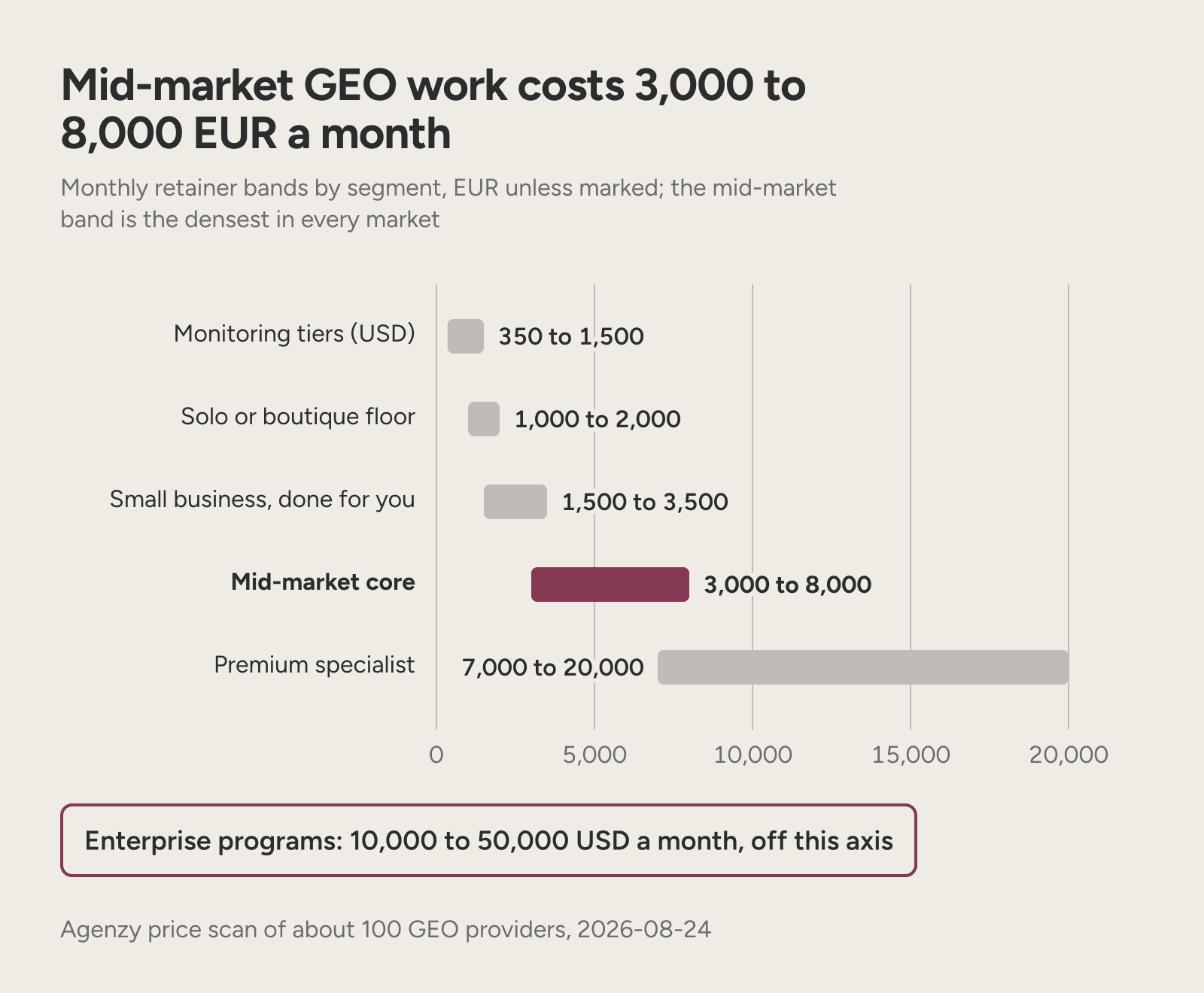
The mid-market bar holds more offers than any other band in our scan, and the premium bar alone stretches from 7,000 to 20,000 EUR.
Sidenote: Lars Lofgren, who hires agencies for the marketing teams he builds, puts the entry for agency work at 5,000 USD a month with "limits on scope". Our scan sets the lower line: below about 1,000 EUR a month, the offer is mostly a dashboard and a report.
Published guides disagree because each is written by a seller quoting its own neighborhood: Digital Elevator says 2,000 to 10,000 USD a month, AEO Vision 2,500 to 15,000 USD, GrowPad's European list 3,000 EUR and up and Omniscient 10,000 USD. None says which prices were read on the provider's own page, so our sweeps tagged every number as verified, reported or estimated.
Our buyer sells in two markets, which puts the company in the mid-market core: a working budget of 3,000 to 8,000 EUR a month.
GEO agency prices by country
Most published prices sit in the UK and German boutique tiers. The bands in each currency, without conversion:
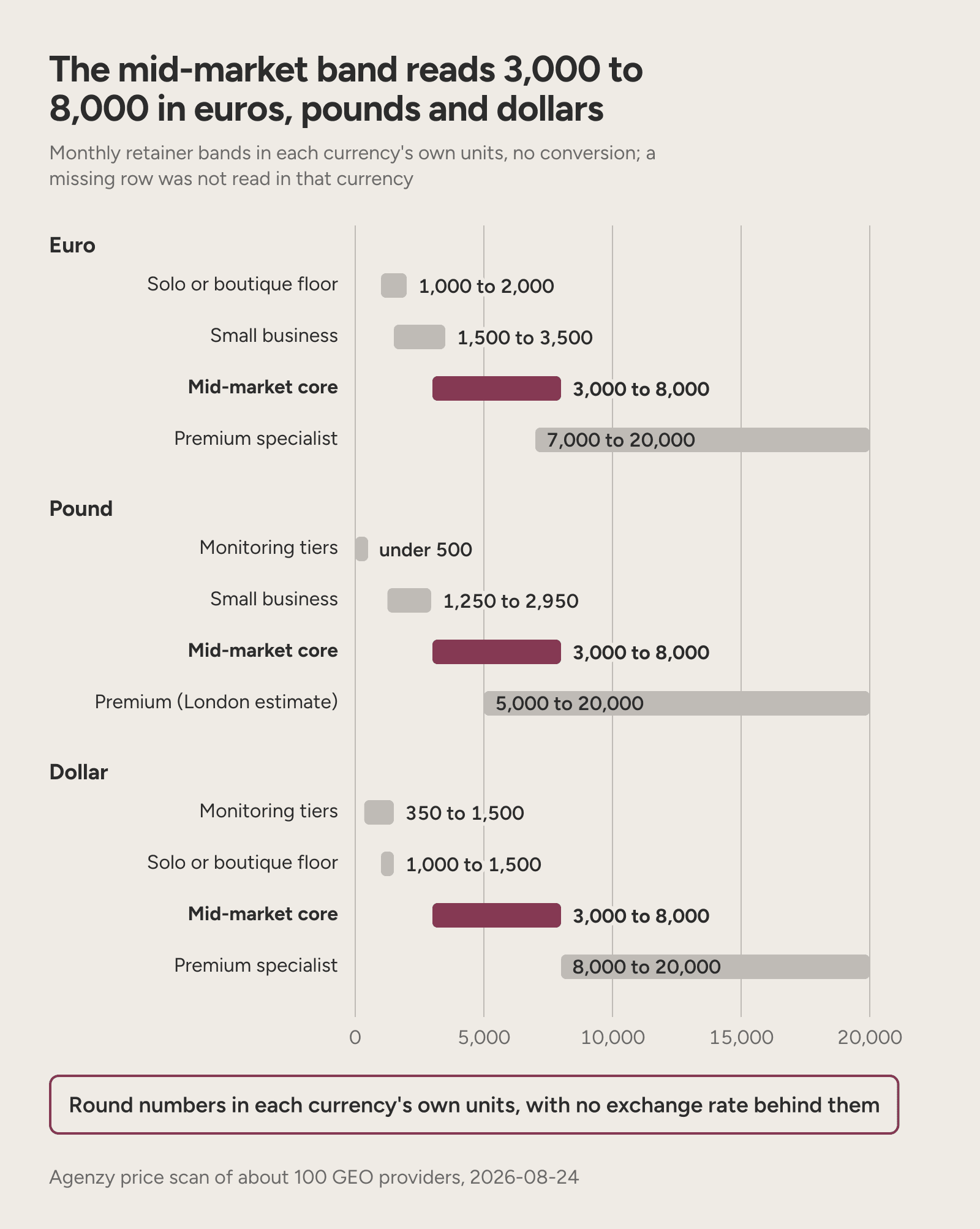
The mid-market rows line up at 3,000 to 8,000 because published ladders cluster on those round numbers in each currency, so read each band in its own units.
In the UK, NeuralAdX publishes 450, 1,250, 5,000 and 10,000 GBP a month plus VAT. MarGen charges 2,950 GBP on a three-month minimum, 5,950 GBP on a 12-month minimum and from 12,950 GBP, and its own read of 34 UK agencies puts the market at 800 to more than 20,000 GBP. Tilio removed its price list and now offers "no packages and no published minimum". In pounds, our scan puts monitoring under 500, small-business delivery at 1,250 to 2,950 and London premium work at an estimated 5,000 to 20,000.
In Germany, NeuRank sells a GEO audit for 890 EUR and monthly support from 890 EUR to firms with 1 to 50 staff. Wescript charges 1,980 EUR a month plus a 1,490 EUR setup fee on a 12-month term, and Gerlach Media starts at 2,500 EUR, with a 3,500 EUR audit. Radyant in Berlin charges from 7,000 EUR a month on 12 months with an opt-out after six, and projects from 10,000 EUR.
Radyant's cost guide reads the AOK-Bundesverband tender at 840,000 EUR over 48 months, or 17,500 EUR a month. That is one public buyer's contract, which is why the enterprise euro cell holds a single number.
In the US, WebFX starts at 3,000 USD a month and Embarque puts advanced GEO work in its 2,999 USD a month package. Omniscient Digital starts full service at 120,000 USD a year, Optimist's month-to-month consulting at 3,000 USD, and Siege Media prints no price and asks for a six-month horizon. Two of the ten agencies in our rated list of US GEO agencies published a monthly price in September. In dollars, our scan puts monitoring at 350 to 1,500, the boutique floor at 1,000 to 1,500 and premium work at 8,000 to 20,000, and large US shops list minimum projects of 50,000 USD and up on Clutch.
In France, the scan found mid-market work at 4,000 to 6,000 EUR a month, six-month minimums and schema audits at 1,800 to 4,500 EUR.
Sidenote: no French agency in the scan printed those figures on a public pricing page, so the French bands are reported with no name attached.
In our scan, remote specialists price on the vertical they serve, whatever their country. Discovered Labs, which sells to B2B SaaS, charges 7,995 EUR month to month, or 6,995 EUR on a six-month commitment, and 12,995 or 10,995 EUR for its larger tier.
The Baltics sit at the floor. Lithuanian providers that publish a price for AI SEO or GEO work start at 100 to 1,650 EUR a month, Marketing Hackers in Riga lists GEO at 1,400 EUR and Maison Mint in Tallinn bundles SEO and GEO at 890 EUR. Our comparison of GEO agencies in Lithuania and our list of GEO agencies in Europe cover them one by one.
Our buyer's German and UK shortlist from published prices: Gerlach at 2,500 EUR, NeuralAdX at 5,000 GBP, MarGen at 5,950 GBP and Radyant at 7,000 EUR.
What each price level buys
What a retainer includes comes down to five scope levers, and the price rises with each one:
Prompts tracked: the buyer questions measured every day, from 5 on an entry tier to 100 or more.
Engines measured: ChatGPT, Gemini and Google AI Overviews are the usual set, and each extra engine adds cost.
Pages per month: the articles and comparison pages written for the prompts where the brand is missing.
Third-party mentions: the review sites, lists and threads the engines already cite.
Markets covered: each extra country or language needs its own prompts and pages.
One retainer month, step by step:
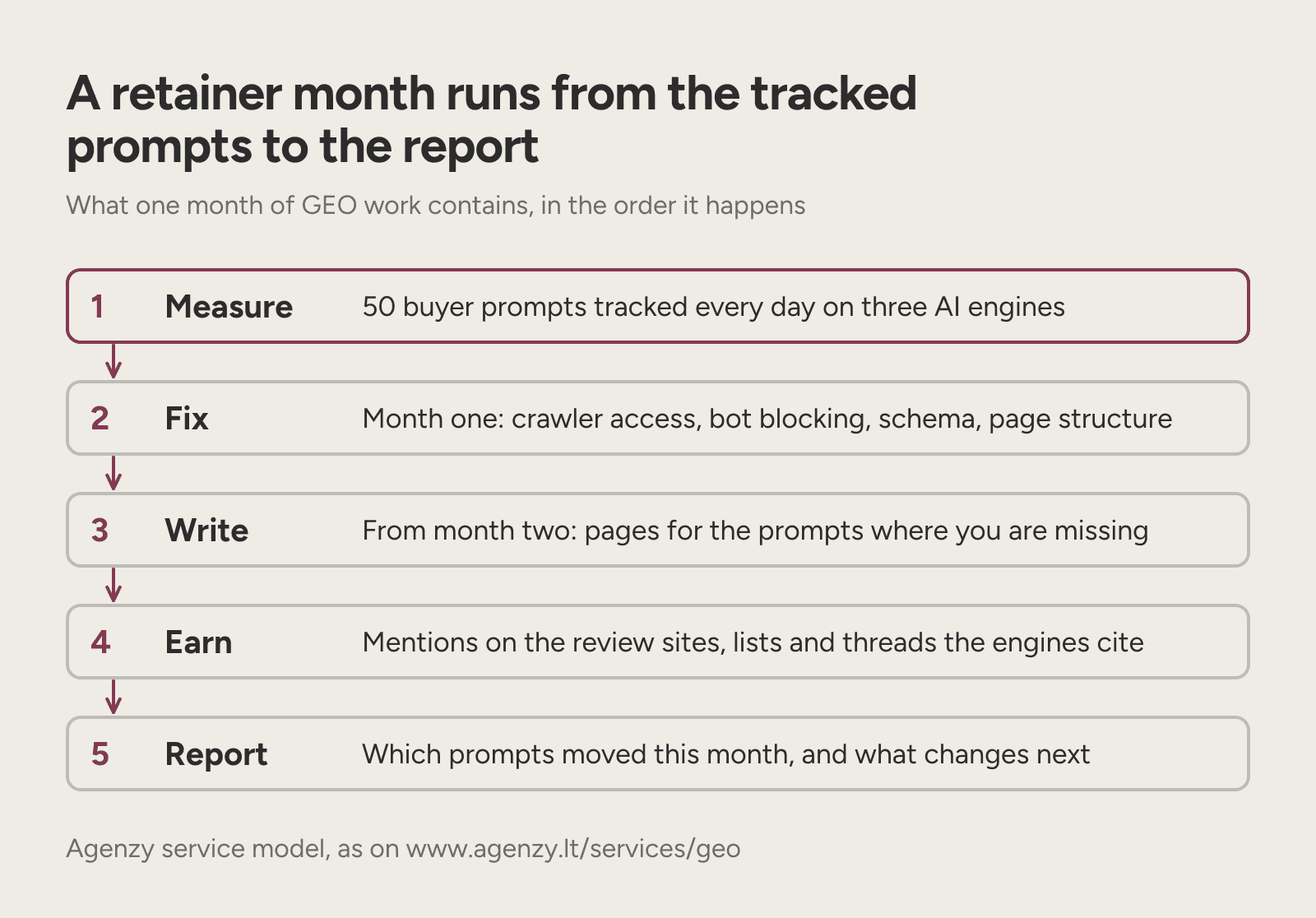
The prompts set what gets measured, the pages and mentions move it, and the report closes the month. Ours looks like this monthly GEO report.
Under about 1,000 EUR a month a retainer is mostly monitoring: NeuralAdX's 450 GBP tier tracks 5 prompts and improves one page a month. In the small-business band the first month is technical, and from month two the fee pays for pages written for the tracked questions, the work our content service does.
Tracking is the cheap part. This is what it produced on our own Peec project in 13 days:
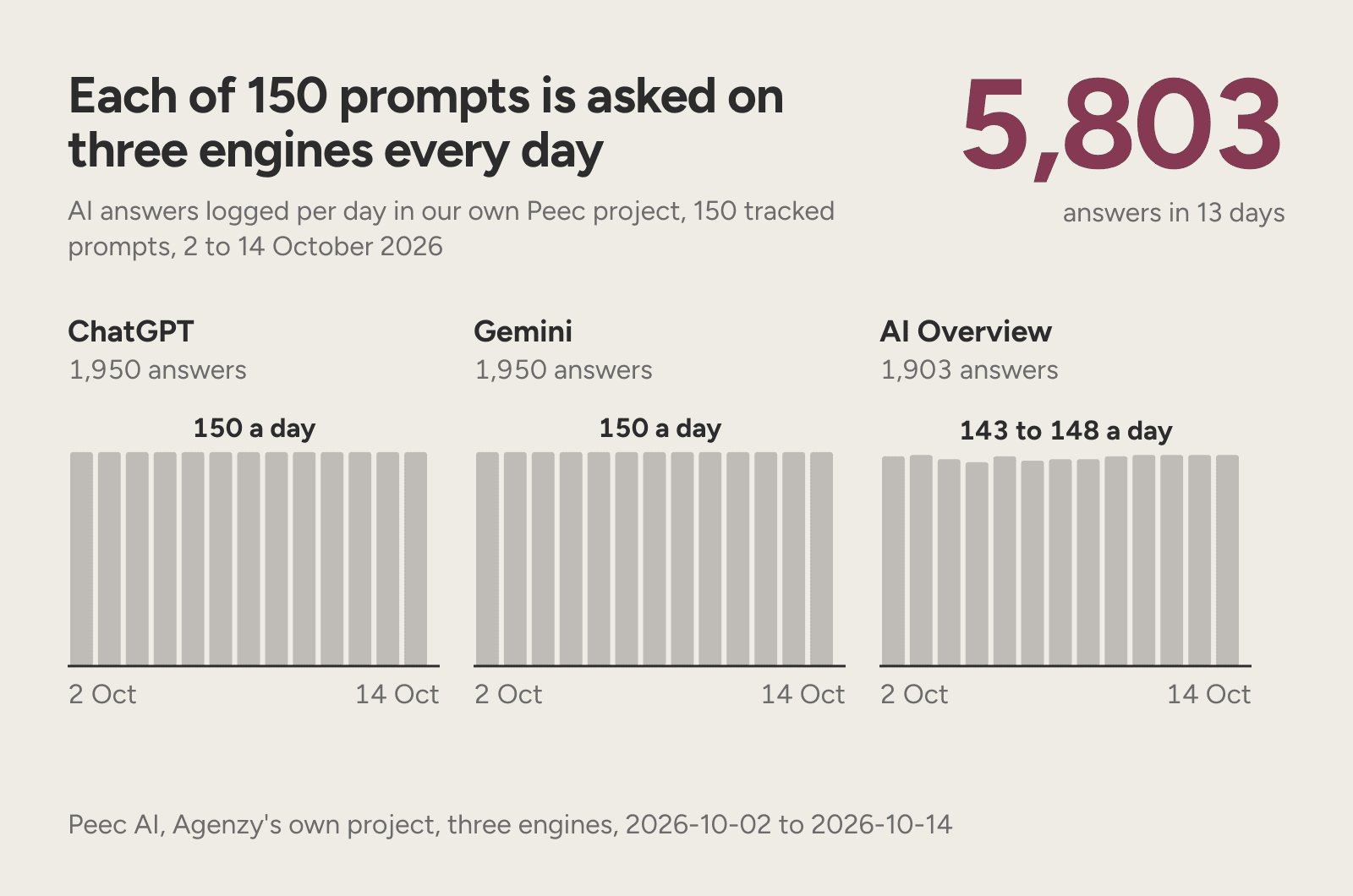
A Peec seat for 50 prompts on three engines costs 85 EUR a month, so most of any retainer above a few hundred euros pays for the people who read the answers and write the pages.
The mid-market core widens the same work to more prompts, a second market and someone earning mentions. At 7,000 EUR and up you buy a team: Radyant's partnership lists team extension, attribution setup, programmatic content and AI search experiments.
Inside 3,000 to 8,000 EUR, our buyer should ask for both markets tracked, pages every month in both languages and mention work in each.
Retainer, project or audit
A one-off project fixes what blocks the engines. In our experience tracked prompts move only when pages are written and measured month by month, which is retainer work. Pick the format by the problem:
One-off project: buy it when the site is closed to AI crawlers and nothing else is budgeted.
Retainer: buy it when the goal is to be named on buyer questions.
Credited audit: buy it when you want the diagnosis first and may continue with the same agency.
What each format leaves behind:

A project makes the site readable once, and the pages and mentions that get cited come later. In our B2B SaaS case study, visibility jumped after the August content batch, three months after the crawler fix.
A one-off audit costs 1,500 to 5,000 USD in our scan, with Germany at 500 to 3,500 EUR and the UK at 2,000 to 10,000 GBP. Four published audit prices against that corridor:

Three of the four sit inside the corridor, and NeuRank's 890 EUR audit sits below it. MarGen credits its 2,950 GBP audit in full if you start within 30 days, and Discovered Labs credits its 4,370 EUR diagnostic within 14 days.
An audit should give you a measured baseline of which brands the engines name and which sources they cite, as in this example GEO audit. The free route is to ask ten buyer questions in ChatGPT yourself or request a free AI visibility check, where we reply with what to fix first within 24 hours.
A credited audit is the cheapest way for our buyer to test one shortlisted agency before signing a term.
Hidden costs to ask about
Four costs sit outside the monthly price, and each one is a question to ask before signing:
Setup fees and terms: Wescript adds a 1,490 EUR setup fee and a 12-month term, Radyant asks for 12 months with an opt-out after six, and Embarque bills quarterly on 3, 6 or 12 month terms.
Tool seats: Peec AI, the tracker we use, costs 85, 205 or 425 EUR a month, with 15% off annual billing, so ask whether the seat is inside the fee.
Caps: a 5-prompt tier can only show movement on five buyer questions, and a 3,000 EUR tier that writes two pages a month pays 1,500 EUR a page.
Paid placements and guarantees: ask which mentions are earned inside the fee and which are paid, and keep paid placements inside ChatGPT as a separate budget line.
Sidenote: ask who owns the tracking data when the contract ends. If the prompts and their history sit in the agency's account, the baseline leaves with the agency.
Read every guarantee's conditions: NeuralAdX's citation-doubling guarantee needs a tier of 5,000 GBP or more, acceptance after assessment and six consecutive paid months, and its remedy is more service, never a refund.
Then multiply the monthly price by the term and add the setup fee. Three published offers over their full terms:
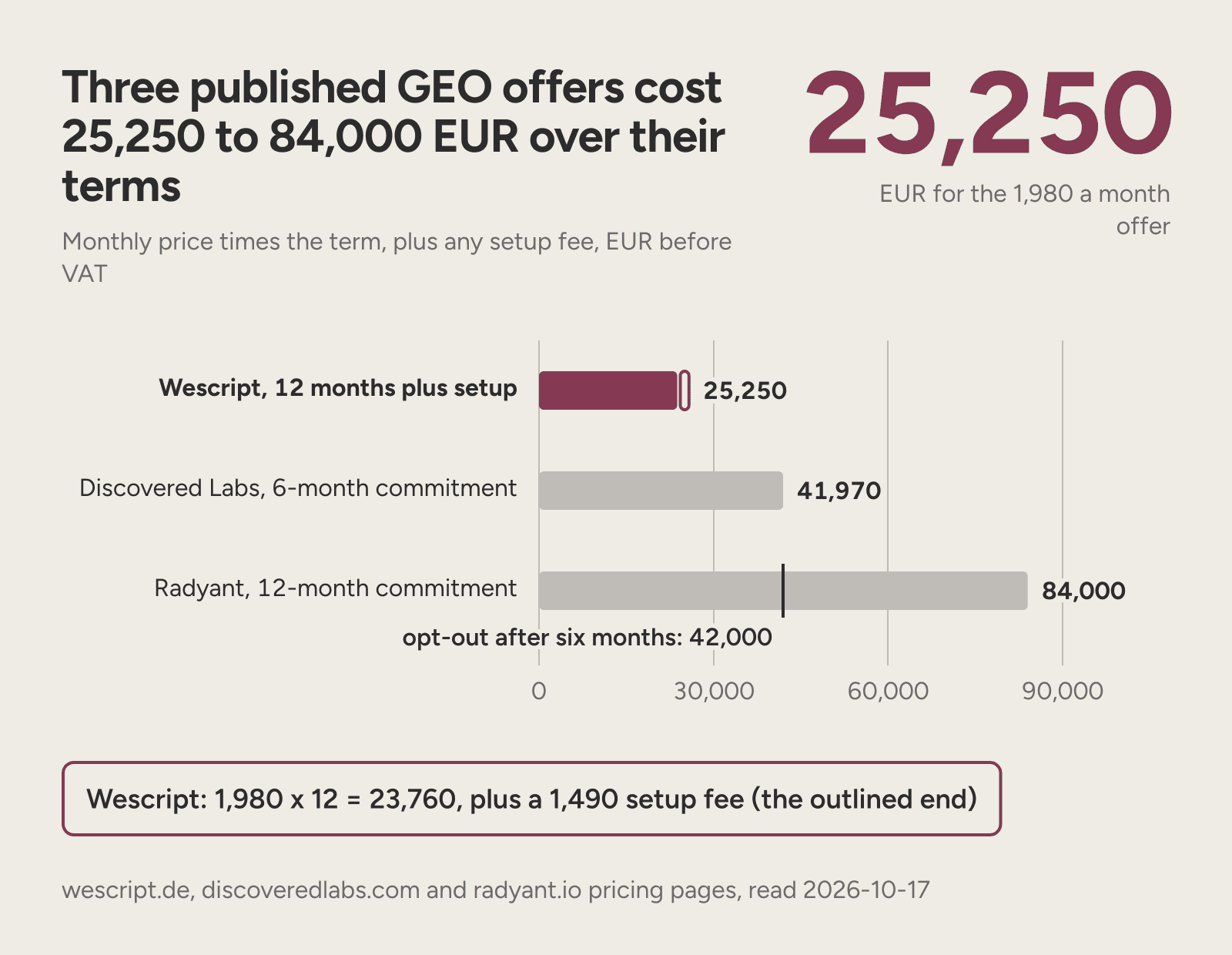
A 1,980 EUR monthly price on a 12-month term with a 1,490 EUR setup fee totals 25,250 EUR, which is the number to compare. Discovered Labs' committed six months come to 41,970 EUR, and Radyant's 12 months to 84,000 EUR, or 42,000 EUR at the opt-out.
On our buyer's shortlist, MarGen's 5,950 GBP tier on a 12-month minimum is a 71,400 GBP decision, and that is the figure the CEO should see.
When GEO is worth the money
GEO is worth the money when your buyers already ask an AI assistant before they buy. Ask existing customers one question: did you check ChatGPT before choosing us? If most say no, wait.
If they say yes, look at how much room there is:

In our European AI search visibility study of 187,810 AI answers, the median small or mid-sized brand appeared in 5% of AI answers about its own category (n=90 tracked market projects, April to August 2026).
Then do the payback sum. For our buyer, six months in the mid-market band cost 18,000 to 48,000 EUR. If one new customer is worth 12,000 EUR in its first year, the work pays back at two to four customers who found the company through an AI answer.
A smaller business has three smaller purchases below the retainer floor:
Technical one-off: it opens robots.txt to AI crawlers, checks bot blocking and fixes schema, priced per project after an audit like NeuRank's 890 EUR one.
Tracking-only month: it measures a fixed prompt set and reports what moved, from 85 EUR for a Peec seat you run yourself to 450 GBP for NeuralAdX's entry tier.
Paid working session: it hands the method to an in-house team, at the 100 to 250 USD an hour our scan found for specialists.
Leave llms.txt for last: Ahrefs found 97% of llms.txt files received zero requests in May 2026, as our guide to llms.txt explains.
How to compare GEO offers
Rewrite both offers onto the five scope levers, then multiply each monthly price by its term and add any setup fee.
Two published UK tiers 950 GBP apart, divided by the prompts they track (MarGen calls them queries):
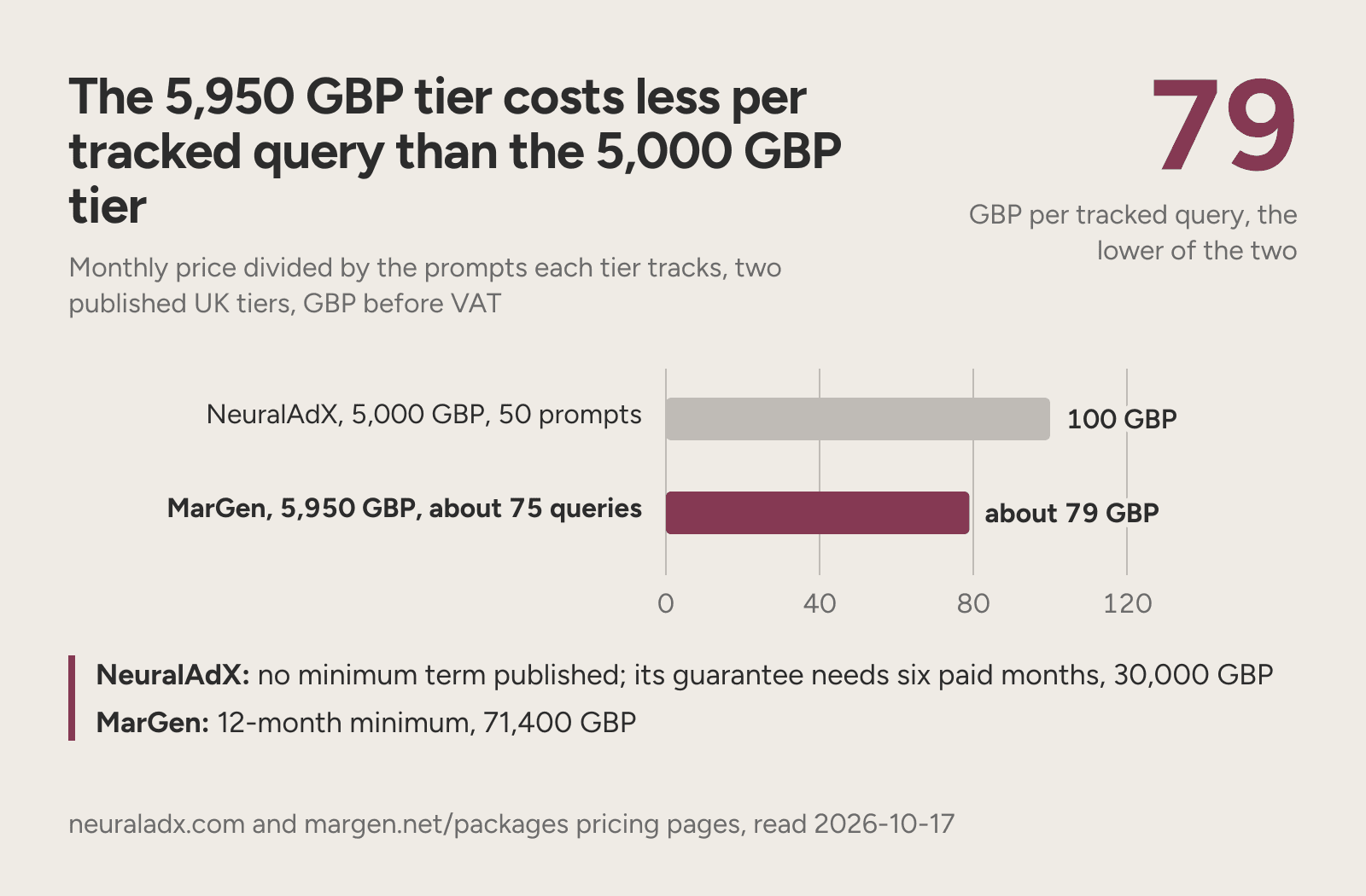
NeuralAdX's 5,000 GBP tier costs 100 GBP per tracked prompt and MarGen's 5,950 GBP tier about 79, yet MarGen's needs 12 months. The arithmetic ignores what each agency does per prompt, so treat it as a sanity check.
Five steps close the gap between the offer and the invoice:
Ask for the tracked prompt count and who writes the prompts; how we build a tracked prompt set shows one method.
Ask which engines are measured and which one your buyers use.
Ask what ships in month one and what ships from month two.
Multiply the monthly price by the term and add the setup fee.
Ask what the month-three report will contain.
Further reading: our guide to choosing a GEO agency.
Our own offer, line by line
Our offer, as our GEO service page prints it:
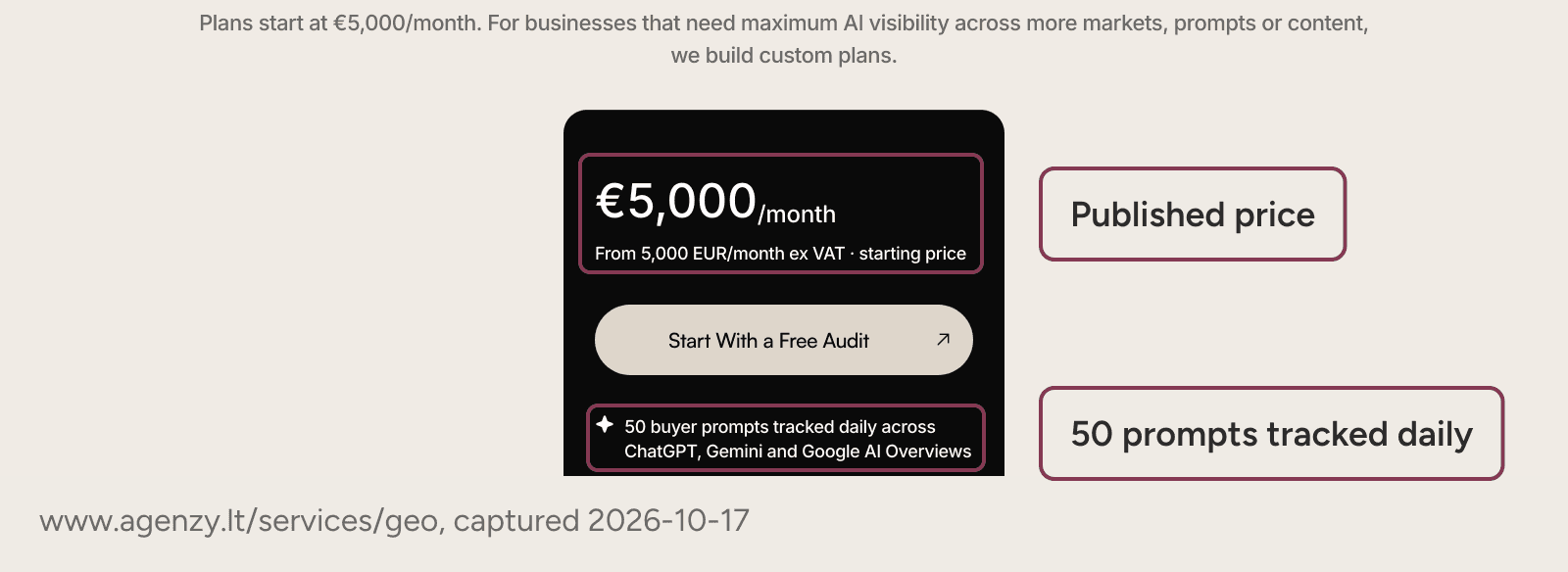
We track 50 buyer prompts daily on ChatGPT, Gemini and Google AI Overviews, with Claude as a paid add-on and Perplexity case by case. Month one is the audit, the strategy and the technical work, and articles start in month two. The plan runs from 5,000 EUR a month ex VAT on a six-month term, plus the onboarding fee in the proposal.
That entry price covers one brand in one market. Our buyer's second market would be scoped on the audit call, so ask us for that figure in writing.
Do we guarantee results? No, and anyone who says otherwise is not being straight with you.
Most of our clients see measurable changes in AI citations within 6 to 12 weeks of implementation, with a before-and-after report by month three. A month-three read can look like this:
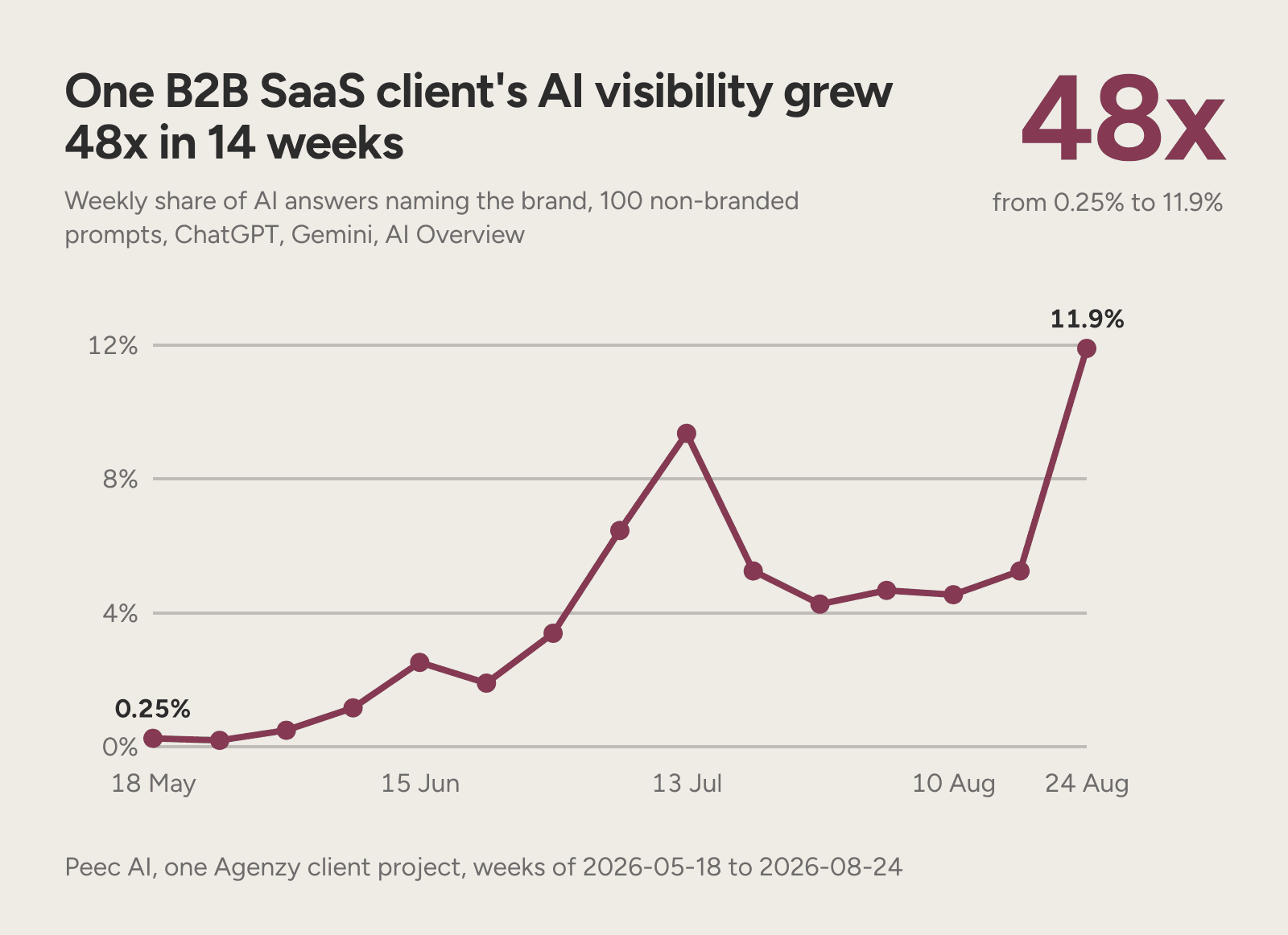
Outcraft went from 0.25% visibility in the week of 18 May to 11.9% in the week of 24 August 2026, across 100 non-branded prompts. Its robots.txt blocked GPTBot, ClaudeBot and Google-Extended when we started, so part of the rise is the site becoming readable at all. For a second country, read how GEO changes by market and language.
FAQ
Few buyers type the price into Google:
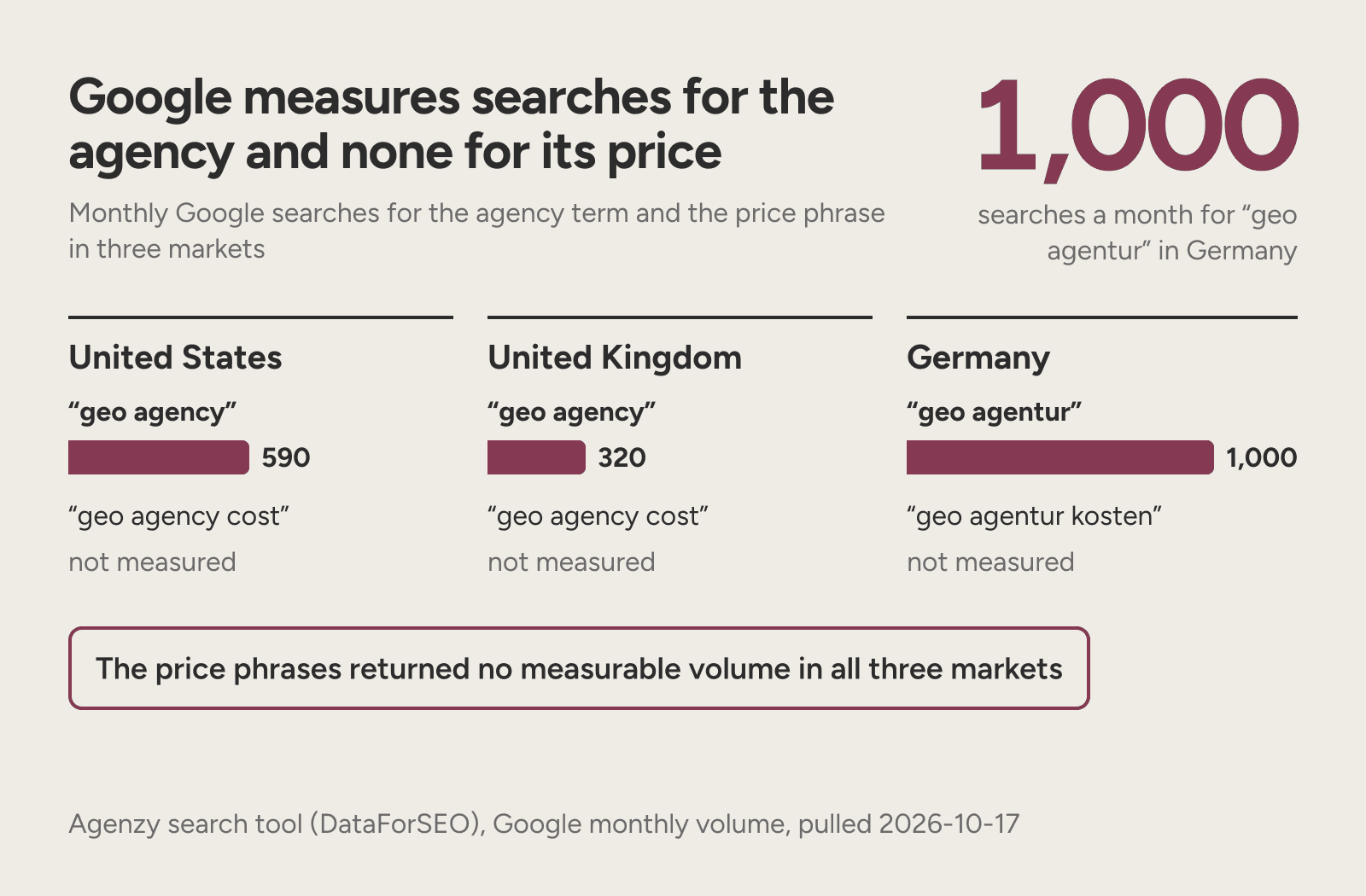
"geo agentur" draws 1,000 searches a month in Germany and "geo agency" 590 in the US, while the price phrases return no measurable volume. The price question still gets asked, and these buyer prompts led AI engines to cite this guide in the last 30 days:
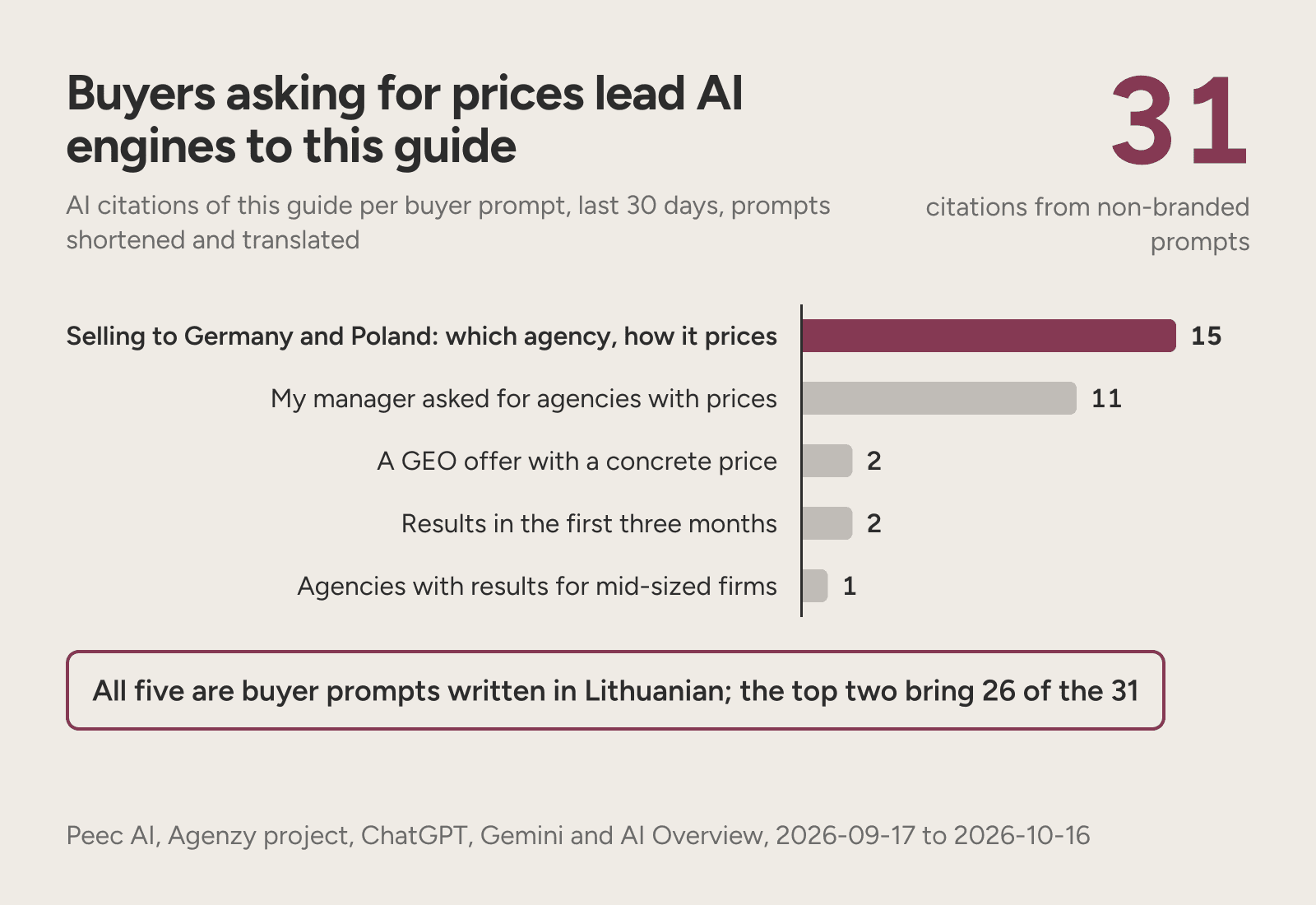
Most come from companies comparing agencies on price, often across several markets, which the first two answers cover.
How much does a GEO agency cost per month?
A GEO agency costs 3,000 to 8,000 EUR a month for mid-market work, with premium specialists at 7,000 to 20,000 EUR and enterprise programs at 10,000 to 50,000 USD. The bands come from our August 2026 scan of about 100 providers in Europe, the UK and the US. Below about 1,000 EUR a month the offer is mostly monitoring.
How do GEO agencies price work in several markets?
Most price a second market as more scope: its own prompts, pages and mentions in that language. Our 5,000 EUR entry plan covers one brand in one market, and wider plans are scoped on the audit call.
How much does generative engine optimization cost as a one-off?
A one-off GEO audit costs 1,500 to 5,000 USD in our scan, with German audits at 500 to 3,500 EUR and UK audits at 2,000 to 10,000 GBP. Fixed implementation projects run higher: Radyant prices them from 10,000 EUR.
Is GEO worth the money for a small business?
It is when its buyers already ask AI assistants before buying, which is common for researched purchases. Ask customers whether they checked ChatGPT first; if they did not, spend the budget elsewhere.
GEO retainer vs one-off project, which is better?
A retainer is better when the goal is to be named on buyer questions, because cited pages are written and revised monthly. A one-off project fits a site whose only problem is that it is closed to AI crawlers.
How long does GEO take to show results?
Most of our clients see measurable changes in AI citations within 6 to 12 weeks of implementation, with a before-and-after report by month three.
Final thoughts
A GEO agency costs 3,000 to 8,000 EUR a month for mid-market work, and what you get for it depends on the prompts tracked, the pages shipped and the markets covered. The monthly number alone tells you little.
This week, write the two offers you are weighing onto the five lines in this guide and put the full-term total under each. The difference is usually clearer than the prices suggested.
If a price here has moved since we read it, tell Emilis Zabilius, Agenzy's co-founder, on LinkedIn and we'll update the page.