LLM SEO is the work of getting your brand named, cited and described correctly by large language models (LLMs). Those models write the answers inside ChatGPT, Gemini, Claude and Perplexity. LLMO, short for large language model optimization, is another name for the same work. Any business whose buyers ask an AI assistant to shortlist products or suppliers needs it. So does any brand the assistants describe with old facts.
What LLM SEO and LLMO mean in plain words
Both names mean shaping what a language model knows and says about your brand when a buyer asks it for advice. A language model behaves like a well-read colleague. Ask her something settled, such as how compound interest works, and she answers from memory. Ask her which help desk software suits a small team this year, and she looks it up before she answers. LLM SEO works on both: what she remembers about your brand, and what she finds when she looks.
LLMO often gets spelled out as LLM optimization. Engineers use those same words for a different job: making a model cheaper or faster to run. That job has nothing to do with marketing.
The SEO part of the name comes from search engine optimization, the older work of ranking pages in Google. LLM SEO and LLMO are two of the market's names for generative engine optimization (GEO). Agenzy calls all of it GEO.
How does LLM SEO work?
An AI model can only describe your brand from pages it has read. The work makes sure the right pages get read, then checks what the answers say.
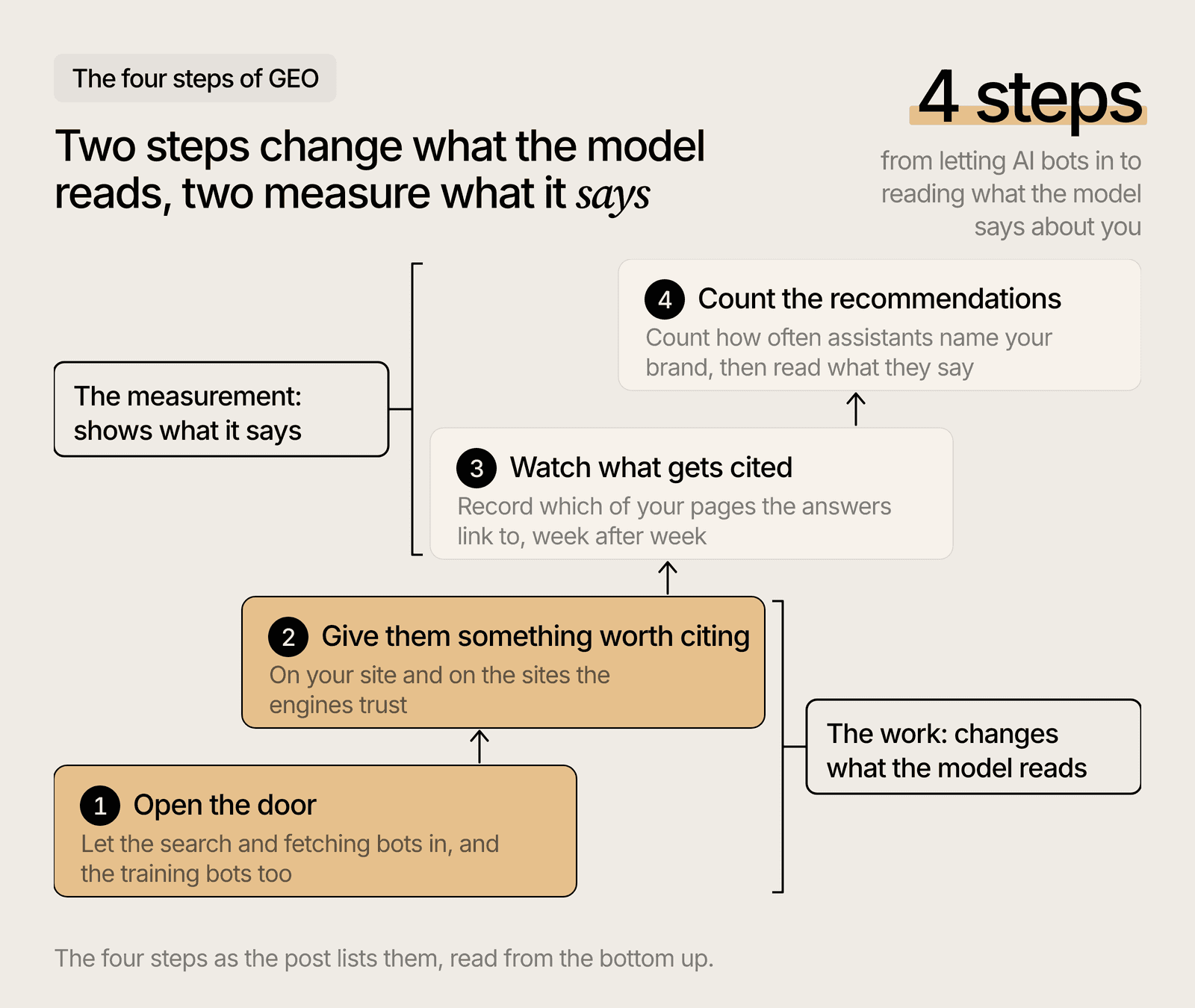
Each step depends on the one below it, so the work starts with bot access.
Open the door. AI companies send out bots that read websites, and each bot does one of three jobs: it collects pages to train new models, builds an AI search index, or fetches a page because a person asked a question. The file called robots.txt tells bots which pages they may read. That file and any firewall in front of your site have to let the search and fetching bots in, and we advise letting the training bots in too. Our list of AI crawlers shows which job each bot does.
Give them something worth citing, on your site and on the sites the engines trust. A model learns about your brand from the pages that describe it, yours and other people's. Keep the basic facts about your company identical everywhere. For live answers, open each page with a direct answer to one buyer question, then back it with numbers, quotes and named sources.
Watch what gets cited. When an assistant searches, it can read more pages than it links to in the answer, so one of your pages can be read and still get no link. Keep a record of which of your pages it links to, on which buyer questions, week after week.
Count the recommendations. Count how often the assistants name your brand when buyers ask for options. Then read what they say about you: the price they quote, and the rivals they put next to you. Running this count every day on a fixed list of buyer questions is called prompt tracking.
Together, these four steps make up GEO. As the term table in our guide to GEO shows, people who say LLM SEO or LLMO usually mean steps two and four: the pages worth citing, and counting how often assistants name your brand.
A worked illustration: what the model remembers and what it looks up
One AI answer can mix a price the model just looked up with an old price it remembers from training. Picture a buyer who asks ChatGPT: "Which help desk software suits a 15-person support team at a software company?" The answer names three made-up tools, with one line about each.
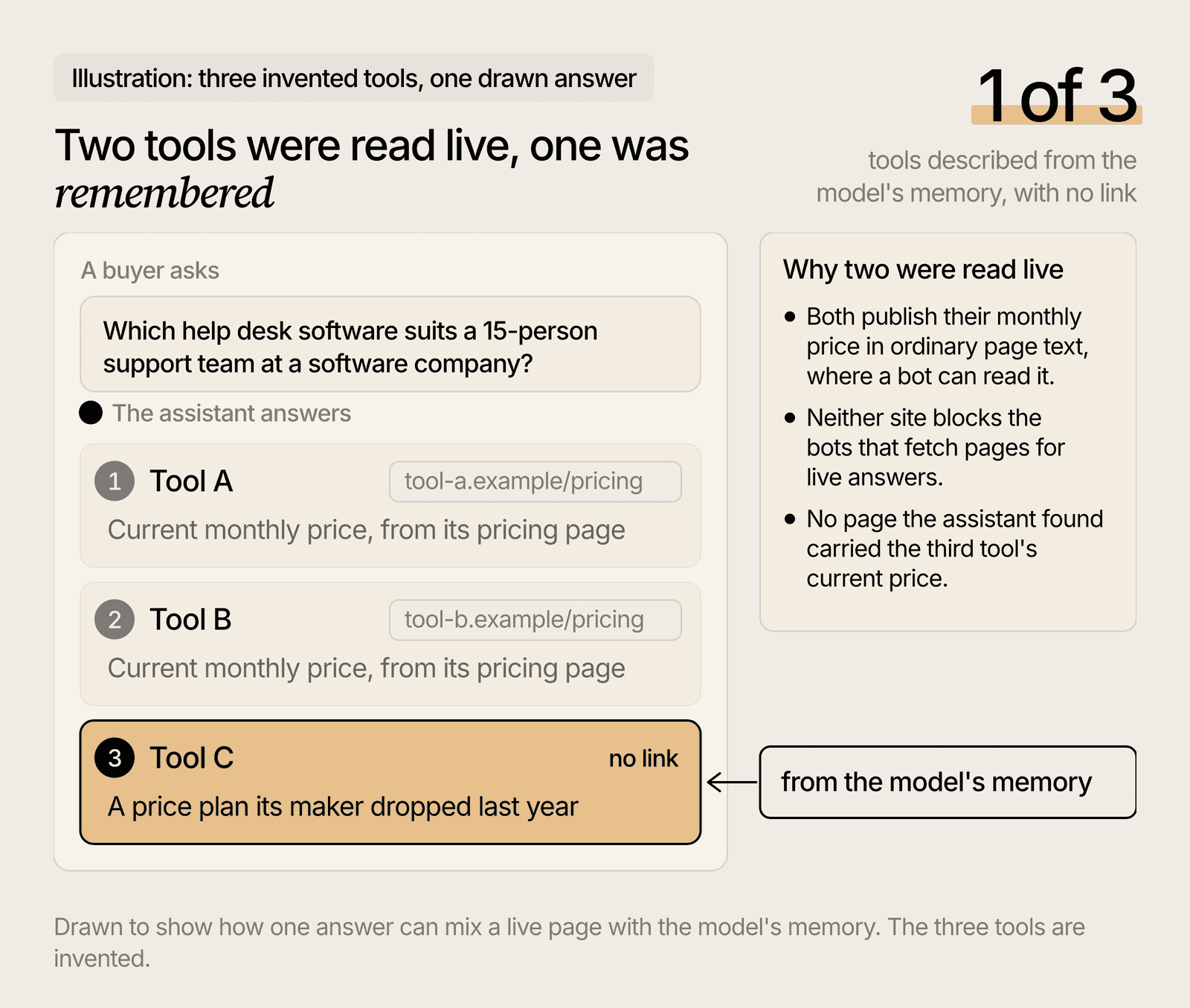
This is not a screenshot. The three tools and their prices are invented.
Two of the lines give a current monthly price and a small source link, because ChatGPT searched and read those tools' pricing pages. The third line describes a price plan its maker dropped last year, and it has no link. That line comes from the model's memory of older pages, so the buyer ends up comparing a current price with an old one.
The difference comes from the tools' own sites. The two linked tools publish their monthly price in ordinary page text, where a bot can read it, and their sites let in the bots that fetch pages for live answers. None of the pages the assistant found for that question carries the third tool's current price.
How is LLM SEO different from traditional SEO?
Traditional SEO aims at one ranked list of pages that Google draws from its index. LLM SEO has to reach the model's memory from training and the pages it reads in a live search.
Anthropic's documentation for developers states that split plainly for Claude. OpenAI's crawler documentation draws the same line for ChatGPT, with one bot for training and others for live answers. Claude "determines when to search based on the prompt", and it searches when a question depends on current or changing information, such as a product that might have changed. Search lets it answer "with up-to-date information beyond its knowledge cutoff". A knowledge cutoff is the point where a model's training data ends.
The two differ in where the answer comes from, what earns you a place in it, when a change shows up and what you measure.
What you are comparing | Traditional SEO | LLM SEO |
|---|---|---|
Where the answer comes from | A ranked list of pages from one search index | The model's memory from training, plus pages it reads in a live search |
What earns you a place | Keywords and links that lift the whole page | A passage that answers the question directly, and the same facts about you on many sites |
When a change you make shows up | Once Google crawls the page again | In live answers once the page is read again, and in the model's memory only with its next version |
What you measure | Your position for a keyword, and the clicks it brings | How often answers name you, and what they say about you |
Most of what you can change quickly sits on the live-search side.
For Google's own AI answers, your existing search work already counts. Google's guide for site owners says its AI features are "rooted in our core Search ranking and quality systems".
When is LLM SEO not worth paying for?
LLM SEO is not worth paying for when your buyers never ask an AI assistant to compare suppliers and the assistants already describe you correctly. For everyone else, the offer to turn down is one that promises your brand a place in ChatGPT's training data. OpenAI decides what goes into that data. Its crawler documentation says the pages its training bot collects "may be used in training" its models.
If OpenAI doesn't promise that a given page will be used, no agency can. Even a page that is used reaches the model's memory only when a new version of the model comes out, on OpenAI's schedule.
What you control is whether the training bot can read your pages, and whether your site and the sites that describe you give the same facts. Put the budget there, and into the pages assistants read in live search.
What the research says about LLM SEO
In the peer-reviewed study that gave GEO its name, the edits that did the most for a page were adding quotes, adding statistics and citing sources. They raised the share of the answer's text that came from the page by 30 to 40% on the test questions.
Researchers at IIT Delhi and Princeton ran the study (Aggarwal et al., KDD 2024). They gave a language model the top search results for each test question, then tried nine kinds of edits on those pages. The model wrote from pages it had just been handed, so the study covered live search only. That is the side where an edit to your page shows up first. What the model learned in training was never tested.
How much each edit helped depended on the kind of question. Statistics worked best for questions on law and government, and for questions asking for an opinion. Quotes worked best for questions on history or on people and society, and for questions that ask for an explanation. Citing sources worked best for factual questions. Clearer writing combined with statistics beat any single edit.
The work is from 2023 and 2024, and it ran on a language model of that time. Its authors write that the methods may need to adapt as AI assistants change. The gains were measured on a test set, so nobody can promise them for a given website.
How do I start with LLM SEO?
Ask ChatGPT, Gemini and Claude to describe your company, then check every fact they give against your own website. Put the same questions to each: what your company sells, to whom, where and at what price. Use a fresh chat, logged out where the assistant allows it, so your own history doesn't color the answer. Mark every fact that's wrong or out of date.
Each wrong fact needs one plain, current statement on your site, and the review sites and directories that list you should say the same. Those are the pages a model draws on when it describes your brand.
Keep this as a one-off check. A question that names your brand nearly always gets your brand back. Ongoing measurement tracks the questions buyers ask before they know your name, so the questions themselves leave your brand out.
Book a free 30 min call and we'll show you where you appear in AI answers today.
Questions people ask about LLM SEO
Is LLM SEO the same as GEO?
Yes, as a name. LLM SEO is another label for generative engine optimization (GEO), and the term GEO comes from a research paper presented at KDD 2024. In Agenzy's map of the terms, AI SEO covers the whole job, and AEO covers its content and citation part.
Is LLM SEO just SEO with a new name?
Most of the groundwork is the same work. An April 2025 Ahrefs article argues that GEO, LLMO and AEO are "all just SEO", and Google's guide for site owners calls optimizing for its AI features "still SEO". The same Ahrefs article concedes the differences: what AI crawlers can read, measuring answers instead of rankings, and brand mentions without a link, which count far more in AI answers.
Can I stop AI companies training on my site and still appear in ChatGPT?
Yes, with OpenAI: a site can block the training bot GPTBot and still appear in ChatGPT search through OAI-SearchBot, OpenAI's crawler documentation says. Anthropic does the same, with ClaudeBot for training and Claude-SearchBot for Claude's search. Google is different: blocking Google-Extended keeps pages out of both Gemini's training and what Gemini reads while answering, though Google Search is unaffected. Our list of AI crawlers shows each bot's job.
What does LLM SEO cost?
LLM SEO is sold under several names, so compare what each offer covers before you compare prices. We run the whole job as GEO, from letting AI bots in to counting how often assistants name your brand. Agenzy's GEO service starts from 5,000 EUR a month, ex VAT, and the full scope is on our GEO service page.
How long does LLM SEO take?
A change in the answers shows up in the daily tracking whenever it happens. In a GEO program with Agenzy, month one covers bot access, the buyer questions to track and a first measurement to compare against. Writing starts in month two, and the first formal review comes in month three. Nobody can promise results by a date, since the AI companies decide what their assistants cite.
About Agenzy
Agenzy is a GEO agency based in Vilnius, working with brands in the US, the UK and across Europe. We get brands named and recommended inside ChatGPT, Gemini, Google AI Overviews, Perplexity, Claude and Copilot. We are an official Peec AI partner. As of September 2026: 500,000+ AI chats analysed, 15,000+ prompts tracked, 150+ audits completed, 1,000,000+ EUR generated for clients by AI search. Dated cases sit at agenzy.lt/case-studies.