How do you rank on ChatGPT in 2026?

ChatGPT retrieves pages and writes one answer, so there is no position to rank for. OpenAI documents a single lever for site owners, the Bing premise on most guides is out of date, and brands' own websites earned 4.6% of the citations in our 2026 study. Here is the order of work, with the exact check for each step.

ChatGPT retrieves pages and writes one answer, so there is no position to rank for. OpenAI documents a single lever for site owners, the Bing premise on most guides is out of date, and brands' own websites earned 4.6% of the citations in our 2026 study. Here is the order of work, with the exact check for each step.

Read Time:

Read Time:

Read Time:

~21 min

~21 min

Author:

Author:

Author:

Emilis Zabilius

Emilis Zabilius

How do you rank on ChatGPT in 2026?

The website is where you become eligible; the citations mostly come from other people's pages.

ChatGPT has no ranking. It runs a few searches, pulls pages, scores passages against the question and writes one answer, so a page is used as a source or it is not.

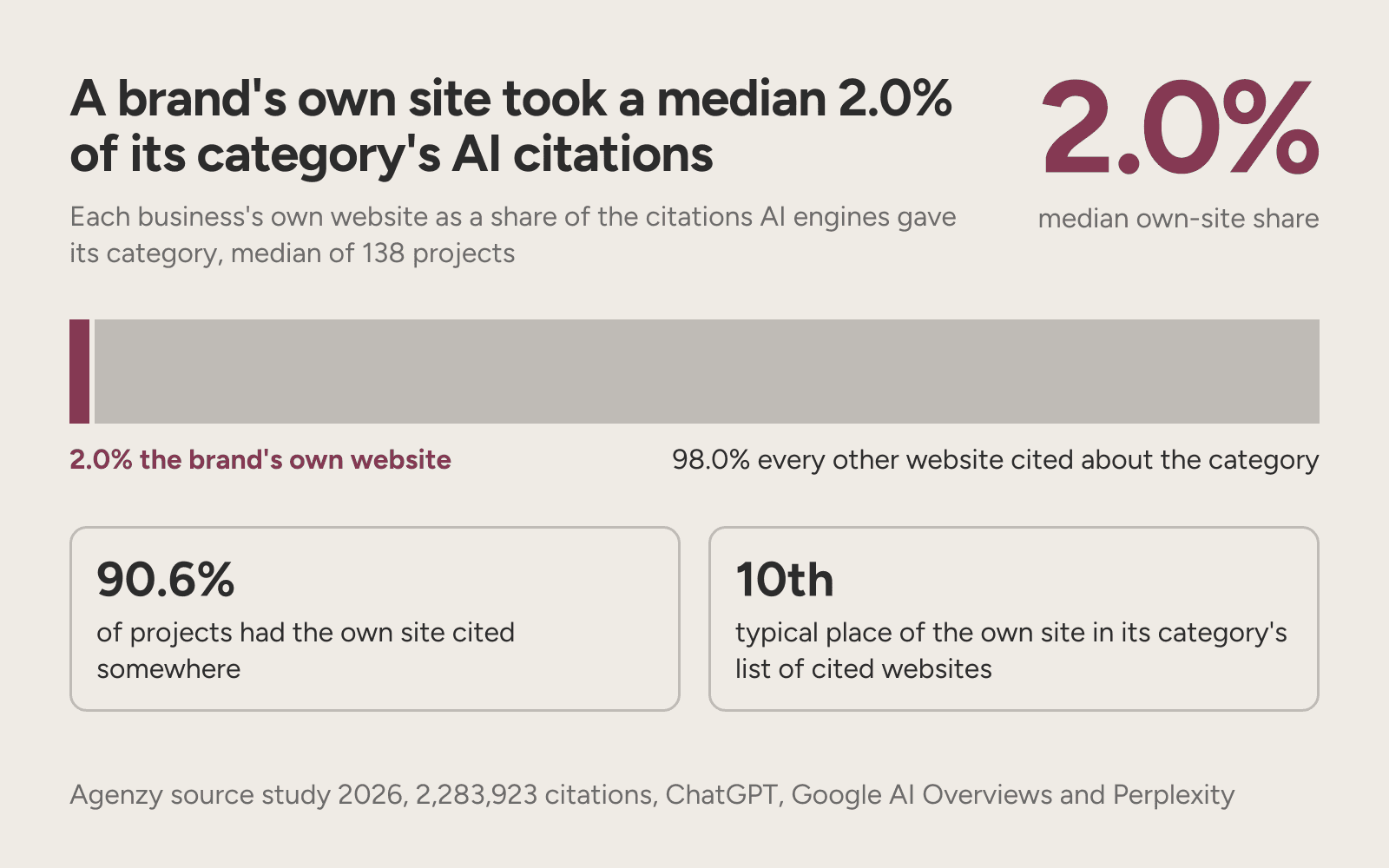
The biggest number in this article comes from Agenzy's own 2026 study, which tracked how AI engines answered buyer questions about 85 European businesses, in Lithuania and across Europe, between April and August 2026, followed as 91 market projects (a business tracked in two countries counts twice). Across 497,883 AI citations analysed by Agenzy in 2026, brands' own websites earned just 4.6% of citations, while competitor and third-party corporate sites took over 60%. The split is measured from one brand's point of view, so any single brand's own website is a small slice of what the engines cite about its category, and the rest goes to other companies' pages and to third parties, which is why most of the work is on other people's pages. The finding applies to a UK or US company for one reason: the engines and their retrieval are the same everywhere.

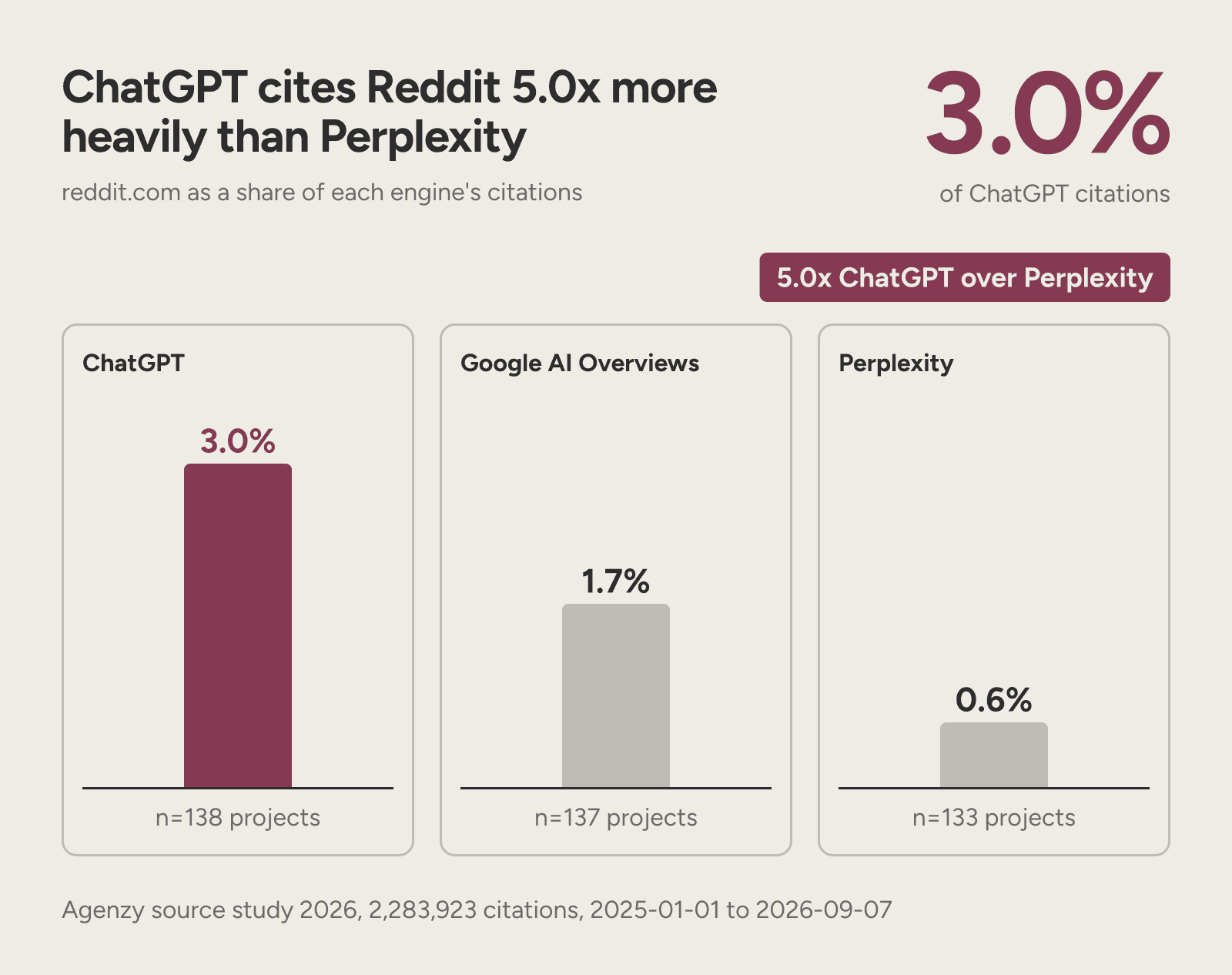
The outside numbers point the same way. Ahrefs' September 2026 count of the domains ChatGPT cites most puts Reddit first at 16.8% of ChatGPT citations and Wikipedia at 7.0%, third-party pages ahead of any brand's own.

OpenAI documents one lever for a site owner: allow OAI-SearchBot in robots.txt. It publishes nothing on how it picks sources.

The advice that ChatGPT runs on Bing's index is out of date: in September 2026 Peec AI showed that OpenAI runs its own index. The work, in order: crawler access in robots.txt, CDN and server bot rules, schema, the answer on the page, citations on other people's pages, and llms.txt last.

Where ChatGPT citations go: brands' own sites 4.6%, competitor and third-party corporate sites over 60%

Share of AI citations by source type in the 2026 study. The brand's own domain is the thin slice.

Why does ChatGPT recommend my competitor and not me?

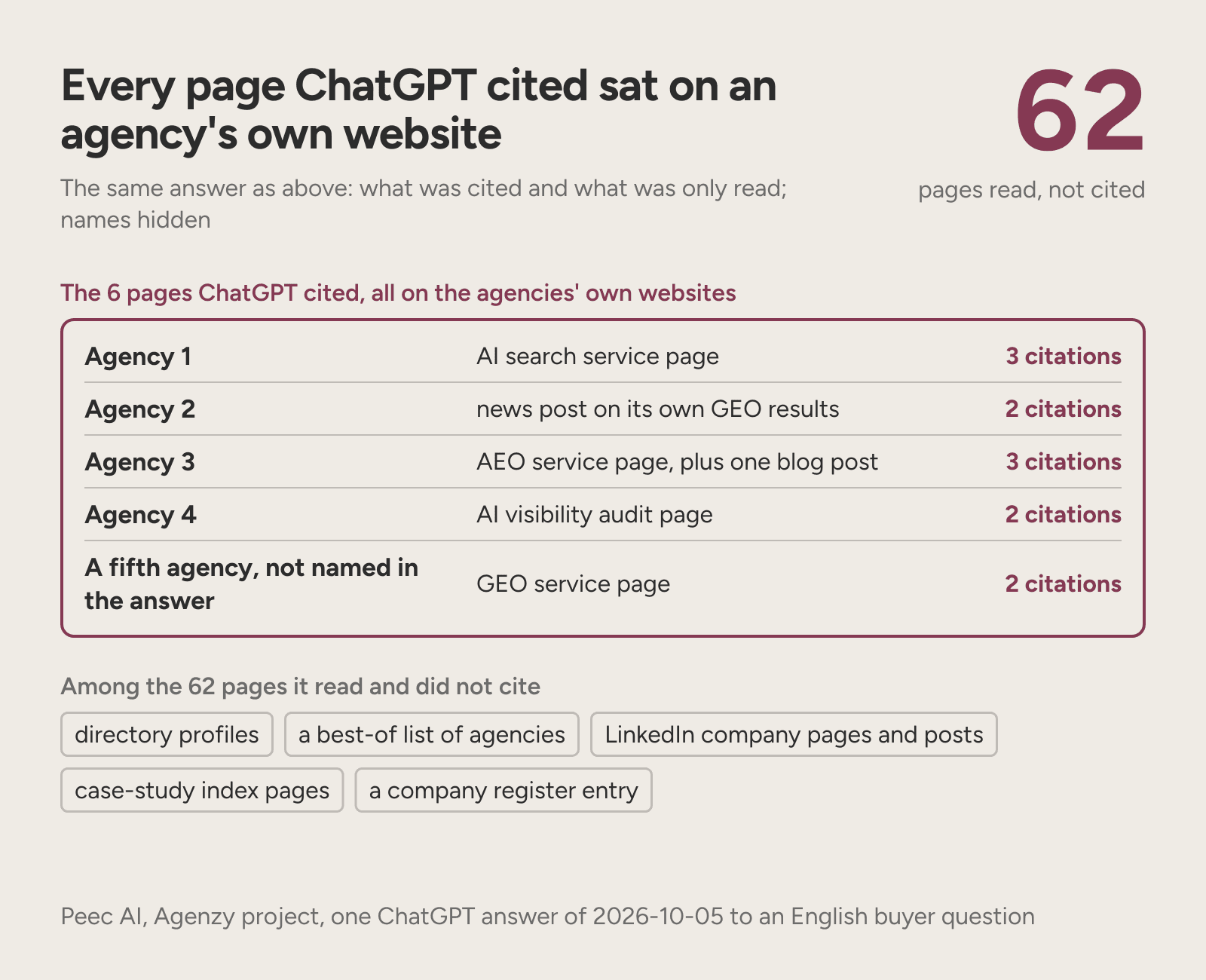
ChatGPT recommends your competitor when the pages it retrieved for that question belong to your competitor, or to a third party that names your competitor, and none of them names you. The fix is rarely on your own site. Brands' own websites earned 4.6% of the citations in the study, so a guide to ranking on ChatGPT that only talks about your website is a guide to a twentieth of the surface. A site that AI crawlers visit every day and never cite is the usual audit finding, and AI reads your website every day, so why is it recommending your competitor walks through why that happens.

Being named and being cited are different events, and the businesses in the study that AI engines mentioned at all show the gap. Agenzy's 2026 study found that 39% of brands mentioned by AI engines never had their own website among the top 30 sources those engines cited (n=87 mentioned brands, 2026-04 to 2026-08). Those brands were in the answer because other people's pages put them there.

Which other people depends on the category, and one domain leads across those businesses' market projects. Reddit appeared among the top-cited sources for 84% of the 91 business projects in Agenzy's 2026 AI search study, more than any other domain on the internet. Ahrefs' September 2026 Brand Radar report puts Reddit first at 16.8% of ChatGPT citations, ahead of Wikipedia at 7.0%; that page is regenerated monthly by an automated agent, so treat it as a running machine count.

Shopping questions and service questions pull different pages. For shopping, the cited pages are shop and retailer pages. For services, the cited pages are listicles, directories and editorial, and they differ by country.

Your own targets come from the citation audit described in Step 5, the buyer's questions on three engines and the domains that keep coming back. No general list replaces it, because the domains an engine trusts for accounting software are not the ones it trusts for a B2B parts supplier or a running-shoe retailer.

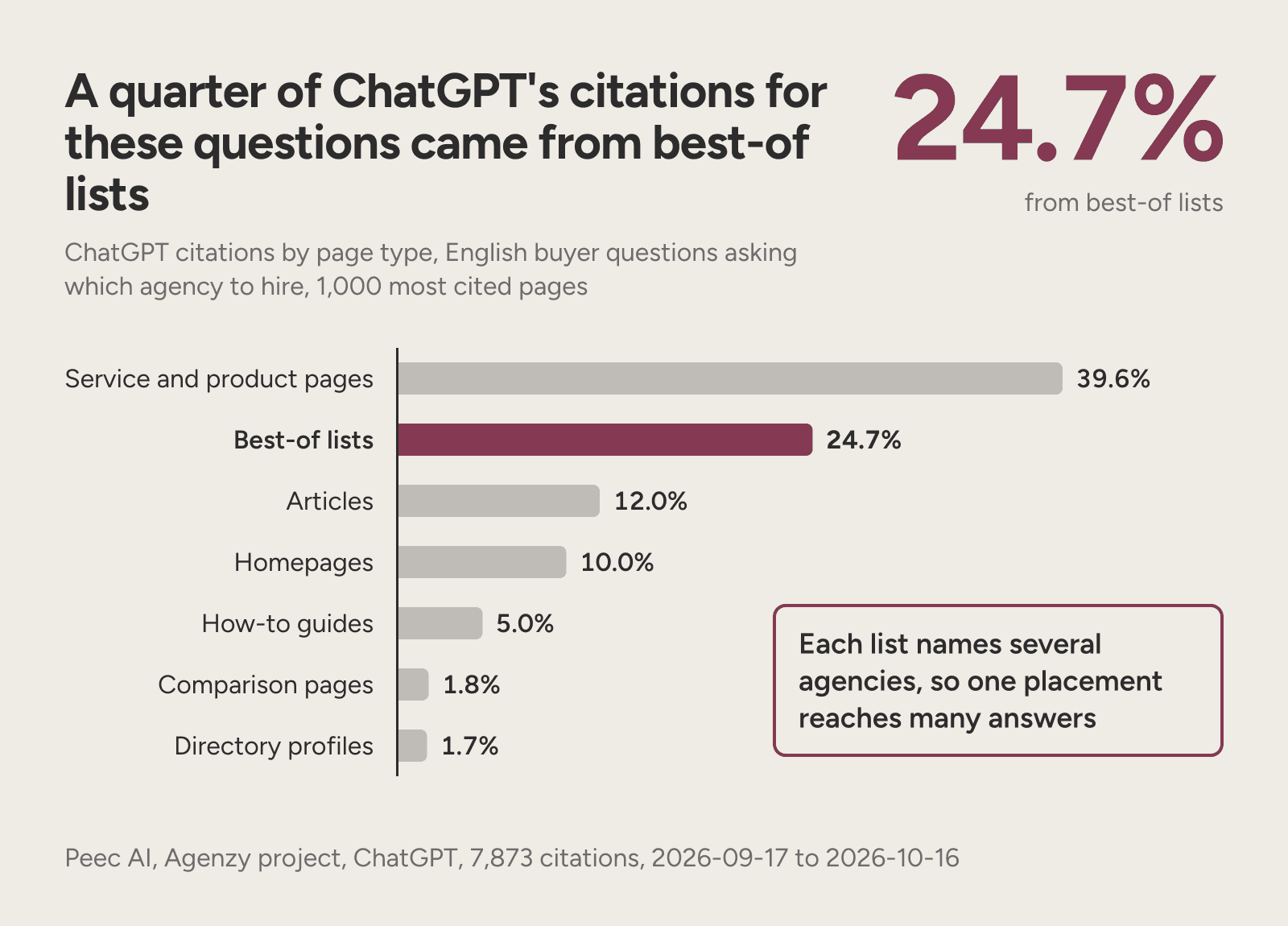
Then earn a place on them. A "best X in Y" listicle usually has an author and an email; send the data that would make your entry accurate, with prices and a named contact. Directories and review sites (G2, Clutch, national business registers, the trade body's member list) are cited because they are structured, so complete the profile. On Reddit, answer the thread as a person with a name, with the honest limits of your product in the answer, because a sales pitch gets removed and a useful answer gets cited for years.

One placement is rarely enough. A Pew Research Center analysis published in July 2025 found 88% of Google AI summaries cited three or more sources; the figure is for Google's summaries, since no equivalent is published for ChatGPT.

Does ChatGPT still use Bing?

OpenAI runs its own retrieval index, internally called Labrador, and still queries Google and Bing alongside it, so Bing is one of three places ChatGPT looks for pages. Tomek Rudzki, writing on Peec AI's blog in September 2026, documented the index in ChatGPT built its own search index from ChatGPT's own server-side events. The field names, the four source values and the identifier of an own-index experiment that ran on 8% of chats are all in that post.

Bing has not gone away. Rudzki's line is worth quoting whole: "Microsoft and Google still matter. We have direct proof that ChatGPT still uses both." Bing shows up in Deep Research sessions, and Google Search Console recorded a traffic spike on a test site on the days ChatGPT was queried about it.

When ChatGPT search launched on 2024-10-31, OpenAI said only that it "leverages third-party search providers". Bing was the provider the industry named, and that premise is what StudioHawk, NoGood and most other ranking guides still run on. Today OpenAI's own index does part of the finding, with Google and Bing results mixed in. Bing submission is still worth ten minutes, and it is no longer the gate.

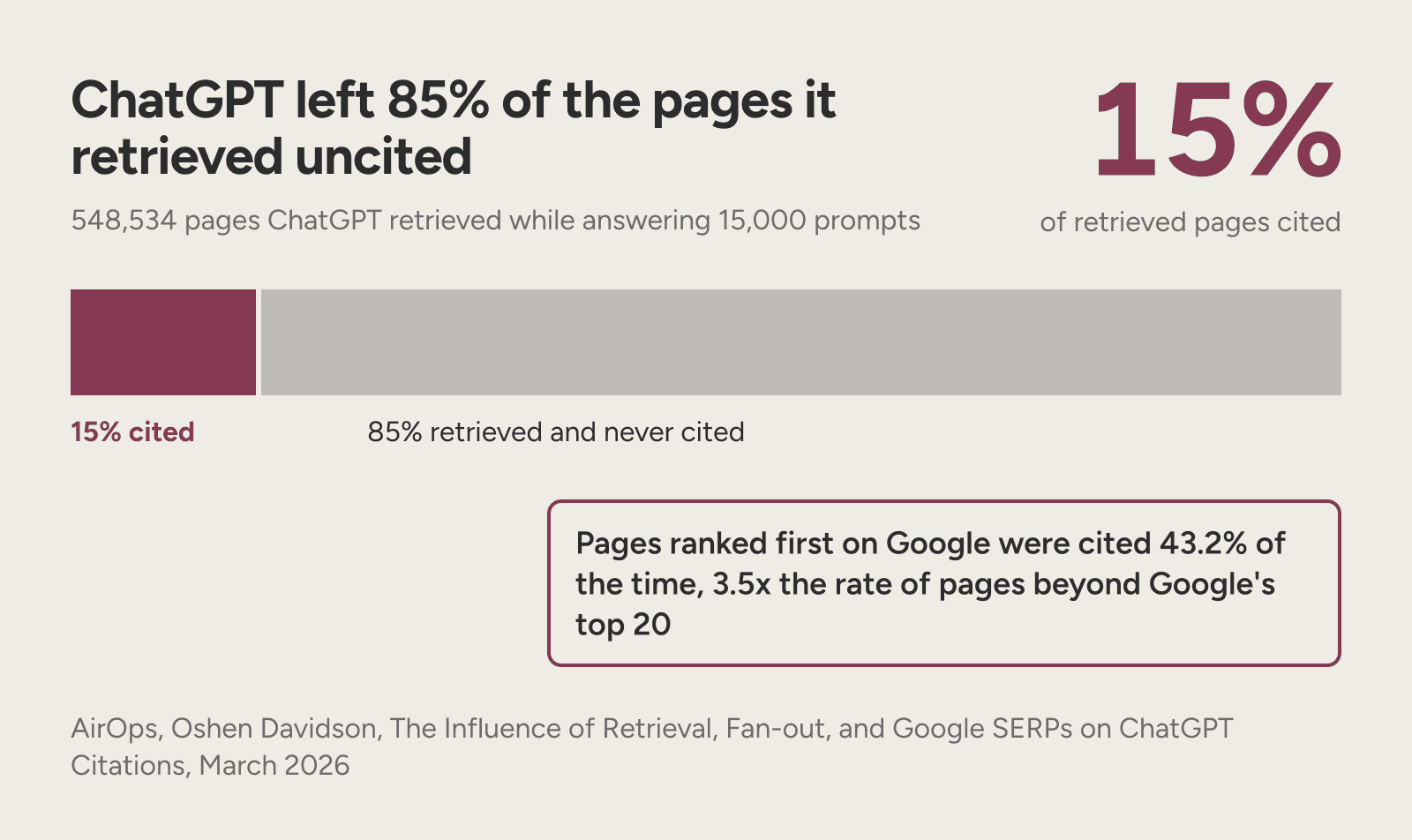
Nobody outside OpenAI knows the current split between Labrador, Google and Bing, so any page giving you a percentage is guessing. Rudzki also warns that "this system is still being rebuilt week to week", so the details will move. What has not moved is the correlation with Google. In Kevin Indig's Growth Memo analysis of ChatGPT citations, pages ranking first in Google were cited 43.2% of the time, against 12.3% for pages beyond Google's top 20.

Timeline: ChatGPT search on third-party providers in 2024, Labrador index visible from 2026-05, own-index experiment 2026-08

How ChatGPT finds pages: third-party search providers at launch on 2024-10-31, OpenAI's own Labrador index visible in server events from 2026-05-21, an own-index experiment on 8% of chats in August 2026. Source: Peec AI, September 2026.

What does OpenAI document, and what does nobody know?

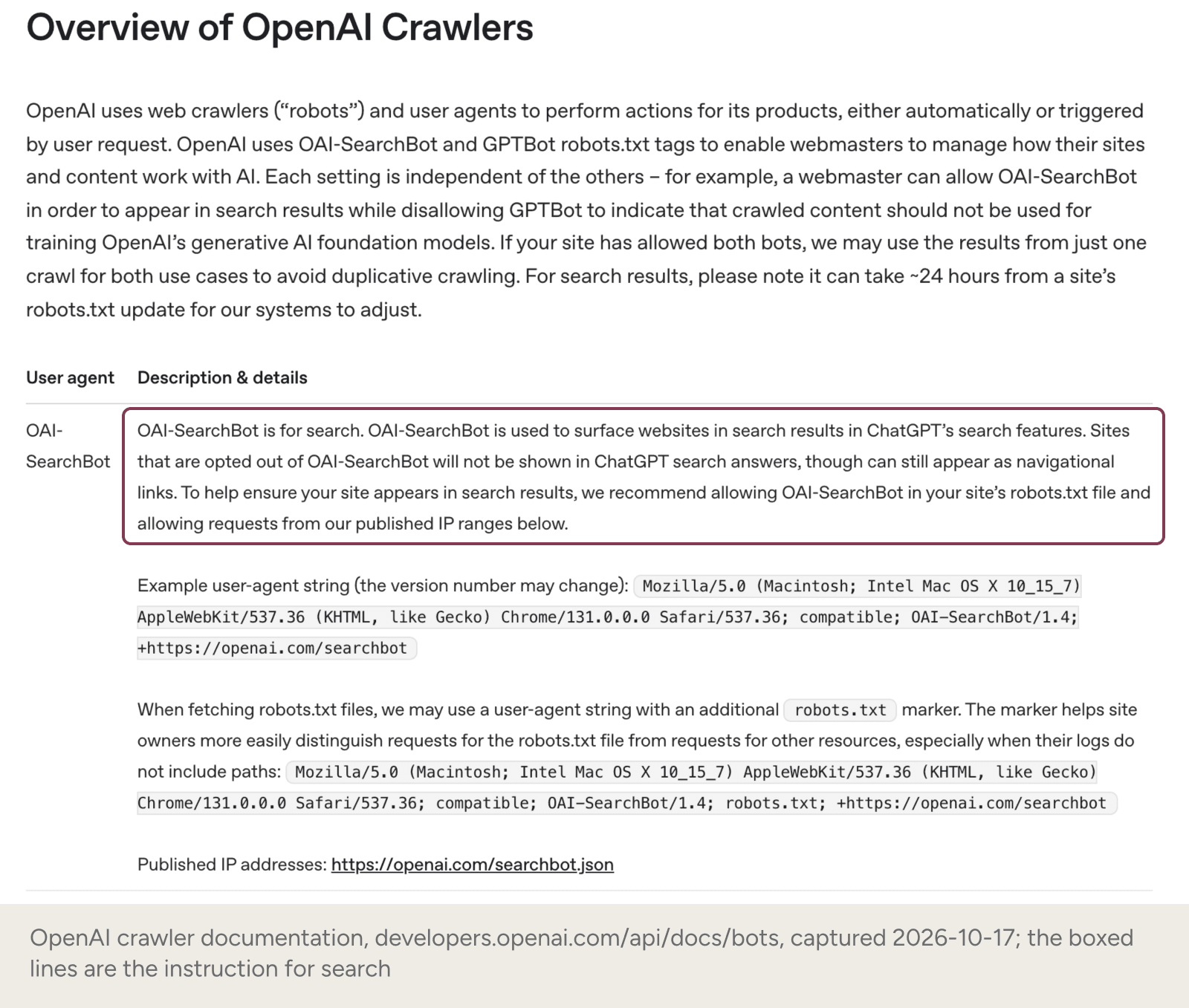
Four crawlers and one instruction for site owners are all OpenAI publishes; there are no ranking factors, no submission form and no instruction to create any file beyond robots.txt. Everything sold as a "ChatGPT ranking factor" is someone's inference, and the claim table below grades each one.

The one instruction, from OpenAI's crawler documentation: "Sites that are opted out of OAI-SearchBot will not be shown in ChatGPT search answers, though can still appear as navigational links." The recommendation on the same page is "allowing OAI-SearchBot in your site's robots.txt file and allowing requests from our published IP ranges."

User agent

OpenAI's stated purpose

Governed by robots.txt

OAI-SearchBot

"used to surface websites in search results in ChatGPT's search features"

Yes. Opted-out sites are not shown in search answers

ChatGPT-User

used "for certain user actions in ChatGPT and Custom GPTs" when a user asks a question

Partly. "Because these actions are initiated by a user, robots.txt rules may not apply"

GPTBot

"used to crawl content that may be used in training our generative AI foundation models"

Yes. A training decision, separate from search

OAI-AdsBot

"used to validate the safety of web pages submitted as ads on ChatGPT"

Yes. Only matters if you buy ChatGPT Ads

Source: developers.openai.com/api/docs/bots, quoted verbatim.

The ChatGPT-User row matters more than it looks. OpenAI says that agent "is not used to determine whether content may appear in Search", so blocking it does not remove you from answers, and allowing it lets ChatGPT read your page live when a user asks about you.

Everything else is inference.

Claim you will read elsewhere

Status

What the evidence says

Allow OAI-SearchBot in robots.txt

Documented by OpenAI

The only stated eligibility condition

Get indexed in Bing

Partly supported

Bing still used, mainly in Deep Research (Peec AI, September 2026). No longer the gateway

Rank in Google

Correlation, measured

43.2% of Google-first pages cited vs 12.3% beyond top 20 (Growth Memo, 2026-03)

Add schema markup

Inference

Ahrefs measured ChatGPT citations up 2.2% after adding JSON-LD, within noise

Get mentioned on third-party sites

Inference, strongly supported

Own sites 4.6% of citations, competitor and third-party corporate sites over 60% (the same dataset)

Write direct-answer passages

Inference, measured on rerankers

Measured on six open reranker models, with ChatGPT's own untested: the direct shortlist sentence beat the product description on every one

Add llms.txt

No vendor statement

97% of published files received zero requests in May 2026 (Ahrefs)

What are the first technical steps, in order?

Allow OpenAI's crawlers in robots.txt before anything else, because every later step is wasted on a site the crawler cannot reach. After that, in order: remove the CDN and firewall rules that block them anyway, add schema that matches the visible page, put the answer in the first lines of the page, then earn citations on the third-party pages ChatGPT already trusts for your category. llms.txt comes last. Each step has a check that takes minutes, and each is pointless if the one before it fails.

Whether your category deserves this work at all, meaning whether buyers ask AI assistants about it, is the question where to start with GEO settles before any of these steps.

The technical order: robots.txt, CDN and WAF bot rules, schema, answer on the page, citations, llms.txt last

The order of technical GEO work, six steps. Each depends on the one before it. llms.txt sits last because no AI service has said it reads the file.

Step 1. Allow OAI-SearchBot, ChatGPT-User and GPTBot in robots.txt

Read the file:

Look for a Disallow: / line under User-agent: * or under any of the three OpenAI agents. Security plugins and CDN templates add blanket disallow rules that nobody remembers writing. What good looks like:


A plain User-agent: * followed by Allow: / passes the same check, since it covers every agent. The explicit form is there so a later plugin cannot quietly narrow it.

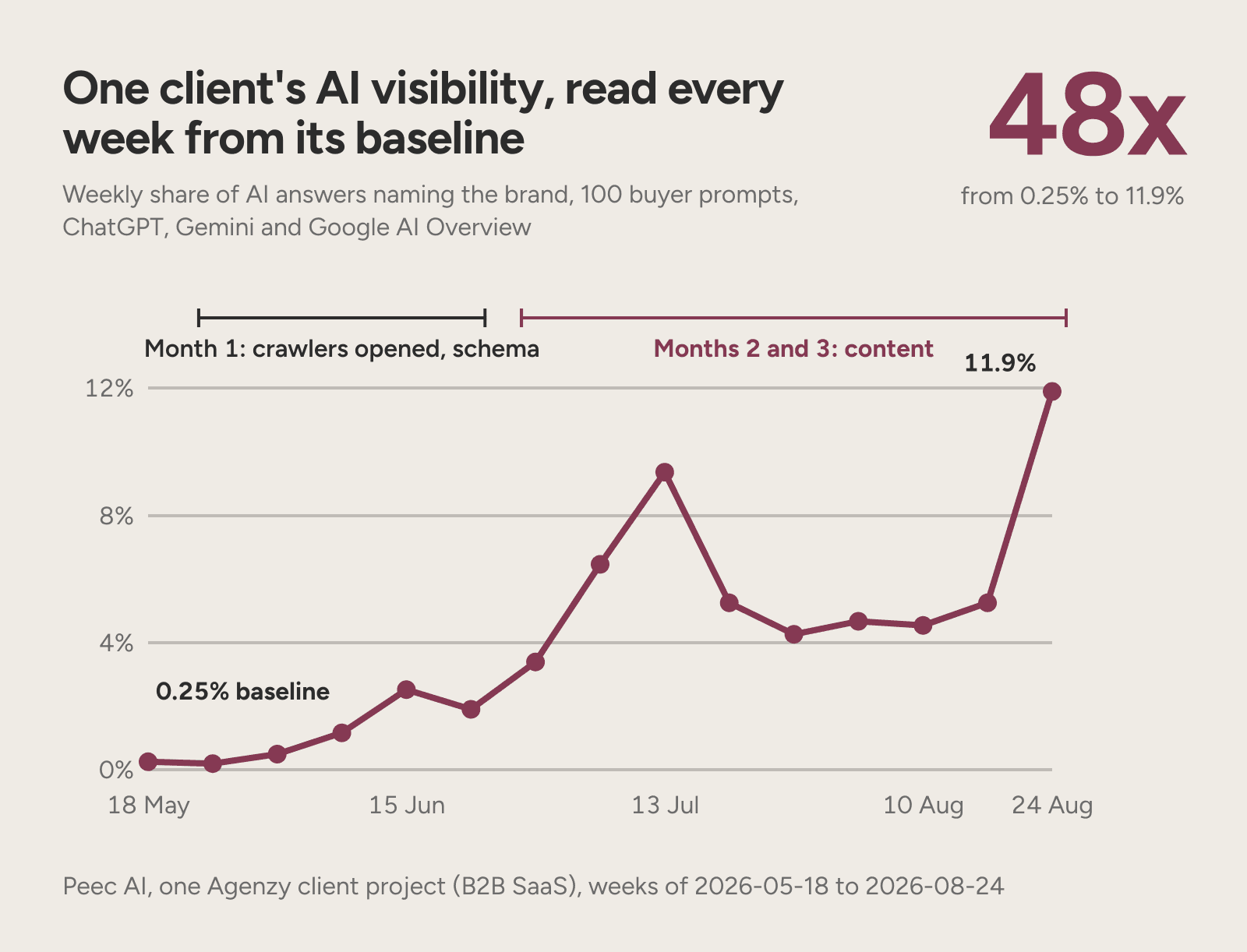
A block at this step is common and expensive. When Outcraft AI came to Agenzy in May 2026, its robots.txt blocked GPTBot, ClaudeBot and Google-Extended, and Outcraft appeared in 5 of 100 tracked buyer prompts. Two separate things happened next. The robots.txt fix made the site eligible, and the content program that followed did the rest; by 2026-08-31 the count stood at 51 of 100.

GPTBot is the training crawler, and allowing it is a separate decision from search. OpenAI's page ties search eligibility to OAI-SearchBot alone. A typical business allows all three; a publisher protecting its archive may block GPTBot and keep the other two.

Step 2. Check that your CDN and firewall are not blocking them anyway

robots.txt is a request. A Cloudflare rule is a wall. Test the wall with a spoofed user agent:

A 200 is good. A 403 or a challenge page means a rule fires on the user agent. Then go where the real rules live. In Cloudflare, the AI Crawl Control panel lists which AI services are reaching the site and lets you allow or block each one, and the security events log shows what was blocked and why. Bot Fight Mode, which challenges clients it suspects are automated, deserves a look too, along with any WAF rule with "bot" in its name and the hosting firewall.

The curl has a limit. A spoofed user agent tests robots.txt and simple user-agent rules only, and it cannot see rules that fire on IP range or on Cloudflare's own verified-bot category. On one client site Agenzy tracks, robots.txt carried the Allow lines Agenzy had written and the curl said the crawler got through, while Cloudflare was still blocking it; the site's own security events showed the block. The curl rules out the simple case, and the security log, filtered to verified bots, shows the rest.

Step 3. Add schema that matches the visible page

Check what the site already emits:

Then paste the URL into validator.schema.org. What good looks like: an Organization block on the homepage with name, address, founder and sameAs links to your real profiles, and a BlogPosting plus FAQPage block on each article, rendered server-side in the head, with question text identical to what the page shows.

Do it, and budget a day: it does not move ChatGPT measurably, since Ahrefs tracked pages that added JSON-LD against a control group and measured ChatGPT citations up 2.2%, indistinguishable from zero. It sits third, ahead of the page copy, because Google's rich results and Merchant Center require it, and Google's AI features guide says the same product and business data feeds its AI responses and shopping results.

Step 4. Put the answer where the crawler reads first

Write the H1 as the question people type, and answer it in the first sentence. Use H2s as the follow-up questions. Restate every table in a sentence, because text extractors lose answers that live only in cells.

The difference in practice, on the first line of a software company's product page:

  • Before: "Smart accounting software for ambitious businesses."

  • After: "[Your product] against Xero and QuickBooks for a UK company of 10 to 50 staff: payroll, VAT filing and price per user, compared in one table."

The first line is the product-description shape that lost in Peec AI's reranker test, because it never engages with the words of the question. The second names the alternatives, the buyer and the criteria, which is the direct-answer shape that won, and a crawler lifts it from a product page as readily as from an article.

Step 5. Earn citations on the pages ChatGPT already trusts for your category

Ask ChatGPT, Gemini and Perplexity the 10 to 15 questions a buyer asks about your category, in the buyer's words, and write down every cited domain. The same three to five domains will keep appearing, and those are the targets. Getting named on them is most of the work, since brands' own websites earned 4.6% of the citations in the study.

That means sending a listicle's author accurate data with a named contact, and completing the profile on any directory that comes up. On Reddit it means answering the thread as a person with a name. The cost is time, spread over months, and it is the step that keeps going after the technical work is done. Where a company hands this step to an outside firm, best GEO agencies in Europe 2026 lists the firms and what to ask them.

Step 6. Add an llms.txt file last, and expect nothing from it

Publishing the file is an hour's work, and no AI service has said it reads one. Ahrefs studied 137,000 domains in its May 2026 server-log study: 28% publish a valid file, and 97% of those files received zero requests in the month. Google's John Mueller put it in one line: "none of the AI services have said they're using LLMs.TXT (and you can tell when you look at your server logs that they don't even check for it)." Google's own AI guide says the same for Search: "You don't need to create new machine readable files, AI text files, markup, or Markdown to appear in Google Search."

One line in OpenAI's own documentation looks like a contradiction. Its developer site opens with "For the complete documentation index, see llms.txt", and a reader who spots that may think it overrules the Ahrefs numbers. It does not. OpenAI publishes an llms.txt for its own documentation site, for people building on its API. Its crawler page, the one that governs whether your site appears in ChatGPT, never mentions the file. Agenzy ships one for clients because it costs about an hour and nothing else, and because some audit tools look for it; nothing measurable follows from it.

Order

Action

What it changes

Evidence it matters

Effort

1

Allow OAI-SearchBot, ChatGPT-User, GPTBot in robots.txt

Eligibility to appear at all

OpenAI: opted-out sites "will not be shown in ChatGPT search answers"

Minutes

2

Remove CDN, WAF and hosting bot blocks

Eligibility again, invisible in robots.txt

Client case: robots.txt carried explicit Allow lines, Cloudflare still blocking

Hours

3

Schema in the head, matching the page

Entity resolution; rich-result and product eligibility on Google

Ahrefs: ChatGPT citations up 2.2%, within noise. Google: not required, keep for rich results

Days, once

4

Answer shape on the page

Whether the passage survives reranking

Peec AI reranker test: the direct-answer sentence beat the product description on all six models

Weeks, ongoing

5

Citations on third-party pages

Where over 60% of citations sit

The study: own sites 4.6% of citations, competitor and corporate sites over 60%

Months, ongoing

6

llms.txt

Nothing measurable

Ahrefs, 137,000 domains: 97% of files got zero requests

About an hour, last

Which pages does ChatGPT retrieve, and which does it cite?

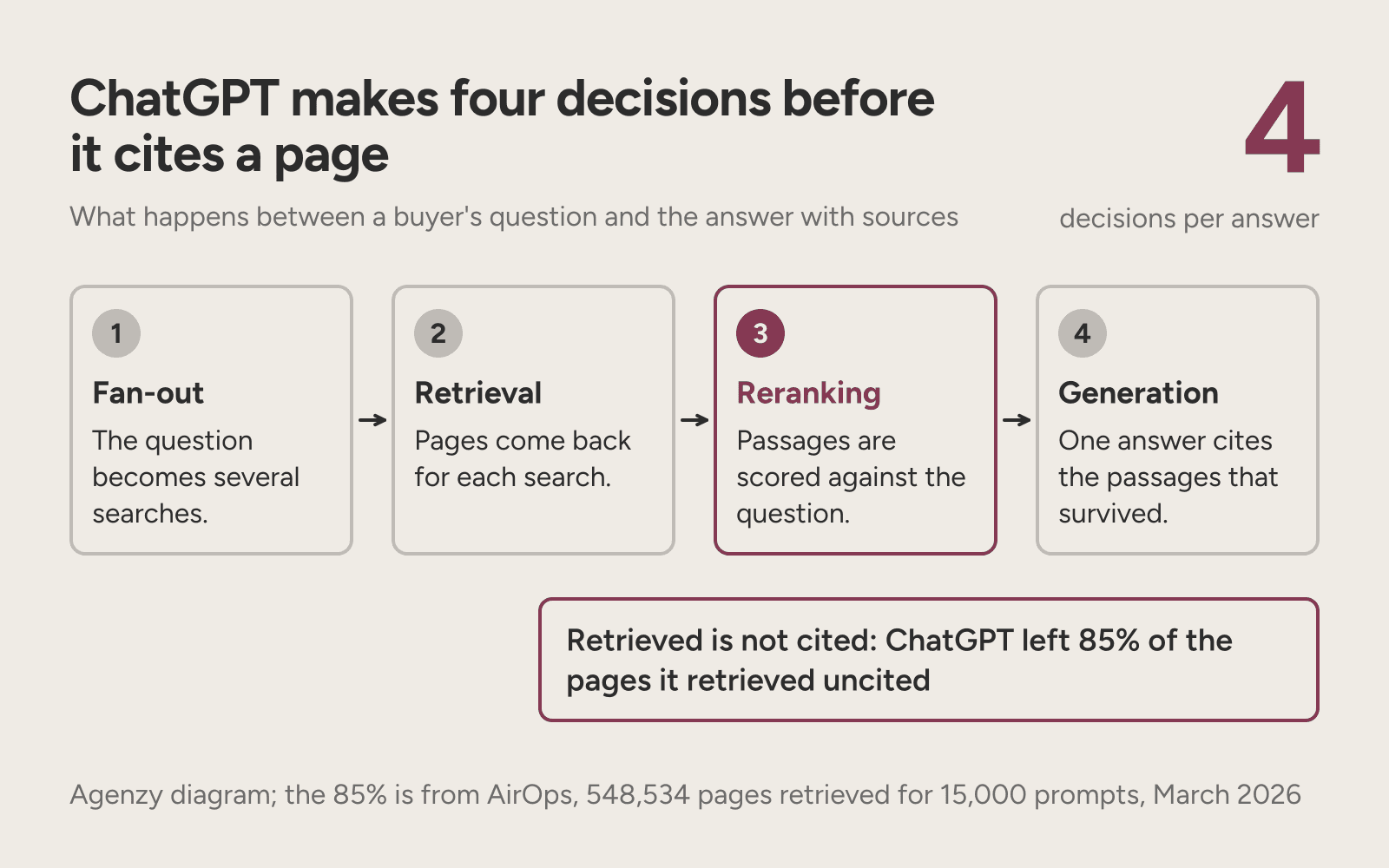
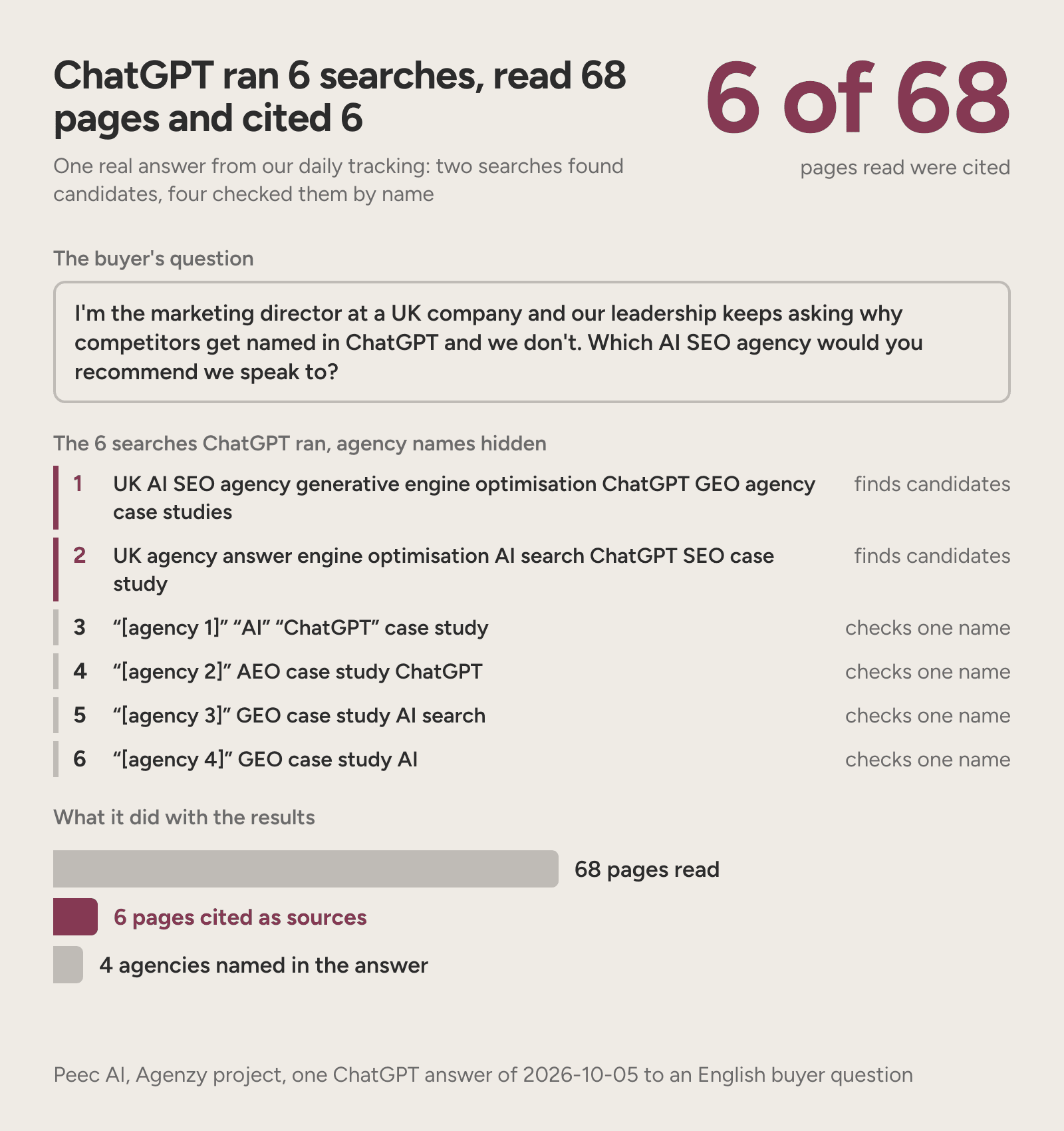
ChatGPT retrieves about six times more pages than it cites, and 85% of retrieved pages are never cited, according to the AirOps data in Kevin Indig's Growth Memo analysis. The loss happens across four decisions. ChatGPT rewrites the question into several queries, which is the fan-out. It retrieves candidate pages for each query. It reranks the candidate passages against the original question. Then it generates the answer from the survivors and cites some of them.

Being fetched only gets a page into the pool. The citation goes to the page whose passage answers the question in the shape the question demands.

The page type matters too, counted over the top-cited URLs of those businesses. In Agenzy's 2026 study, comparison-style pages earned a 1.6x higher median citation rate from AI engines than homepages, yet homepages still absorbed 29% of all citations (n=2,730 top-cited URLs across 91 projects). Build the comparison page, and keep the first screen of the homepage an answer as well, since the homepage still takes 29% of citations.

The passage itself weighs more. Peec AI's reranker test ran six open reranker models over two passages for the query "what are the best aeo tools": a product description scored 0.12% and a sentence naming a shortlist scored above 99.9%. The percentage is the score a model gives a passage for the question, and a higher score means the passage is chosen. Every one of the six model families scored the direct answer higher. Peec AI's own caveat applies: the test describes how retrieval systems commonly work, and ChatGPT's internal model was not tested.

Position matters as much as shape. Indig's positional analysis found the band 10 to 20% down the page, meaning the first fifth measured from the top, is read hardest, while the bottom 10% earns only 2.4 to 4.4% of citations. Conclusions are almost never cited. The shortlist, the criteria and the numbers go in the first screen.

Ethan Smith of Graphite puts a chat query at about 25 words against about 6 for a Google search, so the page has to answer the specific question, constraint and use case included, in the words a person would use. A page titled "Our services" answers none of them.

All of this assumes the page has text to score. A design-first site, with a photo, a tagline and no copy, gives the crawler nothing. The fix that keeps the design is a clickable panel per product or service that opens the full description in the HTML, so the text exists for the crawler and the visual stays clean.

How is AEO different from SEO, and does the same order apply to Gemini and Perplexity?

Answer engine optimization (AEO), also called generative engine optimization (GEO), is the work of getting a brand named and cited inside answers written by AI assistants such as ChatGPT, Gemini, Perplexity and Google AI Overviews. It covers crawler access, the shape of the answer on the page, and the third-party sources those assistants retrieve and trust.

SEO earns a position on a list of ten links. AEO earns a place in one written answer that names two or three brands. The two share a base. Google's guide states that "Our generative AI features on Google Search are rooted in our core Search ranking and quality systems", and Growth Memo's 43.2% figure shows Google rank still predicts a ChatGPT citation. What AEO adds is the passage work and the third-party work, which classic SEO never priced.

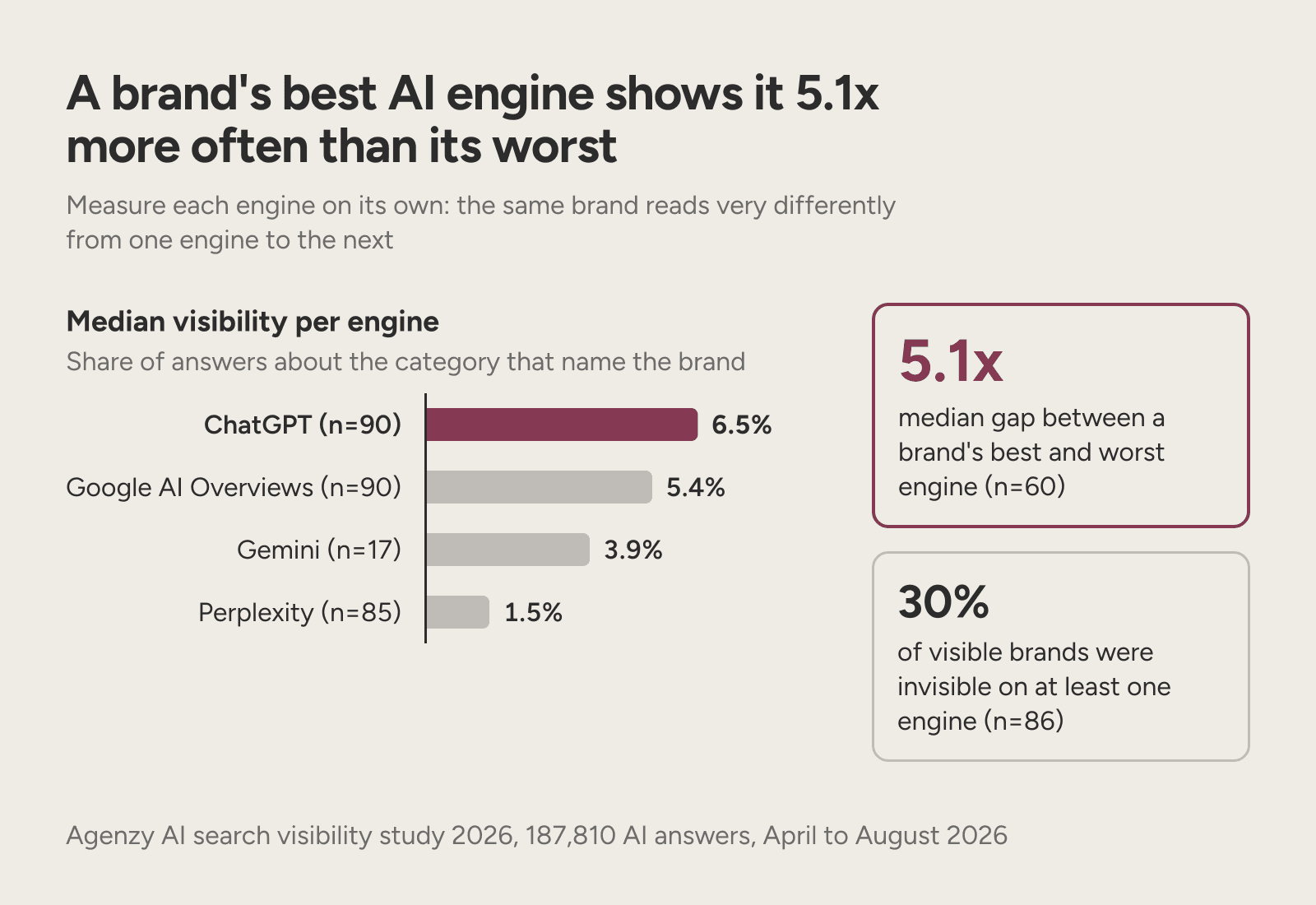
The same order applies to Gemini and Perplexity, with different crawler names. Google's AI surfaces read what Googlebot reads. Perplexity uses PerplexityBot, Anthropic uses ClaudeBot. Allow them in the same robots.txt block and check the same firewall. Measure each engine on its own. Among the businesses in the study that appeared on any engine at all, the spread was wide: Agenzy's 2026 study measured a median 5.1x visibility gap between a brand's best and worst AI engine, and 30% of visible brands were completely invisible on at least one engine (n=86 brands visible somewhere, 2026-04 to 2026-08).

How do I know whether my ChatGPT visibility actually moved?

A screenshot of ChatGPT naming you proves one session on one day on one engine. Visibility has moved when the share of tracked buyer prompts that name your brand rises against a baseline measured before any work started, read weekly and per engine.

The setup Agenzy uses: 50 prompts written the way buyers type them, run daily on ChatGPT, Gemini and Google AI Overviews. The baseline is measured before the first change ships, so the month-one technical fixes read against it. Set the expectation from the data before the first read. The median across those businesses' market projects is low: Agenzy's 2026 study of 187,810 AI answers found the median European SMB brand appears in just 5% of AI answers about its own product category (n=90 tracked market projects, 2026-04 to 2026-08). A brand starting near that median and reaching 10 to 15% has doubled or tripled, and it will still lose most answers.

Google Analytics 4 and Microsoft Clarity sit alongside as free instruments. In GA4, referrals from chatgpt.com, perplexity.ai and gemini.google.com are the traffic that already arrives, so group them into one channel and read it next to organic search. Clarity records what those visitors do on the page. Which tracking tool to buy, and what each costs per prompt, is in best AI visibility tools in 2026.

FAQ

Can you rank on ChatGPT?

No. ChatGPT writes one answer and cites a handful of pages, so there is no list with a position to hold. The nearest equivalent is the share of buyer questions whose answer names your brand, tracked over weeks on each engine. Three things move that share: crawler access so the page is eligible at all, a passage that answers the question directly in its first lines, and a presence on the third-party pages that carried over 60% of citations in the study.

Does ChatGPT still use Bing?

Yes, alongside Google and OpenAI's own index. Peec AI's September 2026 reading of ChatGPT's server events shows the own index, Labrador, in use from 2026-05-21, with Bing appearing mainly in Deep Research sessions. For a site owner this changes one thing: a Bing Webmaster Tools submission is still worth ten minutes, and absence from Bing no longer keeps a site out of ChatGPT. The split between the three sources is not public.

Why does ChatGPT recommend my competitors and not me?

Usually because a listicle, directory or forum thread that ChatGPT retrieved lists your competitor and leaves you out, and your own site was never in the pool. In the study, brands' own websites took 4.6% of citations, and 39% of brands that AI engines mentioned never had their own site among the top 30 cited sources (n=87). The quickest diagnosis is to ask ChatGPT the question yourself and open every cited link: the pages that name the competitor are the pages to get onto. Test your own site for a firewall block first, since that removes you before any of it counts.

What are the first steps to get my business into ChatGPT recommendations?

Start with the two checks that take minutes: robots.txt allows OAI-SearchBot and ChatGPT-User, and a request with a spoofed agent returns 200 with nothing logged in the CDN's security events. In the first month, add Organization schema and rewrite the main product or service page so its opening sentence answers the buyer's question. From the second month, work the citation audit in Step 5: the buyer's questions on three engines, the domains that keep coming back, and accurate data sent to each with a named contact. Start tracking the same prompts on day one, before anything ships, or there is no baseline to read against.

How do I check whether my website is ready to be cited by AI assistants?

Four checks, each under five minutes and each with a pass condition. robots.txt: no Disallow line covers OAI-SearchBot, ChatGPT-User, PerplexityBot or Googlebot. Firewall: a request with a spoofed OAI-SearchBot agent returns 200, and the CDN's security events, filtered to verified bots, show no blocks. Schema: validator.schema.org finds an Organization block whose name and address match the page. Passage: the opening sentence of your main page answers the question a buyer types, and a slogan fails. An absent llms.txt is not a failure, since no AI service has said it reads the file.

How long does it take to show up in ChatGPT?

No published figure exists. Eligibility fixes show first, since a removed robots.txt or firewall block takes effect on the crawler's next visit. Third-party citations take longest, because they depend on other people publishing on their own schedule. Read the tracked prompts weekly against the baseline, per engine, and judge movement on the share of prompts that name you; one session proves one day.

Can I pay to appear in ChatGPT?

Yes, as a labeled ad, and in the United States so far. ChatGPT ads began rolling out on the Free and Go tiers in February 2026, and TechCrunch's report of 2026-02-09 quotes OpenAI saying ads "do not influence the answers ChatGPT gives you". Instant Checkout, the in-chat purchase flow, was pulled back in March 2026; CNBC reported on 2026-03-24 that merchants now use their own checkout while OpenAI focuses on product discovery, with retailers sharing product feeds directly. Which brands ChatGPT names when asked for a recommendation stays unpaid and is decided by the pages it retrieves and cites.

What is AEO, and how is it different from SEO?

AEO, also called GEO, is the work of getting a brand named and cited in the one written answer an AI assistant gives. SEO's unit is a position among ten links; AEO's unit is a mention inside the answer, and the two are measured differently: rank on a results page against the share of tracked buyer questions that name you. They share a base, since Google's generative features run on its core ranking systems and Google-first pages were cited by ChatGPT 43.2% of the time in Growth Memo's data. What AEO adds is the passage work on the page and the third-party pages the engines retrieve, which carried over 60% of citations in the study.

About Agenzy

Agenzy is a generative engine optimization agency based in Vilnius, Lithuania, working with e-commerce, software and B2B brands in Lithuania and abroad. It is an official Peec AI partner. Its own numbers: 500,000+ AI chats analysed, 15,000+ prompts, 150+ audits. The 2026 study behind the citation figures in this article is the AI search visibility study; the GEO service, with its prices and month-by-month scope, is on the GEO service page.

Emilis Zabilius

Emilis Zabilius

CEO & Co-Founder, Agenzy

Where does your brand stand in AI search?

Free check of how often ChatGPT, Gemini and Google AI Overviews name you, and whether they can read your site.

Our help

Related Services

Related Services

Related Services

Services related to the blog.

Services related to the blog.

Services related to the blog.

Keep up with what matters.

Simple, useful ideas on GEO, content and growth, shared on LinkedIn.

Next step

Check your own AI search potential

1

Free check

We check whether AI can read your site and how often it names you.

2

20-minute intro call

We map your goals and give a first read on the gaps.

3

Deep dive + plan

A 60-minute session on your buyer questions and what we would build first.

Emilis Zabilius

Emilis Zabilius

CEO & Co-Founder

Focus · AI search and ChatGPT ads

Based · Vilnius

Rokas Alešiūnas

Rokas Alešiūnas

COO & Co-Founder

Focus · Strategy and clients

Based · Vilnius

Keep reading

More from Agenzy

recommended reads

Guide

Best AI visibility tools in 2026, priced per prompt from the vendors' own pages

Five AI visibility tools priced on one unit, cost per prompt per engine per day, computed from their own pricing pages: Peec AI, Profound, Otterly.AI, Semrush and Ahrefs. Plus two that publish no price you can normalize, Scrunch and Passionfruit Labs, and who owns each tool after the Adobe and Sitecore deals.

read

Guide

How do you rank on ChatGPT in 2026?

ChatGPT retrieves pages and writes one answer, so there is no position to rank for. OpenAI documents a single lever for site owners, the Bing premise on most guides is out of date, and brands' own websites earned 4.6% of the citations in our 2026 study. Here is the order of work, with the exact check for each step.

read

Research

Which sources do AI engines cite? 2,283,923 citations across ChatGPT, Google AI Overviews and Perplexity (Agenzy, 2026)

We counted every source ChatGPT, Google AI Overviews, Gemini and Perplexity cited across 394,180 answers to buyer questions about 130 European businesses, three quarters of them in Lithuania (104 of the 138 tracked projects). No domain holds more than 2.1% of the 2,283,923 citations, the three main engines share only 2 of their top 10 sources, and brands' own websites earn 3.7% against 16.9% for their named competitors.

read

Guide

GEO across Europe in 2026: how AI visibility changes by market and language

We are the most-named GEO agency in Lithuania and fourth in Estonia at 3.1%. Same brand, same method, three answers. Six European markets measured one way: our own Baltic numbers, three client markets in Greece, Poland and Spain, the sources ChatGPT names per market, the fan-out language data and the four checks to run on Germany, where we hold no client data.

read

Guide

How ChatGPT decides which products to recommend, and how to get yours into the answer

On 2026-09-07 ChatGPT answered a UK shopper with three ramps, their prices and its reasons, and dropped a fourth because the maker's site said UK stock was out. The shops it names are the shops whose pages it fetched, with price and stock readable. Here is what that means for an e-commerce or DTC brand, with OpenAI's own criteria and a 90-day plan.

read

Guide

How much does a GEO agency cost in 2026? Prices across Europe, the UK and the US

A credible GEO retainer costs 1,500 to 3,500 EUR a month for a small business and 3,000 to 8,000 EUR a month for mid-market work, and that middle band overlaps in Germany, the UK, France and the US. We scanned about 100 providers in August 2026 and printed only the prices that sit on a live page. Each band comes with what it buys, what a one-off leaves undone and a five-line method for comparing two offers.

read

Guide

Best GEO agencies in Europe 2026, compared on what you can check yourself

25 European and US GEO agencies compared on four things a buyer can check in an afternoon: crawler access in robots.txt, homepage schema, published price and contract terms. Per-market AI visibility from Peec AI where we have measured it: Agenzy third in Latvia, fourth in Estonia, first in Lithuania. The most cited agency page on our European B2B SaaS prompt blocks GPTBot and is cited anyway.

read

Guide

GEO ir AI SEO agentūros Lietuvoje 2026: palyginimas pagal duomenis

Beveik visi Lietuvos GEO agentūrų palyginimai surikiuoti pagal tai, ką agentūros pačios apie save parašė savo puslapiuose. Šitas surikiuotas pagal matavimą: 75 lietuviški promptai, 2 080 AI pokalbių, trys varikliai, nė viename klausime neminimas nė vienas prekės ženklas. Žemiau visa lentelė, metodas ir tai, ko šis matavimas nemato.

read

Agenzy logo

Get started

Let’s make AI recommend you.

Book a free 30 min call and we’ll show you where you appear in AI answers today.

3D phone showing a ChatGPT style answer to what is the best CRM for a small business
Agenzy logo

Get started

Let’s make AI recommend you.

Book a free 30 min call and we’ll show you where you appear in AI answers today.

3D phone showing a ChatGPT style answer to what is the best CRM for a small business
Agenzy logo

Get started

Let’s make AI recommend you.

Book a free 30 min call and we’ll show you where you appear in AI answers today.

3D phone showing a ChatGPT style answer to what is the best CRM for a small business