On 2026-09-07 we asked ChatGPT from the UK: "Where can I buy a portable mountain bike jump ramp online with fast delivery, in stock now, so my son can start practicing before the school holidays?" It recommended the MTB Hopper Intro at GBP 170, "my first choice for a younger/inexperienced rider", then the MTB Hopper Street at GBP 279 and the Ninja Turbo Kicker at about GBP 204.
It dropped a fourth on stock alone: "Jumpack Pro 3 looks excellent and is £219.99, but its own site currently says UK/EU stock is out, so I wouldn't choose it for your deadline." It also warned that "one UK retailer currently shows it as pre-order" about its own first choice.
ChatGPT picks a product when three things hold. Its price and stock state are readable on a page the engine fetched. That page, or the shop's category page, answers the buying question in the shopper's words. And the shop sits on the pages ChatGPT retrieves for that category in that market, which in the UK answer were two retailer product pages and one brand homepage.
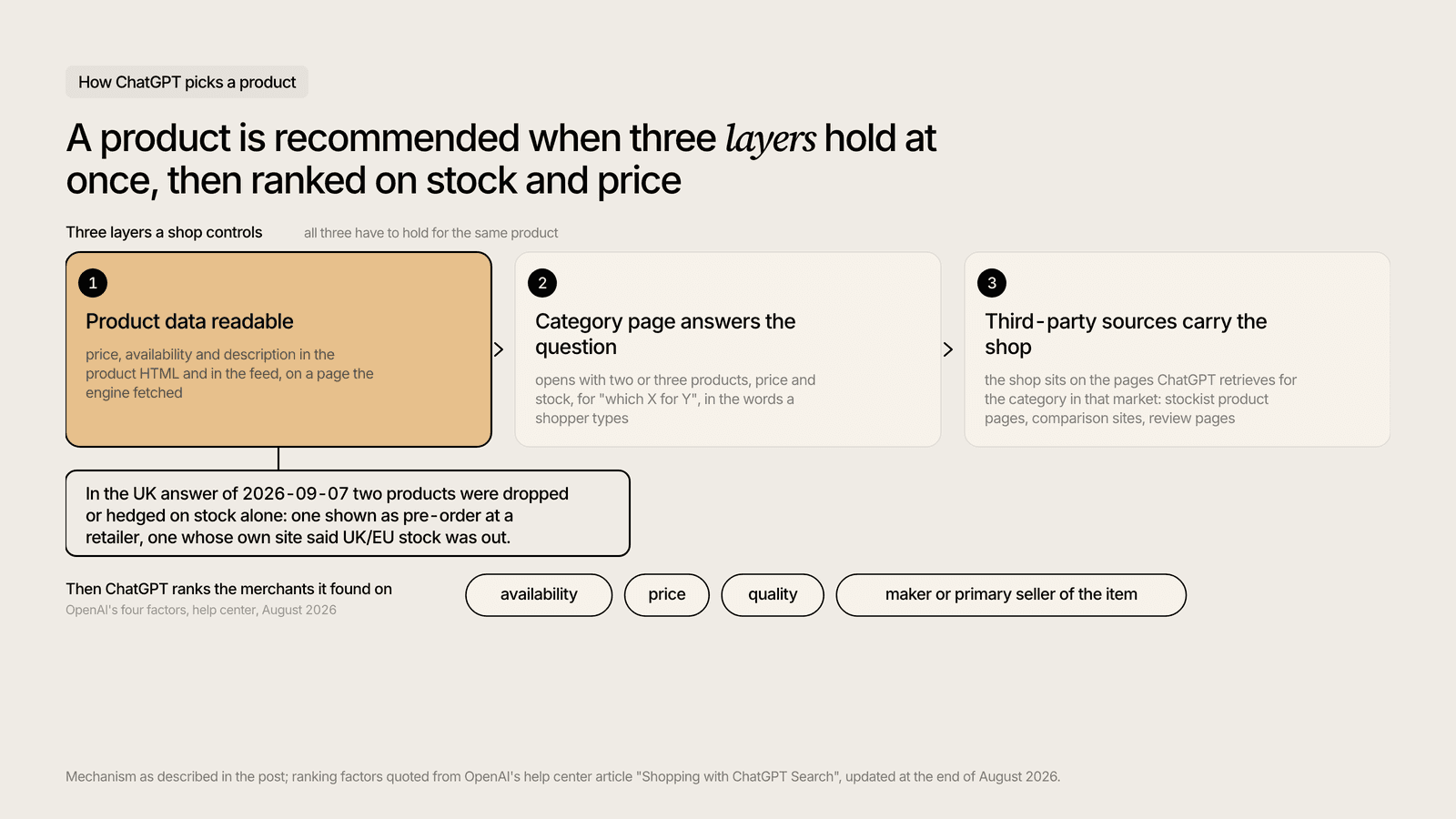
The three conditions the post describes, then OpenAI's four merchant ranking factors as quoted from its help center, updated end of August 2026.
OpenAI's help center names the inputs as "structured metadata from first-party and third-party providers (e.g., price, product description)". It says merchants are "ranked based on factors like availability, price, quality, and whether they are the maker or primary seller of that item."
In Lithuania the same three conditions hold, with one difference. ChatGPT shows a product gallery there in under 1% of answers, so the fetched shop pages and the map panel carry the recommendation on their own. The 12 Lithuanian answers we read across three product categories are broken down under Which sources does ChatGPT cite for products? and Why does ChatGPT recommend my competitor's products?.
How does ChatGPT decide which products to recommend?
ChatGPT decides which products to recommend from structured product data, its own prior knowledge of the category and OpenAI's policies, then ranks merchants on availability, price, quality and whether they make or primarily sell the item. That is OpenAI's own description in the help center article "Shopping with ChatGPT Search", updated at the end of August 2026.
The article opens with a sentence every e-commerce manager should keep in view: "Product results are selected independently by ChatGPT and are not ads, nor influenced by any OpenAI partnerships." Paying for ChatGPT Ads buys a sponsored unit under the answer and nothing inside the organic product results. The same article says "No additional work is required from individual merchants."
The three inputs, in OpenAI's words:
"Structured metadata from first-party and third-party providers (e.g., price, product description) and other third-party content"
"Model responses generated by ChatGPT before it considers any new search results"
"OpenAI safety standards and product policies"
The first input, structured metadata, is the one a shop controls. Price, availability and description sit in the product HTML and in the feed, and the ranking factors OpenAI names are the same fields. The UK jump-ramp answer of 2026-09-07 shows the ranking at work. Two products were dropped or hedged on stock alone: one because "one UK retailer currently shows it as pre-order", one because its own site said UK/EU stock was out.
What does a ChatGPT product answer look like in the UK and US today?
In the UK and the US today a ChatGPT product answer is a written recommendation with a product gallery on almost every buy-intent question. On Free and Go accounts a sponsored unit can sit under it. How often varies widely: on one client's prompts no answer carried an ad, while on another client's most commercial prompts nearly every answer did. Two client projects we track sit at those two ends.
For a bike-ramp brand selling in the UK and the US, we ran five questions in both countries between 2026-08-08 and 2026-09-07. A product gallery appeared in nearly every answer to the four buy-intent questions. Ad share was zero across all ten prompts and the 46 answers behind them, so every recommendation in that window was organic.
One question was the control: "best ramp to learn to jump a mountain bike". The word "learn" turned a purchase into a technique question. ChatGPT showed no product gallery in any answer in either country, one UK answer rendered a map of local bike parks instead, and in the US no tracked brand was named at all.
For a second client, an e-commerce brand selling in the US, the UK, Canada and Australia, an ad sat under 16% of its 4,395 ChatGPT answers in August 2026. On its most commercial product prompts nearly every answer carried an ad. We did not measure that client's gallery or map share.
Country | Share of ChatGPT answers carrying an ad, August 2026 |
|---|---|
United States | 29% |
Canada | 18% |
United Kingdom | 10% |
All four markets | 16% (707 of 4,395 answers) |
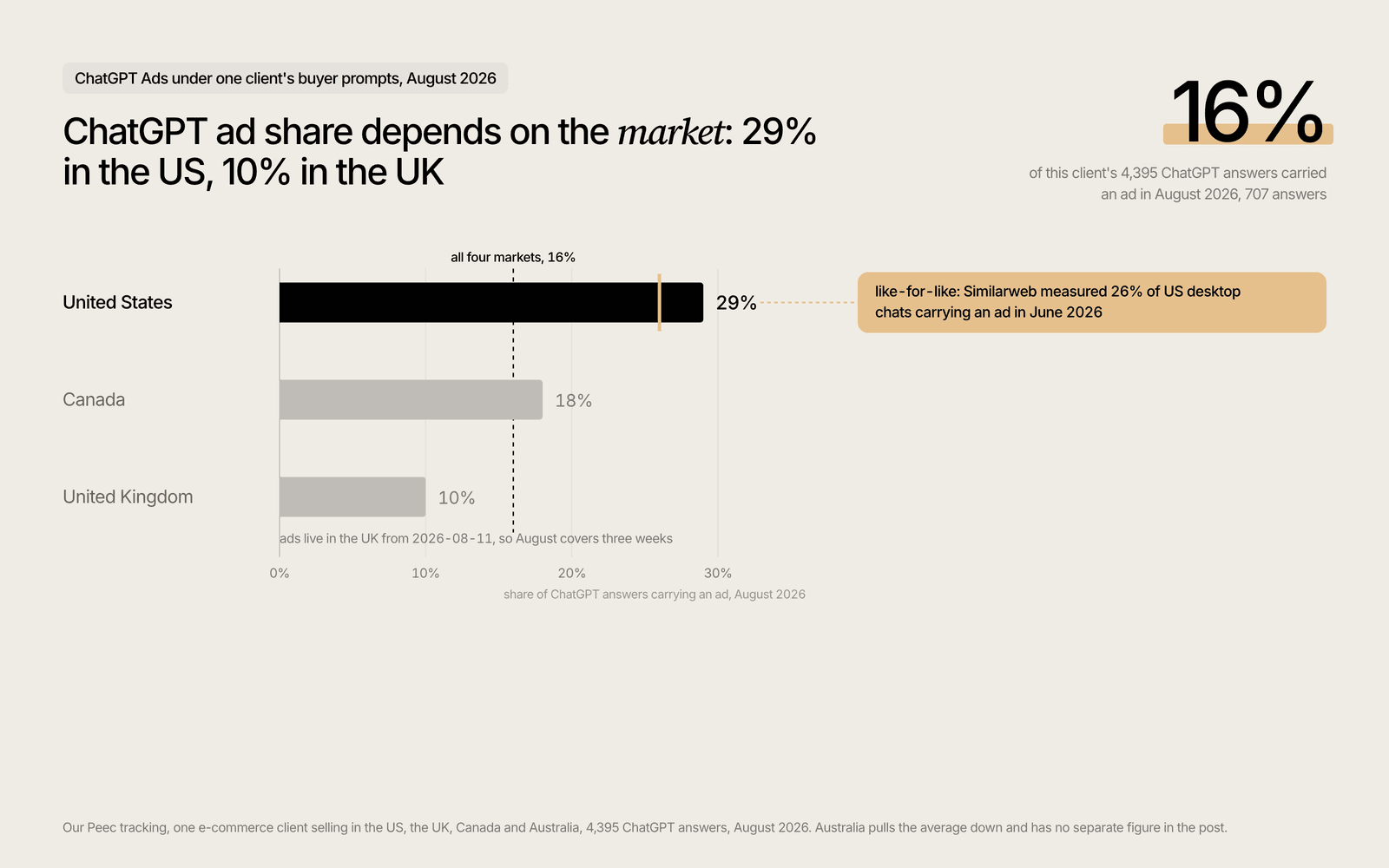
One e-commerce client selling in the US, the UK, Canada and Australia, 707 of 4,395 ChatGPT answers carried an ad in August 2026; ChatGPT Ads began serving in the UK on 2026-08-11, so the UK figure covers three weeks, and Australia pulls the average down. Our Peec tracking.
Source: our Peec tracking, one e-commerce client selling in the US, UK, Canada and Australia, August 2026.
The UK figure is low for a reason. ChatGPT Ads began serving there on 2026-08-11, so August covers three weeks of a new market, and Australia pulls the average down further. The like-for-like comparison is the US: our client's 29% against the 26% Similarweb measured on US desktop chats in June 2026, reported by PPC Land on 2026-08-17.
Lithuania looks different. Across three product clients over the 30 days to 2026-09-07, ChatGPT showed a product gallery in under 1% of answers, a map block in 21 to 58% and ran a web search in 97 to 99%. There the fetched pages and the map decide the answer, and the product feed waits for the carousel to arrive. Why the same brand is named in one country and missed in the next is covered in GEO across Europe: how AI visibility changes by market and language.
Does ChatGPT use Google Merchant Center or a product feed?
No. ChatGPT takes product data through OpenAI's own routes: merchant feeds submitted through the Agentic Commerce Protocol (ACP, OpenAI's standard for sharing catalogs with ChatGPT), Shopify Catalog and third-party data providers. Shopify merchants are already in through Shopify Catalog; every other merchant applies for ACP feed access through OpenAI's merchant application. Google Merchant Center is Google's feed, and it powers Google's AI surfaces: AI Overviews, AI Mode and the Gemini app.
OpenAI set the feed route out in "Powering Product Discovery in ChatGPT": "we're expanding the Agentic Commerce Protocol (ACP) to support product discovery" and "Through ACP, merchants share product feeds and promotions so their catalogs are fully represented in ChatGPT." Delivery runs through the merchant directly or "through third-party providers like Salesforce and Stripe". Target, Sephora, Nordstrom, Lowe's, Best Buy, The Home Depot and Wayfair "have integrated into ACP for discovery".
The same post scaled back Instant Checkout: "the initial version of Instant Checkout did not offer the level of flexibility that we aspire to provide, so we're allowing merchants to use their own checkout experiences". For a DTC brand this is good news: the order lands on your own checkout, with your own analytics.
Google's side is stated on Google's own page. The AI features and your website guide, updated 2026-07-10, says that "Using products like Merchant Center (such as Merchant Center feeds) and Google Business Profiles can help your products and services to be visible in both AI responses and other Google Search results".
Google's Merchant Center help announced an AI performance insights report on 2026-05-27. It shows "how your products are being discovered on AI Mode, AI Overviews in Search, or the Gemini app" and rolls out first to the US, Canada, Australia, India and New Zealand.
AI surface | Where the product data comes from | Who submits it |
|---|---|---|
ChatGPT organic product results | Merchant product feed via the Agentic Commerce Protocol; Shopify Catalog; third-party providers such as Salesforce and Stripe | The merchant, after applying for direct feed access; Shopify stores by default |
Google AI Overviews, AI Mode, Gemini app | Merchant Center feed and Google Business Profile | The merchant in Merchant Center |
ChatGPT Ads product feed campaigns | Catalog uploaded to Ads Manager (CSV, hosted URL or SFTP) | The advertiser |

Sources: OpenAI help center and "Powering Product Discovery in ChatGPT", Google's "AI features and your website" guide updated 2026-07-10, OpenAI Ads Manager.
Each surface reads its own feed. ChatGPT's organic results read the ACP feed, Shopify Catalog or a provider. Google's AI surfaces read Merchant Center. ChatGPT Ads read a separate advertiser catalog. All three are built from the same nine product fields OpenAI's feed spec marks as required.
How do we get a Shopify store into ChatGPT answers?
A Shopify store is already in ChatGPT's product data. OpenAI's help center says "No additional work is required from individual merchants" and that "For merchants on Shopify, product data is already integrated into ChatGPT through Shopify Catalog, helping products appear more accurately and completely in relevant user conversations."
Shopify's Agentic storefronts help page says the channel "is active by default for eligible stores". Which AI channels a store sells on is set under Sales channels, then Agentic, in the Shopify admin, so that screen is also where a store finds out whether it is eligible. For ChatGPT, "ChatGPT users complete their purchase on your online store checkout in a ChatGPT in-app browser, or in a new tab when customers use ChatGPT web."
The remaining work is the same as for any store. OAI-SearchBot has to reach the pages, price and stock have to be readable in the HTML, and the category page has to answer the buying question. A Shopify store with the channel on and a category page that says "Our range of ramps" is in the data and still loses the recommendation.
How do we get our products into ChatGPT's answer?
To get a product into ChatGPT's answer, open the site to OAI-SearchBot, put price and availability in the product HTML, write the category page as the answer to "which X for Y", get onto the pages ChatGPT retrieves for the category in your market, and submit a product feed. The sequence is the same in every market. What changes by market is when the feed starts to pay.
Open the site to OAI-SearchBot, OpenAI's search crawler. OpenAI's crawler documentation is plain: "Sites that are opted out of OAI-SearchBot will not be shown in ChatGPT search answers." GPTBot is a different bot, used for training, and a GPTBot disallow does not remove a site from ChatGPT search. Check robots.txt first, then the server and the CDN, because a Cloudflare bot rule or a WAF can return 403 to a crawler that robots.txt allows.
Put price, availability and description in the product HTML. These are the fields OpenAI's feed requires and the fields the ranking uses. In Sprinklr's study across six language models, a price on the page and a recent timestamp were two of the four gatekeepers every model applied before selecting a source.
Write the category page as the answer to the buying question. The first sentence names two or three products with price and stock, in the words a shopper types.
Get onto the pages ChatGPT retrieves for the category in your market. Run the buying prompts and read the retrieved and cited URLs. In the UK ramp set they were retailer product pages and brand sites. In Lithuania they were shop category pages, price-comparison sites and business directories. For English-market software they include G2 and Reddit.
Submit a product feed. Apply for direct feed access on OpenAI's developer site, or confirm the Agentic channel is on in Shopify. Where the carousel is live the feed pays as soon as it is accepted; elsewhere it waits for the carousel.
Measure from the first week. Peec AI tracks product-level visibility in ChatGPT: per product, the visibility, the win rate, the average position and the merchant ChatGPT sells it through. We can read product-level visibility from the chats already collected once the buyer prompts are tracked. Agenzy is an official Peec AI partner.
Which product data must be on the page?
The product data that must be on the page is the set OpenAI's feed specification marks as required: a stable item id, a title, a factual description, the product URL, the brand, the seller name, a main image, availability and price. The Product Feed spec on OpenAI's developer site lists those nine, with gtin and mpn as optional fields and two flags, is_eligible_search and is_eligible_checkout.
Feed field (OpenAI spec) | What it holds | Where it must also live on the page |
|---|---|---|
| Stable id, unique per item or variant | Product SKU in the HTML, unchanged between visits |
| Product name | The H1 of the product page |
| Factual description | Visible product copy, in the HTML, in plain text |
| Product page with the variant selected | Canonical URL per variant |
| Brand as shown on the product page | Brand line near the title |
| The seller supplying the offer | Shop name in the page and the Organization data |
| Main image for this variant | First product image, with alt text |
|
| Stock status in text, per variant |
| Regular price in major currency units | Price in text, per variant, with currency |
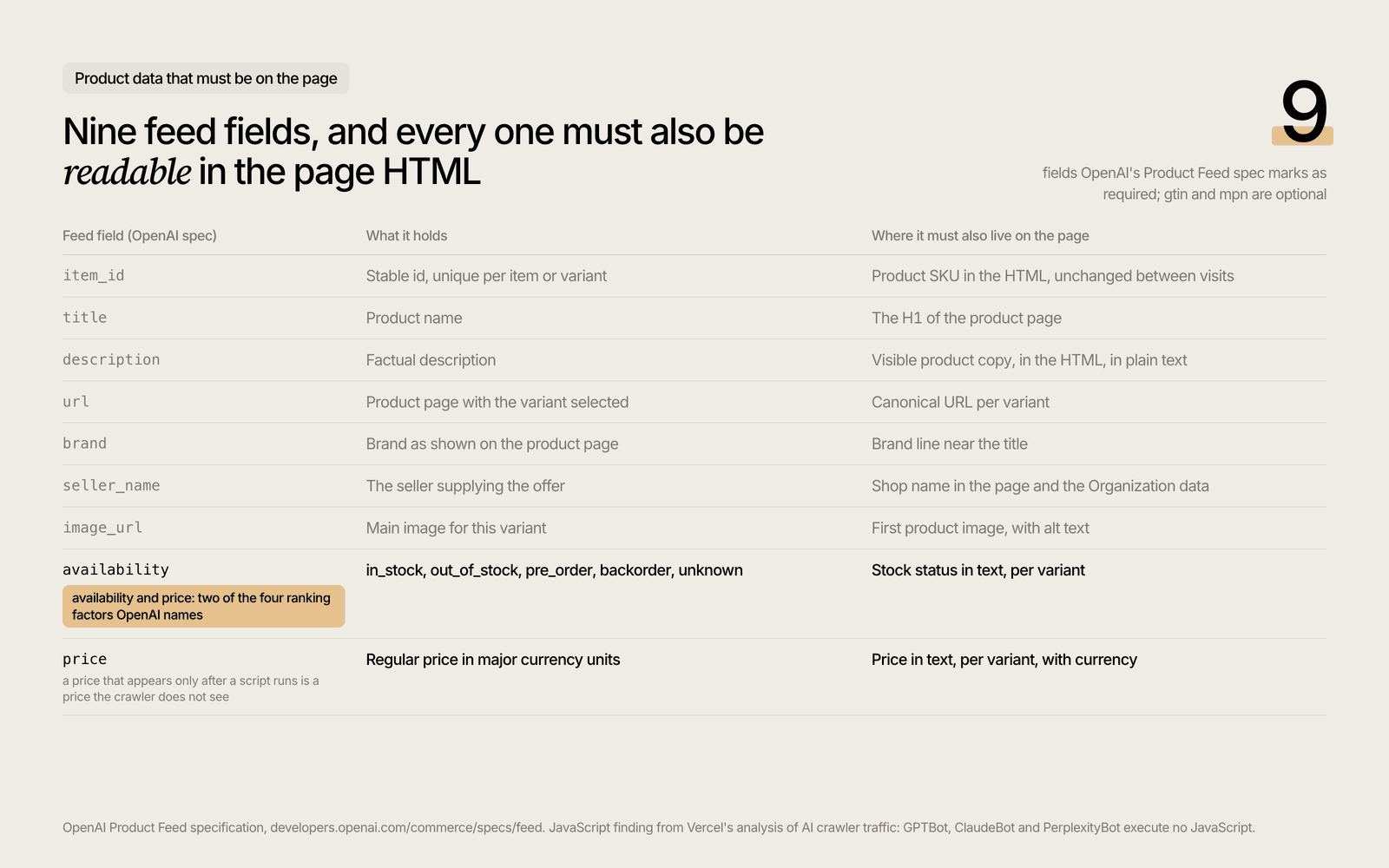
OpenAI Product Feed specification on developers.openai.com; availability and price are two of the four ranking factors OpenAI names.
Every one of the nine should be readable in the page's HTML as well as in the feed. The shopping ranking reads "structured metadata from first-party and third-party providers", and the web-search route reads the page itself. A price that appears only after a script runs is a price the crawler does not see: Vercel's analysis of AI crawler traffic found that GPTBot, ClaudeBot and PerplexityBot execute no JavaScript.
Do the technical work in this order. First, robots.txt access for OAI-SearchBot and ChatGPT-User. Second, server-side and CDN bot blocking, because that is where most silent 403s live. Third, schema markup: Product and Offer JSON-LD with price, priceCurrency and availability, in the head and rendered server-side. Fourth, page structure. llms.txt comes last, as a courtesy: we ship it because it costs nothing, and Ahrefs found that 97% of domains with a valid file received zero requests for it in May 2026.
Schema is hygiene, so the expectation should match. Google's guide says "Structured data isn't required for generative AI search, and there's no special schema.org markup you need to add." Ahrefs tracked pages that added JSON-LD against a control group and measured AI Overviews citations down 4.6%, and ChatGPT citations up 2.2%, a change indistinguishable from zero. Product schema keeps price and availability machine-readable in one place, and that is what the evidence lets anyone promise for it.
Which sources does ChatGPT cite for products?
The sources ChatGPT cites for products depend on the market and the category. For shopping questions in the UK and Lithuania the cited pages were commerce pages: product pages, category pages and shop homepages. Review sites and Reddit dominate other verticals and barely appear here.
In the UK ramp set, of the 25 most-cited URLs across ten prompts, 13 were product pages, 4 were category pages and 3 were shop homepages. Twenty of the 25 were pages where a visitor can already see stock and price. Five were editorial: two reviews, one how-to guide, one listicle and one YouTube comparison.
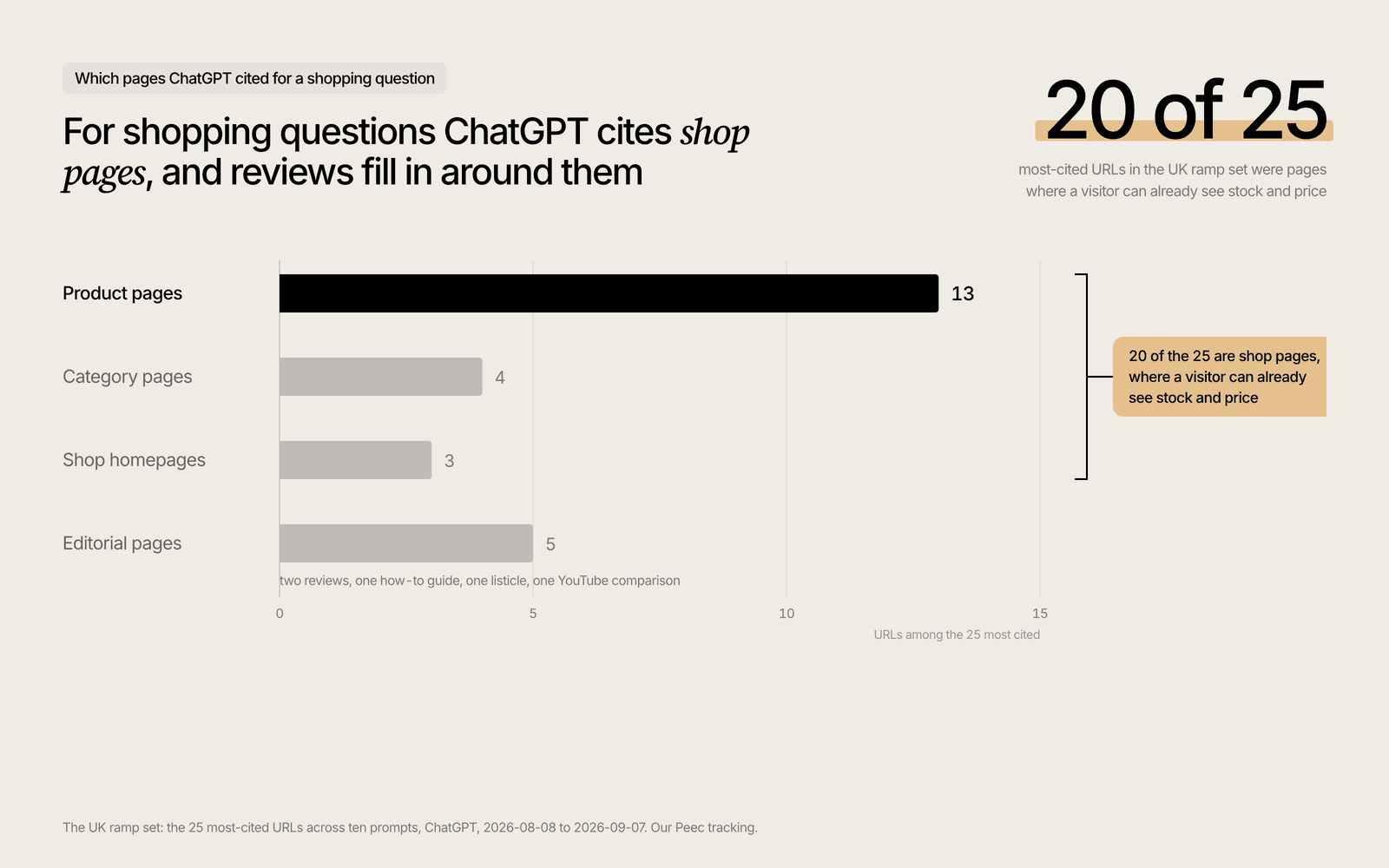
The 25 most-cited URLs across ten ramp prompts, ChatGPT, 2026-08-08 to 2026-09-07; 20 of the 25 show price and stock. Our Peec tracking.
In three Lithuanian product sets, no listicle and no forum page appeared among the 75 most-cited pages (40% category pages, 29% homepages, 19% product pages, 13 of the 75 price-comparison sites or business directories).
The cross-vertical picture is different, and it should be read as such. In our 2026 AI search study across 91 business projects, Reddit sat among the top-cited sources for 84% of projects. Comparison-style pages earned a 1.6x higher median citation rate than homepages, though homepages still took 29% of all citations.
For an English-market software client we track, G2 and Reddit rank 12th and 13th among cited domains. In Kevin Indig's Growth Memo analysis of ChatGPT citations, pages ranking first in Google were cited about three and a half times as often as pages beyond Google's top 20, and the 30 leading domains in a topic took two thirds of its citations.
Reviews carry a recommendation where no shop page was retrieved. The US answer to "best mtb jump ramp" on 2026-08-28 cited only a singletracks.com review and one listicle, while six brand pages were retrieved with zero citations. Where a shop page is in the retrieved set, the shop page gets the citation and the review fills in around it.
One Lithuanian chat shows the reseller case. A wooden-kitchenware maker we track reached the knife-holder answer as a product stocked by another shop, Gerduva, and the page cited behind that line was a kaina24.lt price-comparison page. The maker's own domain was retrieved in 8% of chats in the window; IKEA's was retrieved in 46%. The shop whose page is fetched is the shop that gets named, and the brand rides along when it does.
One limit on all of this: citations move day to day. A survey of 45 GEO studies reports source-level overlap of only 0.34 to 0.42 between consecutive days across four engines (Schulte et al., 2026, as summarised in the survey), so a source list is read over weeks and pulled again monthly.
Why does ChatGPT recommend my competitor's products?
ChatGPT recommends a competitor's products when the competitor's pages are in the set it retrieves for the question and yours are not. In three Lithuanian product categories, every shop with zero visibility on all its buying prompts shared the same three absences: no URL among the 25 most-cited pages, no domain among the 20 most-cited, and no map card. The nearest miss, a camper dealer, was retrieved in one chat at position eight with zero citations and was never named.
The UK ramp set says the same. Three ramp brands we track scored zero on all ten prompts in both countries, and none of their URLs appeared in the cited or the retrieved lists of any answer we read. The omission sits upstream of the answer: the engine fetched nothing of theirs, so it had nothing to cite or name.
A fourth brand had one product page cited four times. That single page earned the brand a place in answers to the one question the page itself answers, and its visibility stopped there.
Retrieval follows the stockist. In the same set, Ninja MTB won the US answers with cited pages on ridelikeaninja.com, scheels.com and walmart.com, and MTB Hopper won the UK answers with cited pages on brink.uk, 3peakscycles.com and its own category page. Freshpark, a US brand, scored zero on every UK prompt because the UK answers drew on UK retailer pages that do not carry it.
So run the buying prompts for your category and check where the gap sits. Is any page of yours in the retrieved list? Does that page show price and stock in the HTML? Does a stockist's page that is retrieved carry your product with a price? The gap is usually visible in one of those three places within a week.
How should category pages be written?
A category page ChatGPT can cite opens with one sentence naming two or three products with price and stock for the question "which X for Y", carries a short comparison, and restates every table row in a sentence. ChatGPT's own answers show the shape. On 2026-08-28 the UK answer to "best mtb jump ramp" read: "Best overall: MTB Hopper Lite - £249, portable and designed specifically for MTB/BMX. Good balance of size, stability and portability." The brand's own category page was the third most-cited URL across the ten prompts.
AI search scores individual passages. In Peec AI's reranker test, on the three cross-encoder rerankers a direct shortlist sentence scored above 99% on a "best X" query and a well-written product description under 0.3%, and every one of the six families tested scored the direct answer higher. The memo's caveat applies: that is how retrieval systems commonly work, and the test measured rerankers; ChatGPT's own model was never tested.
Front-load it. Growth Memo's positional analysis of matched citations found the bottom tenth of a page earns almost none of them, so the shortlist, the criteria and the prices go in the first screen. A dated "updated" line near the top satisfies the recent-timestamp gatekeeper Sprinklr found across all six models.
Text extractors lose answers that live only in table cells. In the PIXELRAG paper on arXiv, two text parsers recovered a table-bound answer among their top three passages 5.0% and 23.8% of the time, against 38.7% and 44.1% for the same answer written in a paragraph. So keep the comparison table and restate each row as a sentence with the price and the stock state.
Write in the shopper's words. The searches ChatGPT ran in the background for the UK question were "portable mountain bike jump ramp UK in stock fast delivery 2026" and "portable mountain bike jump ramp UK in stock delivery". The page's headings should be those questions, with the product recommendations under each one naming the use case, the constraint and the price.
What if we sell on Amazon or a marketplace?
If you sell on Amazon or another marketplace, the marketplace listing is often the product data ChatGPT reads and the marketplace is the merchant it names, so the brand's own store has to become the maker or primary seller the ranking prefers. How often that happens depends on the category. In the UK ramp set, exactly one multi-brand retailer listing, scheels.com, reached the 25 most-cited URLs, and Walmart was cited once in one US answer.
Where the marketplace dominates, three moves claim maker status. First, keep the same product identity across every listing: the feed spec's optional gtin and mpn fields let the engine resolve the Amazon listing, the retailer listing and your own product page to one item. Second, keep the brand store's price and availability at least as good as the marketplace's, because those are two of the four factors OpenAI names.
Third, put the category page on the brand's domain, since a marketplace will never publish "which X for Y" in your favor.
Should we also buy ChatGPT Ads?
ChatGPT Ads are worth testing alongside e-commerce GEO in a market where they serve, because the two do not substitute for each other. SE Ranking's study of 12,974 ad placements on US commercial prompts in July 2026 found that "In 96.37% of placements, the advertiser is not cited among the answer's sources." Whether ads appear under your prompts at all is a market and category question: zero of the UK and US ramp answers carried one, while 16% of the four-market client's answers did.
Ads have served in the US since 2026-02-09, in the UK since 2026-08-11 and in 31 European countries since 2026-08-24, to Free and Go accounts only. Product feed campaigns show image, title, star rating and price. OpenAI says they "have been among the strongest-performing ads in our program to date", and feed products "will not appear in organic ChatGPT conversations", so the ad card and the organic recommendation stay separate.
Two rules carry over from the organic work. The landing page must be crawlable by OAI-AdsBot, and OpenAI recommends allowing OAI-SearchBot as well. OpenAI also states that ChatGPT Ads "does not yet have performance benchmarks across advertisers, industries, or campaign types", so the ads are bought as a test with the measurement set before launch, because no benchmark exists to promise a return against. Both layers run as one program; scope and prices are on the ChatGPT Ads management page, launch mechanics in ChatGPT ads in Lithuania and Europe.
The 90-day plan
The first 90 days of e-commerce GEO run in three blocks: month one is technical and ends with a baseline, month two is category pages and the source list, and month three puts the feed and the ads on top of a measured baseline.
Days | Work | What is measured at the end of the block |
|---|---|---|
1 to 30 | Buyer prompts written and tracked; OAI-SearchBot access confirmed in robots.txt, at the server and at the CDN; price, availability and description in the HTML of every product page; Product and Offer schema server-rendered; feed access applied for or Shopify Agentic channel confirmed | Baseline: share of buyer prompts where the brand is named, per engine; which URLs are retrieved and cited; product gallery, map and ads share per market |
31 to 60 | Category pages rewritten as "which X for Y" answers with shortlist sentence, comparison and prose restatement; retrieved and cited URLs grouped by type; first inclusion requests to the stockist, comparison and review pages that already appear | Retrievals and citations of the new category pages; first third-party mentions live |
61 to 90 | Product feed live where the carousel serves; product-level tracking on, with win rate per product and merchant; ChatGPT Ads product feed campaign launched in the markets where ads serve | Visibility and win rate per product against the day-30 baseline; ad share under the tracked prompts; sales attributed through the "how did you find us" question |
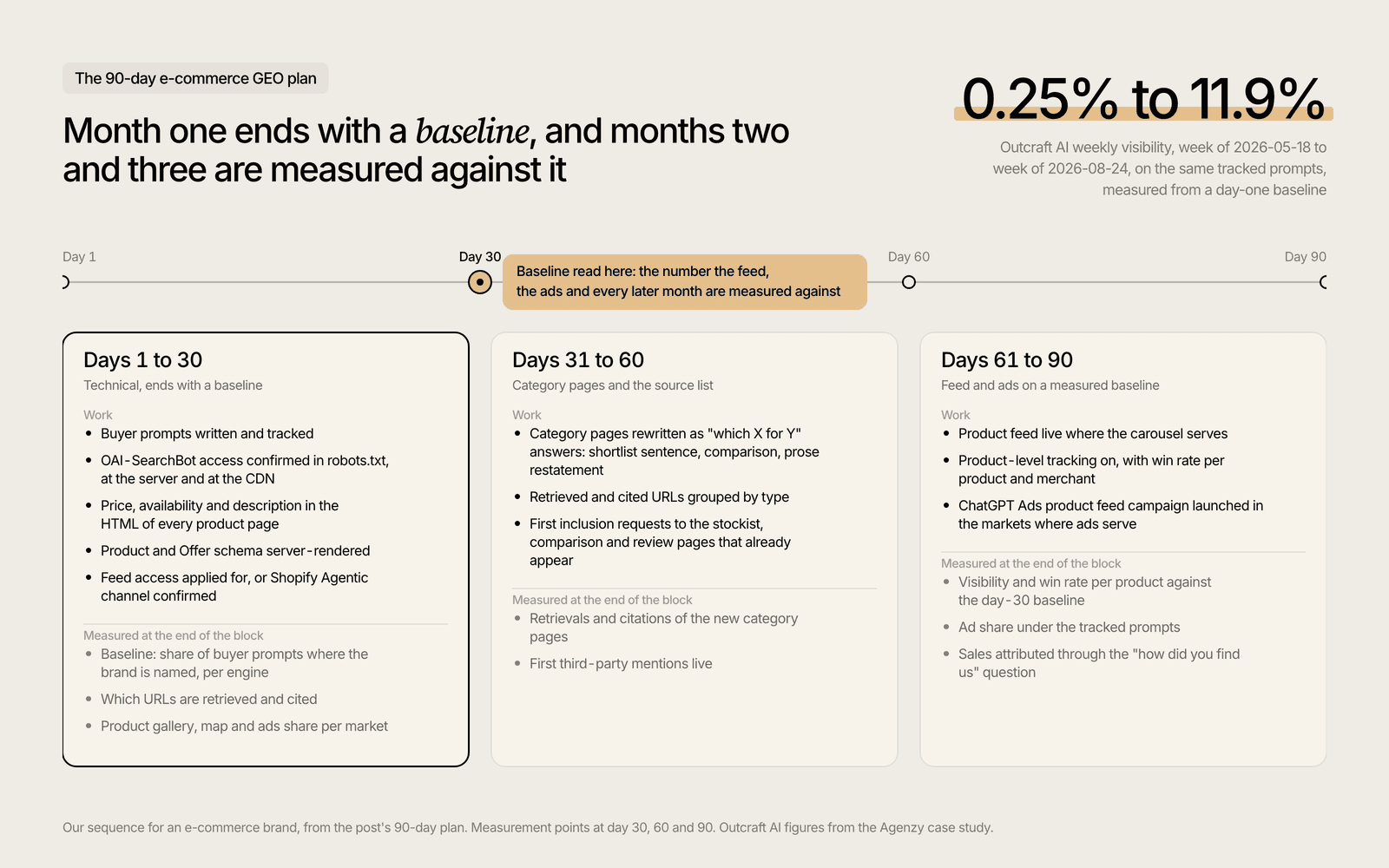
Agenzy's sequence for an e-commerce brand with measurement points at day 30, 60 and 90; Outcraft AI moved from 0.25% to 11.9% weekly visibility between the weeks of 2026-05-18 and 2026-08-24 on the same tracked prompts.
The ordering matters. A feed submitted before the pages are readable puts data into the carousel that the fetched pages contradict, and ads bought before the baseline exists have nothing to be measured against.
The month-one baseline is the part most e-commerce teams skip and the part that pays for the rest. Outcraft AI, a software client, started at 0.25% weekly visibility in the week of 2026-05-18 and reached 11.9% by the week of 2026-08-24 on the same tracked prompts. Without the day-one number that would be an anecdote. The full case is at Outcraft AI, and what a retainer contains month by month is set out in How much does a GEO agency cost in 2026.
When is e-commerce GEO not worth it?
E-commerce GEO is not worth buying when nobody asks an AI engine the buying question your products answer, when the shop cannot keep price and availability accurate, or when the margin cannot fund a category page a month. Emilis Zabilius, Agenzy's CEO and co-founder, applies a demand check before any proposal: run the buying prompts and read whether ChatGPT treats the question as a purchase at all.
The question "best ramp to learn to jump a mountain bike", tracked in the UK and the US, is the demand check failing on a live prompt. One word turned a shopping question into a technique question, the product gallery disappeared in both countries and no brand was named in the US. A category whose questions all read like that has nothing to win yet.
The second test is data discipline. Availability and price are two of the four factors OpenAI names, and the UK answer dropped two products on stock alone, so a catalog that goes stale weekly loses the ranking it earned. The third is volume. A shop that cannot publish category pages month after month is better served by a technical one-off that opens the site to OAI-SearchBot and fixes the product HTML.
Where the demand exists, the buyer who arrives from ChatGPT arrives pre-consulted, in Emilis Zabilius's phrase. The comparison and the stock check have already happened inside the chat.
FAQ
How do we get our products recommended by ChatGPT?
Allow OAI-SearchBot in robots.txt and at the server and CDN, put price, availability and a factual description in the product HTML, and rewrite each category page to open with a shortlist answering "which X for Y". Then run the buying prompts, read which pages ChatGPT retrieves for your category in your market, and get onto those pages: stockist product pages, comparison sites or review pages. Submit a merchant product feed through the Agentic Commerce Protocol or Shopify Catalog. Track the prompts from day one.
How does ChatGPT pick which products to show?
ChatGPT combines "Structured metadata from first-party and third-party providers (e.g., price, product description)", its own model response before it searches, and OpenAI's safety and product policies, then ranks merchants "based on factors like availability, price, quality, and whether they are the maker or primary seller of that item." Product results "are not ads, nor influenced by any OpenAI partnerships." In a UK answer we read on 2026-09-07, two products were dropped on stock state alone. Source: OpenAI help center, "Shopping with ChatGPT Search".
Does ChatGPT shopping use Google Merchant Center?
No. OpenAI's pages name three product-data routes into ChatGPT: merchant product feeds through the Agentic Commerce Protocol, Shopify Catalog, and third-party providers such as Salesforce and Stripe. Merchant Center is Google's feed, and Google says it helps products "be visible in both AI responses and other Google Search results", meaning AI Overviews, AI Mode and the Gemini app. A shop selling on both engines maintains both feeds from the same nine fields.
How do we get a Shopify store into ChatGPT answers?
A Shopify store is already connected. OpenAI states that "No additional work is required from individual merchants" and that "product data is already integrated into ChatGPT through Shopify Catalog". Shopify's Agentic storefronts channel "is active by default for eligible stores" and is managed under Sales channels, then Agentic, in the Shopify admin, where eligibility shows. Customers check out on the merchant's own store. The remaining work is crawler access for OAI-SearchBot, price and stock in the HTML, and category pages that answer the buying question.
Why does ChatGPT recommend my competitor's products?
Because the competitor's pages are in the set ChatGPT retrieves for the question and yours are not. In three Lithuanian categories, every shop with zero visibility shared three absences: no page among the 25 most-cited URLs, no domain among the 20 most-cited, no map card. In a UK and US set, the brand that won each country was the brand whose stockists' pages were retrieved there. Check whether any page of yours is retrieved, whether it shows price and stock, and whether a retrieved stockist page carries your product.
Which GEO agency suits an e-commerce or DTC brand?
A GEO agency for an e-commerce or DTC brand should track visibility at product level and by market, run the technical work in the order robots.txt access, bot blocking, schema and page structure, write category pages as buying answers and get the brand onto the pages ChatGPT retrieves for the category. It should also manage a product feed and ChatGPT Ads where they serve. The measured shortlist of European agencies, with an e-commerce section, is in Best GEO agencies in Europe in 2026.